
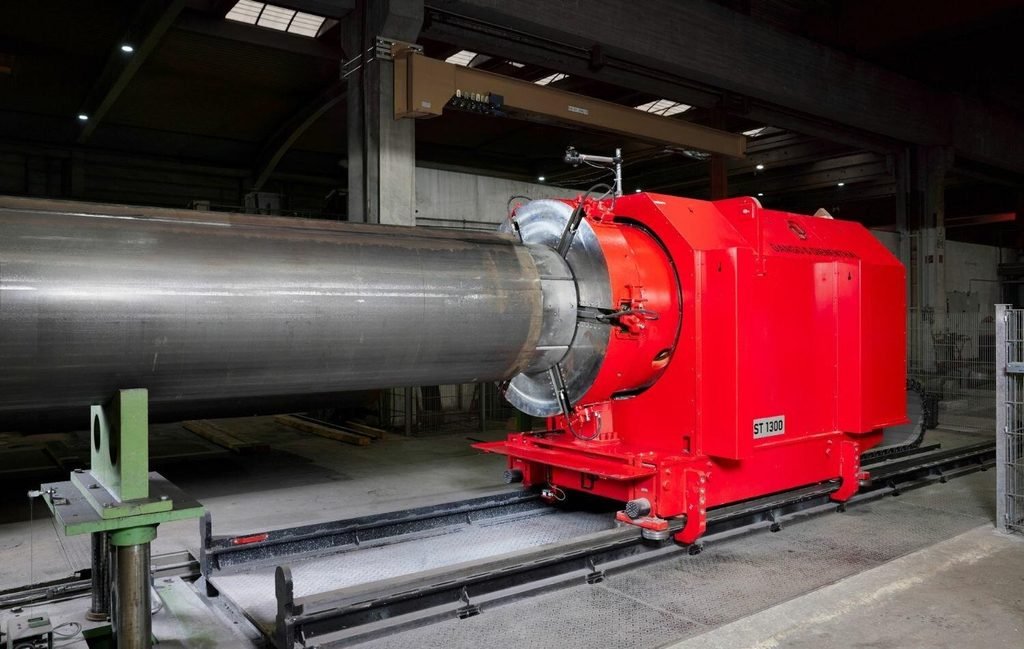
1. What Is Steel Pipe Hot Expansion?
Steel pipe hot expansion is a manufacturing process used to increase the outside diameter of an existing steel pipe by heating it to a suitable hot-working temperature and applying controlled mechanical force.
The process is commonly used to manufacture large-diameter steel pipes from smaller-diameter mother pipes, particularly when the required finished dimensions are not readily available through conventional pipe production routes.
Unlike conventional hot rolling, which forms and reduces the dimensions of a heated steel billet or hollow shell, hot expansion starts with an existing hollow pipe and enlarges its diameter.
The process generally involves:
- Selecting a suitable mother pipe.
- Heating the pipe using an induction heating system or another controlled heating method.
- Expanding the heated pipe with an expansion mandrel or forming tooling.
- Controlling the expansion ratio and wall thickness.
- Straightening and sizing the finished pipe.
- Performing the required heat treatment and quality inspections.
Hot expanded steel pipes are used in oil and gas transportation, petrochemical facilities, power plants, water transmission and other industrial applications.
The main advantage is manufacturing flexibility. A manufacturer can produce certain large-diameter pipe sizes from available smaller-diameter starting materials without requiring a completely different large-diameter seamless piercing mill.
However, hot expansion does not automatically improve the mechanical properties of the original pipe. The final quality depends on the starting material, heating uniformity, expansion deformation, cooling conditions and final heat treatment.
2. Why Are Steel Pipes Hot Expanded?
Hot expansion is mainly used when the required pipe diameter is larger than the available or economically practical starting pipe size.
There are several reasons why manufacturers use this process.
2.1 Producing Large-Diameter Steel Pipes
Large-diameter pipes are required in many industrial projects.
However, producing every diameter directly through conventional seamless pipe manufacturing can require specialized equipment and significant investment.
Hot expansion provides another manufacturing route by increasing the diameter of a suitable mother pipe.
It is particularly useful for certain large-diameter and thick-wall pipe specifications.
2.2 Reducing Dependence on Large-Diameter Production Equipment
Not every steel pipe manufacturer operates a large-diameter seamless rolling mill.
A properly equipped hot expansion production line can process suitable mother pipes into larger dimensions.
This gives manufacturers greater flexibility when producing different diameter and wall thickness combinations.
2.3 Meeting Special Project Dimensions
Some engineering projects require non-standard combinations of:
- Outside diameter.
- Wall thickness.
- Length.
- Material grade.
- Manufacturing condition.
Hot expansion can help manufacturers produce selected dimensions that are difficult to obtain directly through conventional production routes.
The feasibility of each specification depends on the available mother pipe, expansion equipment, material grade and applicable product requirements.
2.4 Supporting Customized Pipe Production
For project-based orders, buyers may require specific large-diameter steel pipes rather than standard stock sizes.
Hot expansion can offer a practical manufacturing option for selected low-volume or customized specifications.
However, production feasibility and cost must be evaluated for each order.
3. How Are Hot Expanded Steel Pipes Manufactured?
The manufacturing process involves several controlled stages.
Although equipment arrangements vary between manufacturers, medium-frequency induction heating followed by controlled mechanical expansion is a common industrial route.
Step 1: Mother Pipe Selection
The process begins with selecting a suitable mother pipe.
The mother pipe is the existing steel pipe that will be enlarged during hot expansion.
Important selection factors include:
- Material grade.
- Original outside diameter.
- Original wall thickness.
- Pipe length.
- Chemical composition.
- Mechanical properties.
- Surface and internal quality.
- Heat treatment condition.
The starting pipe must have sufficient dimensional and material quality to withstand the planned expansion deformation.
Any existing defects, excessive wall thickness variation or material inconsistencies may become more significant during forming.
The manufacturer should therefore inspect and verify the mother pipe before processing.
Step 2: Surface Preparation
Before heating, the mother pipe is checked and prepared.
Depending on its condition and manufacturing requirements, preparation may include:
- Removing loose scale and surface contamination.
- Inspecting the internal and external surfaces.
- Checking the original dimensions.
- Marking the pipe identification and heat number.
- Preparing the pipe ends for the expansion equipment.
Surface preparation helps reduce the risk of defects being overlooked during production.
Step 3: Induction Heating
The mother pipe is heated using an induction heating system.
In medium-frequency induction heating, alternating electrical current passes through an induction coil and produces a changing magnetic field.
This field induces electrical currents in the steel pipe, generating heat within the material.
The heating system is designed to bring the relevant pipe section to the required hot-working temperature.
Important process parameters include:
- Heating temperature.
- Heating rate.
- Heating length.
- Coil position.
- Pipe feeding speed.
- Circumferential temperature uniformity.
Uniform heating is important because temperature differences can result in uneven deformation during expansion.
The required temperature is not universal. It depends on the steel grade, material condition, deformation process and approved manufacturing procedure.
Step 4: Mechanical Pipe Expansion
After the pipe reaches the specified processing temperature, mechanical expansion begins.
The heated pipe is expanded using an expansion mandrel or other forming tooling.
Depending on the equipment design, hydraulic thrust and controlled pipe movement are used to enlarge the pipe diameter.
The process must control:
- Expansion force.
- Mandrel geometry.
- Pipe feeding speed.
- Expansion ratio.
- Heating temperature.
- Deformation sequence.
The pipe diameter gradually increases as the heated steel undergoes plastic deformation.
For certain production systems, expansion is performed in stages to control deformation and dimensional accuracy.
Step 5: Diameter and Wall Thickness Control
During expansion, the manufacturer must monitor the dimensional changes of the pipe.
Increasing the diameter changes the geometry of the original pipe wall.
Wall thickness may decrease during expansion, and the amount of reduction depends on the original dimensions, deformation conditions and forming method.
For this reason, manufacturers should not determine the final wall thickness solely from the nominal mother pipe dimensions.
Dimensional checks should include:
- Outside diameter.
- Wall thickness.
- Ovality.
- Straightness.
- Length.
- End geometry.
The expansion process must be controlled to achieve the specified finished dimensions within the applicable tolerances.
Step 6: Cooling and Heat Treatment
After expansion, the pipe undergoes cooling and any heat treatment required by the product specification.
The appropriate cooling method depends on the material grade and manufacturing procedure.
Depending on the steel grade and applicable standard, additional heat treatment may be required to obtain the specified mechanical properties and microstructure.
Possible treatments include:
- Normalizing.
- Quenching and tempering.
- Other specified heat treatment conditions.
Not every hot-expanded pipe requires the same heat treatment.
The final delivery condition must comply with the applicable product specification and purchase order.
Step 7: Straightening and Finishing
After thermal processing, the pipe may undergo straightening and finishing operations.
These operations help establish the required final geometry.
Common finishing operations include:
- Mechanical straightening.
- End trimming.
- Beveling.
- Surface cleaning.
- Dimensional calibration.
- Marking.
- Protective coating, where specified.
The final dimensions and surface condition are verified before the pipe is released for inspection and delivery.
Step 8: Quality Inspection and Testing
The finished pipe must be inspected according to the applicable product specification and project requirements.
Inspection may include:
- Chemical composition analysis.
- Tensile testing.
- Hardness testing.
- Impact testing, where required.
- Ultrasonic testing (UT).
- Magnetic particle testing (MT), where applicable.
- Eddy current testing (ET), where applicable.
- Hydrostatic testing, where required.
- Dimensional inspection.
- Visual examination.
The manufacturer should also maintain traceability between the finished pipe, original mother pipe and relevant heat numbers.
4. What Is Medium-Frequency Induction Heating in Hot Expansion?
Medium-frequency induction heating is an important technology used in modern steel pipe hot expansion production lines.
Unlike conventional furnace heating, induction heating generates heat directly within the conductive steel material through electromagnetic induction.
How Does Induction Heating Work?
The process can be explained in four stages.
1. Electrical Power Supply
The induction heating system converts electrical power into alternating current at the required frequency.
2. Magnetic Field Generation
The alternating current flows through the induction coil and creates a changing magnetic field.
3. Induced Current in the Steel Pipe
The changing magnetic field induces electrical currents within the steel pipe.
4. Heat Generation
Electrical resistance within the steel converts the induced current into heat.
The pipe temperature rises until it reaches the required processing range.
Advantages of Medium-Frequency Induction Heating
- Rapid and controllable heating.
- No need to heat the entire factory atmosphere.
- Flexible adjustment of heating power.
- Suitable for continuous or controlled section heating.
- Potentially improved production efficiency.
- Easier integration with automated production systems.
However, induction heating does not guarantee uniform temperature by itself.
Coil design, pipe positioning, feeding speed, electrical parameters and temperature monitoring all influence heating uniformity.
5. Hot Expanded Steel Pipe vs Hot-Rolled Seamless Steel Pipe
Hot expansion and hot rolling are two different manufacturing processes.
Although both involve elevated temperatures, their starting materials and forming mechanisms are different.
Hot-Rolled Seamless Steel Pipe
Hot-rolled seamless pipes are typically manufactured from solid steel billets.
The billets are heated, pierced to create hollow shells and then rolled or sized to achieve the required dimensions.
The production process commonly includes:
- Billet heating.
- Rotary piercing.
- Hollow shell elongation.
- Wall thickness and diameter reduction.
- Sizing.
- Cooling and finishing.
- Inspection.
Hot-Expanded Steel Pipe
Hot-expanded pipes start from an existing hollow mother pipe.
The mother pipe is heated and mechanically enlarged to achieve a larger outside diameter.
The process generally includes:
- Mother pipe inspection.
- Surface preparation.
- Induction heating.
- Mechanical expansion.
- Dimensional control.
- Cooling and heat treatment.
- Straightening and finishing.
- Final inspection.
Comparison Table
| Parameter | Hot-Rolled Seamless Pipe | Hot-Expanded Pipe |
|---|---|---|
| Starting Material | Solid billet | Existing hollow mother pipe |
| Main Process | Piercing and hot rolling | Heating and mechanical expansion |
| Main Objective | Forming and sizing a seamless pipe | Increasing an existing pipe diameter |
| Heating Method | Typically furnace heating | Often medium-frequency induction heating |
| Diameter Range | Depends on rolling mill capability | Depends on mother pipe and expansion equipment |
| Wall Thickness | Controlled through rolling and sizing | Influenced by starting dimensions and expansion |
| Manufacturing Equipment | Piercing and rolling mills | Induction heating and expansion equipment |
| Typical Applications | General industrial and pressure piping | Selected large-diameter pipe requirements |
Neither process is universally better.
The appropriate route depends on the required dimensions, material grade, production capability, mechanical properties and applicable product standard.
6. Hot Expansion vs Cold Expansion: What Is the Difference?
The terms hot expansion and cold expansion can refer to different processes in the steel pipe industry.
It is important to distinguish hot expansion of seamless mother pipes from cold mechanical expansion of welded pipes.
Hot Expansion
Hot expansion uses elevated temperatures to reduce the resistance of steel to plastic deformation.
It is commonly used to increase the diameter of existing seamless mother pipes.
The process is particularly relevant to certain large-diameter steel pipe products.
Cold Expansion
Cold expansion is performed without heating the pipe to a hot-working temperature.
In welded pipe manufacturing, mechanical expansion can be used after forming and welding to improve dimensional accuracy, roundness and residual stress distribution.
Cold expansion may also refer to other mechanical diameter-enlargement operations.
These applications should not be confused with the induction-heated expansion process used to manufacture large-diameter seamless pipes.
Comparison Table
| Parameter | Hot Expansion | Cold Mechanical Expansion |
|---|---|---|
| Processing Temperature | Elevated hot-working temperature | Usually near ambient temperature |
| Deformation Resistance | Reduced through heating | Higher than during hot working |
| Main Application | Diameter enlargement of suitable mother pipes | Mechanical sizing and expansion of selected pipes |
| Equipment | Induction heating and expansion tooling | Hydraulic or mechanical expansion equipment |
| Thermal Effects | Requires temperature and cooling control | Does not involve hot-working thermal cycles |
| Dimensional Control | Depends on heating and forming control | Depends on tooling and mechanical expansion control |
The actual effect on residual stress and mechanical properties depends on the process, material and degree of deformation.
7. What Are the Advantages of Hot Expanded Steel Pipes?
Hot expansion provides several manufacturing advantages for selected steel pipe applications.
7.1 Flexible Large-Diameter Production
The process allows manufacturers to enlarge suitable mother pipes into larger diameters.
This provides an additional manufacturing option for certain large-diameter requirements.
7.2 Flexible Product Dimensions
Manufacturers can evaluate different combinations of starting diameter, finished diameter and wall thickness.
This can be useful for customized project orders.
7.3 Reduced Dependence on Specialized Piercing Equipment
A manufacturer with suitable induction heating and expansion equipment may produce selected large-diameter products without relying exclusively on a dedicated large-diameter seamless rolling line.
7.4 Controlled Forming Process
Modern expansion equipment can integrate:
- Temperature monitoring.
- Hydraulic force control.
- Automated pipe feeding.
- Mandrel positioning.
- Dimensional measurement.
These systems help manufacturers control the forming process.
7.5 Application Flexibility
Hot-expanded products may be used in different industrial sectors, provided the finished pipe meets the applicable material, dimensional, mechanical and inspection requirements.
8. What Are the Limitations of Hot Expanded Steel Pipes?
Although hot expansion offers manufacturing flexibility, it also introduces several technical challenges.
8.1 Wall Thickness Variation
The diameter enlargement process can change the original wall thickness.
If heating or deformation is uneven, local wall thickness variation may occur.
Manufacturers must monitor wall thickness throughout the expansion process.
8.2 Dimensional Accuracy
Maintaining a consistent outside diameter and roundness requires accurate control of:
- Pipe temperature.
- Expansion force.
- Mandrel alignment.
- Feeding speed.
- Tooling condition.
Poor process control may result in ovality or dimensional deviations.
8.3 Changes in Mechanical Properties
Hot working and subsequent cooling can affect the steel microstructure and mechanical properties.
The final tensile strength, yield strength, hardness and toughness depend on the material grade and thermal history.
Appropriate heat treatment may be necessary to achieve the required delivery condition.
8.4 Residual Stress and Distortion
Uneven heating and cooling can contribute to residual stress and dimensional distortion.
Controlled thermal processing, straightening and final inspection are important for minimizing these issues.
8.5 Material and Process Compatibility
Not every steel grade or mother pipe is suitable for every expansion ratio.
The manufacturer must evaluate the material composition, hot-working behavior, initial condition and planned deformation.
A technically suitable expansion process must be established before production.
9. What Materials Are Used for Hot Expanded Steel Pipes?
Material selection depends on the intended service conditions and product specification.
Common material groups that may be considered include carbon steel, low-alloy steel and selected alloy steel grades.
Carbon Steel
Carbon steel is widely used for general industrial piping and fluid transportation.
Examples include:
- ASTM A106 Grade B.
- ASTM A53 Grade B.
- API 5L Grade B.
These grades have different product scopes and should not be considered interchangeable simply because they belong to the carbon steel family.
Low-Alloy Steel
Low-alloy steel grades are used in applications requiring specific mechanical properties and elevated-temperature performance.
Examples include:
- ASTM A335 P11.
- ASTM A335 P22.
The manufacturing and heat treatment route must be suitable for the selected grade.
High-Strength Pipeline Steel
Selected API 5L grades, such as X42, X52 and X60, may be considered for pipeline applications when the manufacturing route and final product meet the applicable requirements.
The suitability of a particular grade for hot expansion must be confirmed by material and process qualification.
Material Selection Considerations
Before choosing a material, manufacturers and buyers should confirm:
- Chemical composition.
- Hot-working characteristics.
- Required mechanical properties.
- Design temperature.
- Design pressure.
- Corrosion conditions.
- Required heat treatment.
- Applicable product specification.
The final product must satisfy the ordered standard, not merely the starting mother pipe specification.
10. What Quality Tests Are Required for Hot Expanded Steel Pipes?
Quality control is essential because hot expansion changes the original dimensions and may affect the material condition.
The inspection plan should be based on the finished product standard and the customer’s technical requirements.
10.1 Chemical Composition Analysis
Chemical analysis verifies the steel grade and confirms that the specified alloying elements are within the required limits.
10.2 Tensile Testing
Tensile testing evaluates:
- Yield strength.
- Tensile strength.
- Elongation.
These values help confirm whether the finished product meets the specified mechanical properties.
10.3 Hardness Testing
Hardness testing helps identify possible variations in material condition and heat treatment.
10.4 Ultrasonic Testing
Ultrasonic testing is used to detect internal discontinuities and assess material integrity according to the applicable inspection procedure.
10.5 Dimensional Inspection
Dimensional inspection should verify:
- Outside diameter.
- Wall thickness.
- Ovality.
- Straightness.
- Length.
- End preparation.
Wall thickness measurement is particularly important because expansion may change the original wall dimensions.
10.6 Hydrostatic Testing
Hydrostatic testing checks the pressure integrity of the finished pipe when required by the applicable product specification.
10.7 Impact Testing
For applications involving low temperatures or specified toughness requirements, impact testing may be required.
10.8 Material Traceability
The manufacturer should maintain traceability between the mother pipe and the finished expanded pipe.
The inspection documentation should identify the relevant heat number, material grade, production condition and test results.
11. Applications of Hot Expanded Steel Pipes
Hot-expanded steel pipes are used in applications where suitable large-diameter dimensions and specified mechanical properties are required.
11.1 Oil and Gas Industry
Large-diameter pipes are used in oil and gas transportation systems.
Depending on the project specification, hot-expanded pipes may be considered for selected pipeline applications.
The final product must satisfy the relevant line pipe requirements, including material properties, dimensional tolerances, testing and traceability.
11.2 Petrochemical Industry
Petrochemical facilities use large-diameter pipes for transporting process fluids and connecting industrial equipment.
Material selection depends on pressure, temperature and chemical compatibility.
11.3 Power Plants
Power generation facilities require steel pipes for steam systems, water transportation and other industrial services.
For elevated-temperature service, the material grade and heat treatment must be suitable for the design conditions.
11.4 Water Transmission Projects
Large-diameter pipes are commonly used in water supply, industrial water circulation and municipal infrastructure.
Depending on the project, different pipe manufacturing routes may be acceptable.
11.5 Industrial Engineering Projects
Hot-expanded pipes may also be used in selected structural, mechanical and equipment-related applications where customized dimensions are required.
12. How to Select a Reliable Hot Expanded Steel Pipe Manufacturer?
Choosing a supplier requires more than comparing prices and available dimensions.
Buyers should evaluate the manufacturer’s actual production capabilities and quality control procedures.
12.1 Verify Manufacturing Equipment
Ask whether the manufacturer operates:
- Medium-frequency induction heating equipment.
- Hydraulic pipe expansion systems.
- Suitable mandrels and forming tooling.
- Temperature monitoring systems.
- Straightening equipment.
- Dimensional inspection instruments.
12.2 Check Mother Pipe Quality
The quality of the starting material directly influences the finished product.
Ask for information about the mother pipe’s material grade, manufacturing route, inspection records and heat number traceability.
12.3 Review Dimensional Control
Confirm whether the manufacturer can meet the required:
- Outside diameter.
- Wall thickness.
- Ovality.
- Straightness.
- Length tolerances.
12.4 Check Heat Treatment Capability
For materials requiring specific heat treatment, verify that the supplier has suitable equipment and documented process controls.
12.5 Request Inspection Documents
Typical documents include:
- Material Test Certificate (MTC).
- Chemical analysis report.
- Tensile test report.
- Hardness test report.
- NDT report.
- Hydrostatic test report, where required.
- Dimensional inspection report.
12.6 Confirm Product Standard Compliance
A manufacturer should clearly identify the applicable finished product specification.
Do not assume that a mother pipe certified to a particular standard automatically means the expanded product complies with the same standard.
The expansion route, supplementary requirements and final acceptance criteria must be verified.
13. Frequently Asked Questions
What is hot expanded steel pipe?
Hot expanded steel pipe is produced by heating an existing hollow steel pipe and mechanically increasing its diameter through controlled plastic deformation.
Why is hot expansion used in steel pipe manufacturing?
It allows manufacturers to produce selected larger-diameter pipe sizes from suitable smaller-diameter mother pipes.
Is hot expanded steel pipe seamless?
It depends on the starting pipe. When a seamless mother pipe is expanded, the finished pipe can retain its seamless manufacturing origin. However, hot expansion itself does not make a welded mother pipe seamless.
What is the difference between hot-expanded and hot-rolled steel pipes?
Hot-rolled seamless pipes are generally formed from heated solid billets through piercing and rolling. Hot-expanded pipes are produced by enlarging an existing hollow pipe through heating and mechanical deformation.
What is the difference between hot expansion and cold expansion?
Hot expansion uses elevated temperatures to facilitate plastic deformation. Cold mechanical expansion enlarges or sizes the pipe without heating it to a hot-working temperature.
Does hot expansion reduce wall thickness?
It can. Increasing the diameter may reduce the wall thickness depending on the initial dimensions, expansion ratio and deformation process. Final wall thickness must be measured and verified.
Does hot expansion affect steel pipe mechanical properties?
Yes. Heating, deformation and cooling can influence the microstructure and mechanical properties. Final heat treatment may be required depending on the material grade and product specification.
Can ASTM A106 steel pipes be hot expanded?
The material may be considered for a suitable hot-expansion route, but the process must be qualified and the finished product must comply with the applicable ASTM specification and purchase requirements. Starting with an A106-certified mother pipe does not automatically establish compliance of the finished product.
Are hot expanded steel pipes suitable for high-pressure applications?
They may be suitable when the finished product meets the relevant material, dimensional, mechanical and inspection requirements and is permitted by the applicable design and product specifications.
What inspections are required after hot expansion?
Depending on the product standard, inspections may include dimensional measurement, tensile testing, hardness testing, ultrasonic testing, hydrostatic testing and other specified examinations.
What information should buyers provide when requesting a quotation?
Buyers should provide the material grade, mother pipe dimensions if relevant, required finished outside diameter, wall thickness, length, quantity, product standard, heat treatment condition and inspection requirements.
14. Conclusion
Steel pipe hot expansion is a manufacturing process used to enlarge the diameter of suitable existing steel pipes through controlled heating and mechanical deformation.
Medium-frequency induction heating and hydraulic expansion systems are commonly used in modern production lines.
The process provides manufacturing flexibility for selected large-diameter steel pipe requirements, particularly where conventional production routes are less practical.
However, finished product quality depends on mother pipe quality, heating uniformity, expansion ratio, wall thickness control, heat treatment and final inspection.
For buyers, the most important considerations are not simply whether a pipe is described as hot expanded, but whether its finished dimensions, material properties, manufacturing condition and inspection results meet the project specification.
Looking for Large-Diameter Hot Expanded Steel Pipes?
When requesting a quotation, provide the required outside diameter, wall thickness, material grade, length, quantity, product standard and inspection requirements.
A clearly defined technical specification allows the manufacturer to evaluate the appropriate mother pipe, expansion process and final product requirements.