
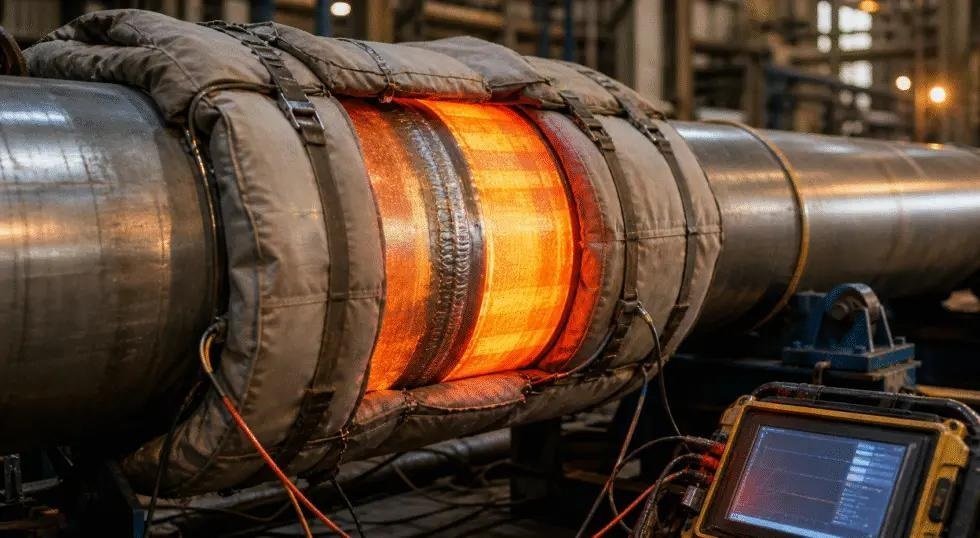
1. What Is Heat Treatment for Steel Pipe Welds?
Steel pipe weld heat treatment is a controlled thermal process applied to welded joints or weld seams to achieve specified metallurgical and mechanical properties.
During welding, the localized heat input causes rapid heating and cooling of the base metal, weld metal and heat-affected zone (HAZ).
These thermal cycles can produce:
- Residual stresses caused by uneven heating and cooling.
- Localized hardness variations.
- Changes in microstructure.
- Reduced toughness in certain welding conditions.
- Increased susceptibility to hydrogen-assisted cracking under unfavorable conditions.
To address these issues, manufacturers and pipeline contractors may apply heat treatment before or after welding, depending on the material and service requirements.
The most commonly discussed post-welding treatment is Post Weld Heat Treatment (PWHT).
PWHT generally involves heating the welded joint to a specified temperature, holding it for a defined period and then cooling it under controlled conditions.
The purpose is to reduce residual stresses and, depending on the material and treatment temperature, temper or modify the weld and heat-affected-zone microstructure.
However, PWHT is not required for every steel pipe weld.
Its necessity and procedure depend on the material grade, thickness, welding procedure, applicable construction code and project specification.
It is also important to distinguish two different manufacturing situations:
- Longitudinal seam heat treatment: Treatment of the weld seam during welded pipe manufacturing, particularly for certain high-frequency electric-welded pipes.
- Post-weld heat treatment of circumferential or field welds: Treatment of welded joints made during pipe fabrication, installation or repair.
Both involve heat treatment of weld regions, but their processes, purposes and applicable requirements are not identical.
2. Why Is Heat Treatment Required After Steel Pipe Welding?
Heat treatment is performed to address metallurgical and mechanical changes associated with welding.
The main purposes are explained below.
2.1 Reducing Residual Welding Stress
During welding, the weld metal and adjacent base metal experience intense localized heating.
As the joint cools, the material contracts. Because surrounding material restricts this contraction, residual stresses can remain in the welded structure.
These stresses may contribute to:
- Distortion.
- Dimensional instability.
- Stress-corrosion cracking under susceptible service conditions.
- Reduced resistance to certain forms of brittle fracture.
- Increased stress concentration around the weld.
PWHT allows stress redistribution through temperature-dependent stress relaxation and material behavior.
It can reduce residual stresses, although it does not necessarily eliminate them completely.
2.2 Reducing Excessive Hardness in the Heat-Affected Zone
The heat-affected zone is the region of base metal adjacent to the weld that experiences thermal changes without melting.
Depending on steel composition and cooling conditions, certain areas of the HAZ may develop hard microstructures.
This is particularly important for some carbon and low-alloy steels.
PWHT may temper these hardened microstructures and reduce excessive hardness.
Hardness control is important in applications where the pipe is exposed to hydrogen-containing environments, sour service or other conditions with specific hardness restrictions.
However, hardness acceptance limits must come from the relevant material standard, project specification or applicable service requirement.
2.3 Improving Weld Toughness and Ductility
Some welding processes can produce microstructures with relatively high hardness and limited toughness.
For suitable materials, PWHT can modify the weld and HAZ microstructure and improve their toughness and ductility.
The actual effect depends on the steel composition, welding consumables, heat input and thermal cycle.
Excessive temperature or holding time can also cause undesirable changes, such as over-tempering or reduced strength.
Therefore, heat treatment parameters must be controlled.
2.4 Reducing the Risk of Hydrogen-Assisted Cracking
Hydrogen-assisted cracking can occur in susceptible steel weldments when several conditions are present:
- Diffusible hydrogen.
- A sufficiently hard and susceptible microstructure.
- Tensile stress.
- Suitable temperature and time conditions.
Post-heating after welding can help hydrogen diffuse out of the weld region when applied under an appropriate procedure.
However, hydrogen bake-out and code-required PWHT are not the same process.
A lower-temperature hydrogen bake-out should not be treated as a substitute for required PWHT.
Hydrogen control should begin with low-hydrogen consumables, proper storage, suitable preheating and appropriate welding procedures.
2.5 Improving Dimensional Stability
Welding can produce non-uniform residual stress and distortion.
In certain applications, PWHT helps improve dimensional stability before machining or subsequent fabrication.
This is particularly relevant to thick-walled components, large pipe assemblies and precision industrial equipment.
3. What Are the Main Types of Heat Treatment for Steel Pipe Welds?
Different heat treatments are used depending on the material, manufacturing stage and required properties.
3.1 Post Weld Heat Treatment (PWHT)
PWHT is performed after welding.
For many ferritic steel applications, it involves heating the weld region to a temperature below the lower critical transformation temperature, holding it for a specified period and cooling it under controlled conditions.
Its main objectives include:
- Reducing residual stresses.
- Tempering hardened microstructures.
- Controlling weld and HAZ hardness.
- Improving certain toughness characteristics.
PWHT is commonly used for selected carbon steel and alloy steel piping systems.
3.2 Stress Relief Heat Treatment
Stress relief is a form of heat treatment intended primarily to reduce residual stresses.
The component is heated to a specified temperature, held and then cooled at a controlled rate.
It is commonly applied to suitable ferritic steel weldments.
Stress relief does not necessarily produce the same microstructural changes as normalizing or full annealing.
3.3 Normalizing
Normalizing involves heating suitable steel above its critical transformation temperature, allowing austenite to form, followed by cooling in air or under a specified cooling procedure.
It is used to refine or modify the microstructure and establish the required mechanical properties.
Normalizing is a different metallurgical process from conventional subcritical PWHT.
3.4 Quenching and Tempering
Quenching and tempering is commonly used for certain high-strength and alloy steel products.
Quenching involves heating the steel to the required austenitizing temperature and cooling it rapidly using an appropriate medium.
Tempering follows at a specified temperature to adjust hardness, strength and toughness.
This treatment may be relevant to the overall condition of certain steel pipes and welded components.
However, quenching and tempering should not be confused with routine stress-relief PWHT.
The selected treatment must be compatible with the material grade and qualified manufacturing procedure.
4. How Is Post Weld Heat Treatment Performed on Steel Pipes?
The PWHT process must be planned and monitored carefully.
For industrial piping, local induction heating and electrical resistance heating are common methods when the entire pipe assembly cannot be placed in a furnace.
A typical local PWHT procedure includes the following stages.
Step 1: Weld Inspection Before Heat Treatment
Before PWHT, the welded joint should undergo the inspections required by the applicable procedure.
These may include:
- Visual testing (VT).
- Magnetic particle testing (MT), where applicable.
- Liquid penetrant testing (PT), where applicable.
- Radiographic testing (RT), where required.
- Ultrasonic testing (UT), where required.
The purpose is to identify unacceptable defects before heat treatment.
Step 2: Install Heating Equipment
Heating equipment is positioned around the welded joint.
Common equipment includes:
- Induction heating coils.
- Electrical resistance heating pads.
- Ceramic heating elements.
- Industrial heat treatment furnaces.
For local PWHT, heating elements are arranged around the pipe circumference.
Thermal insulation is installed to help maintain a controlled temperature distribution.
Step 3: Install Thermocouples
Thermocouples are attached to the pipe to measure the actual metal temperature.
Their positions must follow the approved heat treatment procedure.
Temperature measurement should consider:
- Weld centreline.
- Heated band.
- Soak band.
- Opposite side of the pipe, where applicable.
- Circumferential temperature variation.
The number and arrangement of thermocouples depend on pipe geometry, wall thickness, heating method and applicable requirements.
Reliable temperature measurement is essential because the controller temperature alone does not prove that the entire required region has reached the specified temperature.
Step 4: Controlled Heating
The pipe is gradually heated according to the approved procedure.
Heating rate is particularly important for thick-walled components because excessive temperature gradients can produce additional thermal stresses.
The heating rate must comply with the applicable construction code and qualified heat treatment procedure.
Step 5: Holding at the Specified Temperature
Once the required metal temperature is reached, the weld region is held within the specified temperature range.
This stage is commonly called soaking.
The holding time depends on:
- Material group.
- Control thickness.
- Applicable design code.
- Welding procedure.
- Project specification.
The holding period should not be selected using a universal rule without checking the governing requirements.
Step 6: Controlled Cooling
After the holding period, the pipe is cooled according to the approved procedure.
Depending on the material and code requirements, cooling may occur:
- In the furnace.
- Under thermal insulation.
- Through controlled heating equipment.
- By another specified cooling method.
Rapid or uncontrolled cooling can introduce undesirable thermal stresses or affect the final material condition.
Step 7: Record the Heat Treatment Cycle
The temperature recorder should produce a time-temperature chart for the treatment cycle.
The record typically includes:
- Heating rate.
- Target temperature.
- Actual holding temperature.
- Holding time.
- Cooling rate.
- Thermocouple identification.
- Equipment identification.
- Date and joint number.
This record provides evidence that the approved thermal procedure was followed.
Step 8: Final Inspection
After PWHT, the joint is inspected according to the applicable code and project requirements.
Depending on the service and specification, this may include:
- Hardness testing.
- Visual examination.
- Radiographic testing.
- Ultrasonic testing.
- Surface examination.
- Dimensional inspection.
Additional inspection may be required after heat treatment, especially for critical piping systems and specific alloy steel applications.
5. What Temperature Is Used for Steel Pipe Weld Heat Treatment?
There is no single PWHT temperature suitable for all steel pipes.
The required temperature depends on the material group, weld thickness, design code and service requirements.
For example, ASME B31.3 Table 331.1.1 includes different PWHT temperature ranges for different material groups.
The following examples are illustrative reference ranges from commonly used ASME B31.3 editions. They should not be treated as a universal production instruction.
| Material Group | Typical PWHT Temperature Range | General Consideration |
|---|---|---|
| P-No. 1 carbon steel | 595–650°C | Common stress-relief range |
| P-No. 3 low-alloy steel | 595–650°C | Subject to material and code requirements |
| P-No. 4 low-alloy steel | 650–705°C | Higher-temperature treatment |
| P-No. 5A alloy steel | 675–760°C | Requires careful temperature control |
| P-No. 5B alloy steel | 675–760°C | Requires material-specific procedure |
| P-No. 6 stainless steel | 760–800°C | Specialized requirements; not a general stainless PWHT recommendation |
Important:
- These ranges are not applicable to every grade within a broad material family without checking the relevant P-No. and Group No.
- Some materials may be exempt from PWHT under specific code conditions.
- Some stainless steels require different thermal treatment approaches.
- The applicable code edition, material classification and project specification must be verified before production.
For carbon steel piping, a commonly encountered PWHT range is approximately 595–650°C.
However, the exact temperature, holding time and cooling requirements must be established from the governing code and approved procedure.
6. How Long Should Steel Pipe Welds Be Held During PWHT?
Holding time is an important parameter in post-weld heat treatment.
The purpose is to ensure that the required material region receives sufficient thermal exposure at the specified temperature.
A commonly encountered ASME B31.3 rule for certain material groups uses a minimum holding time related to control thickness.
For example, the table includes requirements such as:
- 1 hour per 25 mm of control thickness.
- A specified minimum holding time.
- Additional holding time for thicknesses beyond defined limits.
The actual requirement varies by material group and code table.
Example of a Simplified Holding-Time Calculation
Assume a hypothetical carbon steel weld with a control thickness of 25 mm.
Using a reference rate of 1 hour per 25 mm:
Holding time = 25 / 25 × 1 hour
Holding time = 1 hour.
This example is only an illustration of the thickness-based calculation.
It does not establish that every 25 mm carbon steel weld must receive exactly one hour of PWHT.
The governing code, applicable material group, exemptions, thickness definition and project specification must be checked.
7. Which Steel Pipe Materials Require Post Weld Heat Treatment?
PWHT requirements vary considerably between material grades.
7.1 Carbon Steel Pipes
Carbon steel pipes are widely used in industrial process piping and power generation.
Common specifications include:
- ASTM A106 Grade B.
- ASTM A53 Grade B.
- API 5L Grade B.
PWHT requirements depend on the applicable construction code, material classification, thickness, service conditions and specified exceptions.
Not every carbon steel pipe weld requires PWHT.
7.2 Low-Alloy Steel Pipes
Low-alloy steel pipes are used in applications requiring higher-temperature strength or specific mechanical properties.
Examples include:
- ASTM A335 P11.
- ASTM A335 P22.
These materials commonly require carefully controlled preheating, interpass temperature management and post-weld heat treatment.
The exact requirements depend on the material grade, wall thickness, welding procedure and applicable code.
7.3 Chromium-Molybdenum Steel Pipes
Chromium-molybdenum steels are used in high-temperature industrial applications.
Their welding procedures are particularly sensitive to thermal history.
Inappropriate heating and cooling can produce undesirable hardness and microstructural conditions.
For materials such as P11 and P22, PWHT is frequently an important part of the qualified welding procedure.
7.4 P91 and Other Creep-Strength-Enhanced Ferritic Steels
P91 is a 9Cr-1Mo-V-Nb creep-strength-enhanced ferritic steel used in high-temperature power generation and industrial applications.
Its welding and heat treatment requirements are particularly strict.
The procedure generally requires careful control of:
- Preheat temperature.
- Interpass temperature.
- Welding heat input.
- Post-weld cooling.
- Final PWHT temperature.
- Holding time.
The weldment must follow an approved, material-specific procedure.
Incorrect heat treatment may result in unacceptable hardness, reduced creep performance or other metallurgical problems.
7.5 Austenitic Stainless Steel Pipes
Austenitic stainless steels such as 304L and 316L do not generally require conventional PWHT for routine welded piping applications.
In some cases, additional thermal treatment may be undesirable because it can affect corrosion resistance.
Special applications may require solution annealing or other specified treatment.
The correct approach depends on the stainless steel grade, service environment and governing specification.
8. What Are the Common Methods of Post Weld Heat Treatment?
Different heating methods are available depending on pipe dimensions, production conditions and accessibility.
8.1 Furnace Heat Treatment
Furnace heat treatment involves placing the entire pipe or welded assembly inside a controlled furnace.
Advantages include:
- More uniform heating.
- Controlled thermal cycles.
- Suitable for shop fabrication.
- Easier monitoring of multiple components in a batch.
Limitations include:
- Furnace size restrictions.
- Transportation requirements.
- Longer handling time.
- Less practical for large installed pipelines.
8.2 Induction Heat Treatment
Induction heating uses electromagnetic induction to generate heat in the pipe.
A coil is positioned around the weld region, allowing localized heating.
Advantages include:
- Rapid heating.
- Precise temperature control.
- Suitable for field applications.
- Good potential for controlled heating through the pipe wall.
The actual temperature distribution depends on coil design, pipe thickness, frequency, heating width and insulation.
8.3 Electrical Resistance Heating
Electrical resistance heating uses heating elements or flexible ceramic pads installed around the welded joint.
Electric current generates heat within the heating elements, which is transferred to the pipe.
Advantages include:
- Flexible installation.
- Suitable for local PWHT.
- Good temperature control.
- Useful for complex pipe arrangements.
The method requires appropriate insulation, thermocouple positioning and temperature monitoring.
Comparison of Heat Treatment Methods
| Method | Main Advantages | Typical Applications |
|---|---|---|
| Furnace Heating | Uniform heating of the entire component | Shop fabrication |
| Induction Heating | Rapid and localized heating | Large pipes and field welds |
| Resistance Heating | Flexible local heating and controlled soaking | Industrial pipe joints and repairs |
The selected method must be capable of meeting the temperature uniformity and thermal cycle requirements of the approved procedure.
9. What Happens If Post Weld Heat Treatment Is Not Performed Correctly?
Incorrect PWHT can be as problematic as omitting a required heat treatment cycle.
Common problems include:
9.1 Excessive Weld Hardness
Insufficient thermal exposure may leave hard microstructures in the weld or HAZ.
This can increase susceptibility to certain cracking mechanisms in susceptible materials and environments.
9.2 Incomplete Stress Relief
If the specified temperature or holding time is not achieved, residual stresses may remain higher than intended.
9.3 Excessive Grain Growth or Over-Tempering
Excessive temperature or holding time may alter the microstructure and reduce certain mechanical properties.
This is particularly important for alloy steels with carefully controlled heat treatment requirements.
9.4 Uneven Heating
Incorrect heating band width or thermocouple placement can result in temperature gradients.
The weld centreline may reach the required temperature while other parts of the required treatment region remain outside the specified range.
9.5 Uncontrolled Cooling
Cooling too rapidly or unevenly can produce unwanted thermal gradients and metallurgical changes.
9.6 Distortion
Thermal expansion and contraction can affect pipe geometry.
Proper support, heating arrangements and cooling control help reduce the risk of distortion.
10. How to Verify the Quality of Post Weld Heat Treatment?
A completed PWHT operation should be supported by documented process records and appropriate inspection.
Temperature Recording
The time-temperature chart should demonstrate that the heating, holding and cooling cycles complied with the approved procedure.
Thermocouple Inspection
Thermocouples should be installed in the specified positions and connected to a calibrated temperature recording system.
Hardness Testing
Hardness testing helps assess whether the weld and HAZ meet applicable hardness limits.
Non-Destructive Testing
Depending on the code and project specification, RT, UT, MT or PT may be required before or after PWHT.
Mechanical Testing
For procedure qualification or specified production testing, tensile, impact and other mechanical tests may be required.
Documentation Review
A complete quality package may include:
- Approved WPS.
- PQR records.
- Heat treatment procedure.
- Time-temperature charts.
- Thermocouple layout.
- Equipment calibration records.
- Hardness test reports.
- NDT reports.
- Material Test Certificates.
11. Common Mistakes When Applying PWHT to Steel Pipes
Mistake 1: Assuming All Steel Pipes Require PWHT
PWHT requirements depend on material, thickness, code and service conditions.
Mistake 2: Using the Same Temperature for Every Material Grade
Carbon steel, Cr-Mo alloy steel and stainless steel have different metallurgical requirements.
Mistake 3: Calculating Holding Time Without Checking Control Thickness
The applicable code definition of control thickness must be used.
Mistake 4: Ignoring Heating and Cooling Rates
Thermal gradients can affect residual stress and material properties.
Mistake 5: Installing Too Few Thermocouples
Insufficient monitoring may fail to detect circumferential or through-wall temperature differences.
Mistake 6: Treating Hydrogen Bake-Out as PWHT
Hydrogen bake-out and code-required PWHT have different purposes and requirements.
Mistake 7: Failing to Retain Temperature Records
Without a reliable time-temperature chart, it becomes difficult to demonstrate that the specified procedure was followed.
12. Frequently Asked Questions
What is PWHT in steel pipe welding?
PWHT stands for Post Weld Heat Treatment. It is a controlled thermal process applied after welding to reduce residual stresses and achieve specified metallurgical or mechanical properties.
Why is post weld heat treatment necessary?
It may be required to control residual stress, reduce excessive weld hardness, temper susceptible microstructures and meet applicable construction code requirements.
What temperature is used for PWHT of carbon steel pipes?
A commonly encountered range for certain carbon steel piping applications is 595–650°C. The exact temperature must follow the applicable code, material classification and approved procedure.
How long does PWHT take?
The holding time depends on material group, control thickness and applicable code requirements. Some code provisions use thickness-based holding-time rules with minimum durations.
Does ASTM A106 Grade B require PWHT?
Not automatically. The requirement depends on the applicable piping code, thickness, service conditions, welding procedure and relevant exemptions.
Does ASTM A335 P11 require post weld heat treatment?
P11 welding procedures commonly include PWHT, but the actual requirements must be established using the applicable code, material specification and qualified welding procedure.
Is PWHT required for stainless steel pipes?
Not generally for routine austenitic stainless steel welds. Special applications may require solution annealing or another specified treatment. Conventional PWHT should not be applied without checking the material requirements.
What is the difference between PWHT and stress relief?
Stress relief is one of the main purposes of certain PWHT procedures. However, PWHT can also be used to temper microstructures and achieve other specified metallurgical properties.
Can induction heating be used for PWHT?
Yes. Induction heating is commonly used for local PWHT of industrial pipe welds. Proper coil arrangement, thermocouple positioning, insulation and temperature control are essential.
What documents are required after PWHT?
Typical records include the approved heat treatment procedure, temperature chart, thermocouple layout, calibration records and required inspection reports.
Does PWHT eliminate all residual stress?
No. PWHT can reduce residual stress, but complete elimination should not be assumed.
13. Conclusion
Heat treatment plays an important role in controlling the metallurgical and mechanical condition of selected steel pipe welds.
Post Weld Heat Treatment can reduce residual stresses, temper hardened weld regions and help meet the mechanical and service requirements of industrial piping systems.
The correct procedure depends on the steel grade, wall thickness, welding process, construction code and service conditions.
Furnace heating, induction heating and electrical resistance heating are common methods used to apply controlled thermal cycles.
For buyers and project engineers, the most important checks are the approved heat treatment procedure, actual metal temperature, holding time, heating and cooling rates, thermocouple arrangement and final inspection records.
Looking for Steel Pipes for Critical Industrial Applications?
For ASTM A106 carbon steel pipes, ASTM A335 alloy steel pipes, API 5L line pipes and other industrial piping products, confirm the required material grade, dimensions, delivery condition, welding requirements and inspection documentation before ordering.
A clear technical specification helps ensure that the supplied steel pipe is suitable for the intended fabrication and operating conditions.