
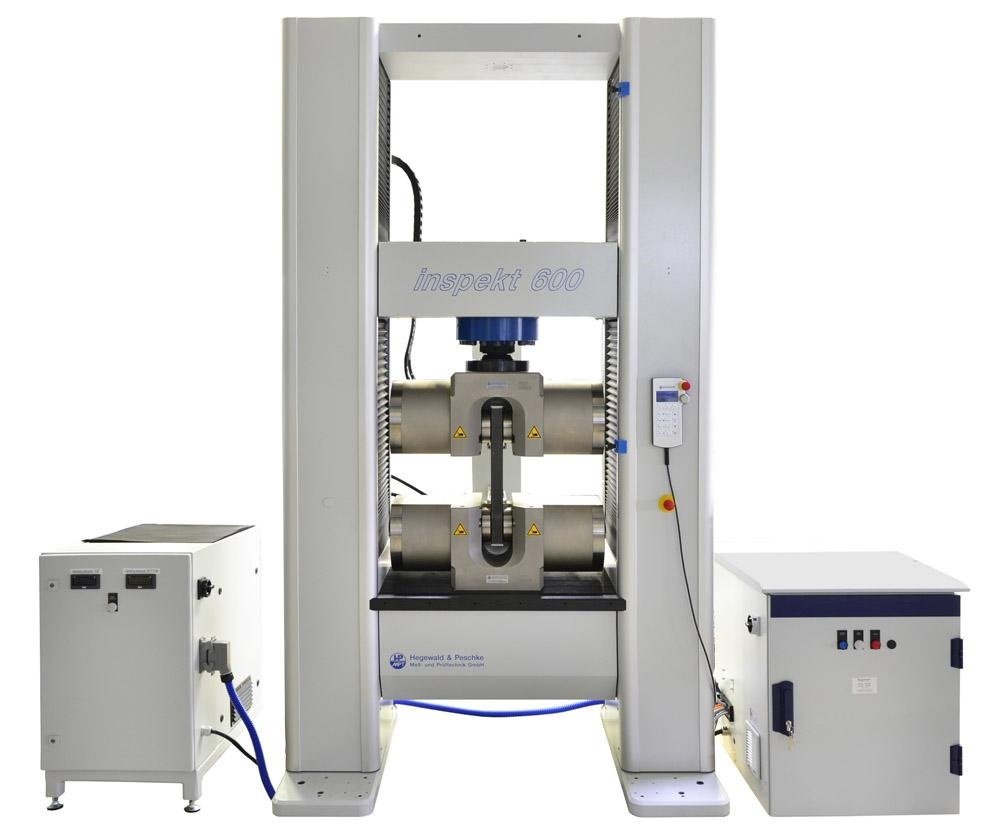
1. Why Are Yield Strength, Tensile Strength and Elongation Important for Steel Pipes?
When purchasing steel pipes for industrial applications, checking the material grade and dimensions is not enough. Mechanical properties are equally important because they determine how the pipe responds to applied loads during manufacturing, installation and operation.
Three properties are particularly important:
- Yield strength.
- Tensile strength.
- Elongation.
These values are commonly reported in the Material Test Certificate (MTC) and verified through tensile testing.
Although they are related, they describe different stages of material behavior.
Yield strength indicates when steel begins to deform permanently. Tensile strength represents the maximum engineering stress reached during a tensile test. Elongation measures how much the specimen stretches before fracture.
Understanding these properties helps engineers and buyers evaluate whether a steel pipe meets the mechanical requirements of its intended application.
They are particularly important for:
- Oil and gas transmission pipelines.
- Seamless carbon steel pipes.
- High-pressure industrial piping.
- Boiler and heat exchanger tubes.
- Structural steel pipes.
- Offshore pipelines.
- Oil casing and tubing.
- Mechanical and hydraulic applications.
A steel pipe with high tensile strength is not automatically the best choice. The required balance of strength, ductility, toughness and fabrication performance depends on the service conditions.
2. What Is Yield Strength in Steel Pipes?
Yield strength is the stress at which a material begins to undergo permanent plastic deformation.
Before reaching the yield point, steel generally behaves elastically. When the applied load is removed, the material can return approximately to its original dimensions.
Once the material exceeds its yield strength, permanent deformation occurs.
In steel pipe specifications, yield strength is usually expressed in megapascals (MPa) or pounds per square inch (psi).
Why Is Yield Strength Important?
Yield strength is an important parameter in structural and pressure-related engineering calculations.
It helps engineers evaluate how much stress a steel pipe can withstand before permanent deformation begins.
For example, steel pipes used in oil and gas pipelines may experience internal pressure, bending, axial loads and external forces.
If the applied stress exceeds the material’s yield strength, permanent deformation may occur.
Important applications include:
- Pipeline stress analysis.
- Pressure piping design.
- Structural support systems.
- Offshore pipeline engineering.
- Pipe bending and forming.
- Mechanical component design.
Yield Strength and Yield Point
Not all steels exhibit a clearly defined yield point.
Some low-carbon steels show a distinct upper and lower yield phenomenon. Other steels transition gradually from elastic to plastic deformation.
For materials without a clear yield point, proof stress is commonly used.
A typical example is the 0.2% proof stress, often written as Rp0.2.
It represents the stress associated with a specified permanent strain offset of 0.2%.
The exact yield or proof-strength definition must follow the relevant product specification and test method.
3. What Is Tensile Strength in Steel Pipes?
Tensile strength, also called ultimate tensile strength (UTS), is the maximum engineering stress reached by a material during a tensile test.
It is calculated by dividing the maximum applied tensile force by the original cross-sectional area of the test specimen.
The formula is:
UTS = Fmax / A0
Where:
- UTS = Ultimate tensile strength (MPa).
- Fmax = Maximum force recorded during the tensile test (N).
- A0 = Original cross-sectional area of the specimen (mm²).
Since 1 N/mm² equals 1 MPa, the resulting unit is MPa.
Example Calculation
Assume a steel tensile specimen has:
- Original cross-sectional area: 50 mm².
- Maximum recorded tensile force: 25,000 N.
Then:
UTS = 25,000 / 50
UTS = 500 MPa
This means the specimen reached a maximum engineering tensile stress of 500 MPa during the test.
Why Is Tensile Strength Important?
Tensile strength helps evaluate a material’s resistance to tensile loading and is an important acceptance parameter in steel pipe standards.
It is particularly relevant to:
- Pipeline material qualification.
- Mechanical component manufacturing.
- Welding and fabrication.
- Structural steel applications.
- Quality control and material certification.
However, tensile strength is not the same as the maximum allowable operating stress of a pipe.
A steel pipe should not be designed to operate continuously at its ultimate tensile strength. Design codes use allowable stresses and other safety-related factors to establish suitable design limits.
4. What Is Elongation in Steel Pipes?
Elongation measures the percentage increase in the gauge length of a tensile specimen after deformation.
It is commonly used to evaluate the ductility of steel.
Ductility describes a material’s ability to undergo plastic deformation before fracture.
The percentage elongation after fracture is calculated as:
A = [(Lu − L0) / L0] × 100%
Where:
- A = Percentage elongation.
- L0 = Original gauge length.
- Lu = Final gauge length after fracture and specimen reassembly.
Example Calculation
Assume a tensile specimen has:
- Original gauge length: 50 mm.
- Final gauge length after fracture: 62 mm.
Then:
A = [(62 − 50) / 50] × 100%
A = 24%
The specimen has a percentage elongation of 24%.
This indicates that its gauge length increased by 24% before fracture.
Why Is Elongation Important?
Elongation is an important indicator of material ductility.
A steel pipe with suitable ductility can accommodate a certain amount of plastic deformation during fabrication and service without immediate fracture.
It is particularly relevant to:
- Pipe bending.
- Forming and fabrication.
- Pipeline installation.
- Mechanical expansion.
- Resistance to deformation during handling.
- Material selection for demanding service conditions.
However, elongation values must be interpreted using the specified specimen geometry and gauge length.
A value measured over 50 mm cannot automatically be compared with a value measured over 200 mm.
5. Yield Strength vs Tensile Strength vs Elongation: Key Differences
These three properties describe different aspects of steel mechanical behavior.
| Property | Definition | What It Indicates | Unit |
|---|---|---|---|
| Yield Strength | Stress at the specified onset of plastic deformation | Resistance to permanent deformation | MPa |
| Tensile Strength | Maximum engineering stress during a tensile test | Maximum tensile stress reached | MPa |
| Elongation | Percentage increase in gauge length after fracture | Ductility | % |
A Simple Way to Understand the Difference
Imagine pulling a steel tensile specimen with increasing force.
At the beginning: The specimen stretches elastically and returns to its original length when the load is removed.
At the yield stage: Permanent deformation begins. This is associated with yield strength or the specified proof strength.
At the maximum load: The specimen reaches its maximum engineering tensile stress. This is the tensile strength.
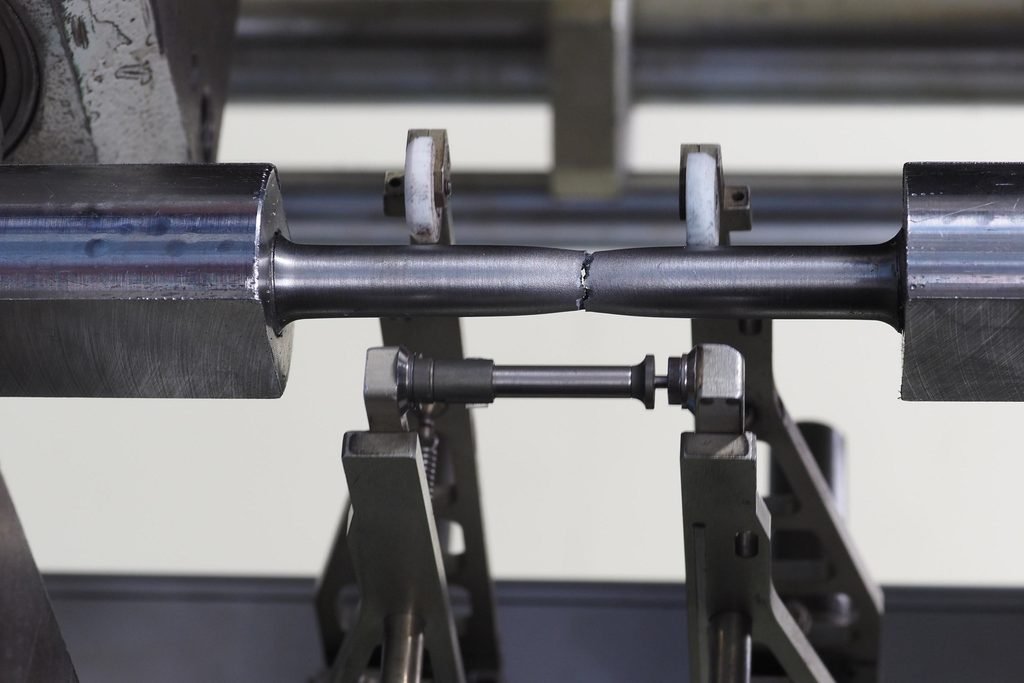
Before fracture: Localized necking may develop, followed by final fracture.
After fracture: The two specimen pieces are fitted together to measure the final gauge length and calculate percentage elongation.
These properties provide complementary information. None should be used alone to determine the overall quality of a steel pipe.
6. Understanding the Stress-Strain Curve of Steel
The stress-strain curve is one of the most useful tools for understanding the relationship between yield strength, tensile strength and elongation.
It is generated from data recorded during a tensile test.
The typical engineering stress-strain curve for ductile steel includes several stages.
6.1 Elastic Region
In the initial region, stress is approximately proportional to strain.
The material deforms elastically and can return to its original dimensions when the load is removed.
The slope of the linear elastic region represents Young’s modulus.
6.2 Yielding Region
As stress increases, the steel reaches its yield strength or specified proof stress.
Plastic deformation begins.
Some low-carbon steels show a distinct yield point, while others have a gradual transition.
6.3 Strain Hardening Region
After yielding, additional deformation requires increasing stress.
This behavior is known as strain hardening or work hardening.
The material continues to deform plastically until it reaches its maximum engineering stress.
6.4 Ultimate Tensile Strength
The highest point on the engineering stress-strain curve represents the ultimate tensile strength.
After this point, localized necking generally develops in a ductile tensile specimen.
6.5 Necking and Fracture
The specimen’s cross-sectional area decreases locally.
The engineering stress calculated using the original area generally decreases until the specimen fractures.
The final elongation is then measured according to the applicable test procedure.
The relationship between these stages helps engineers evaluate both the strength and deformation characteristics of steel pipe materials.
7. Typical Yield Strength and Tensile Strength Requirements for Common Steel Pipe Grades
Different steel pipe specifications establish different mechanical property requirements.
The following examples illustrate commonly specified minimum values. Actual acceptance requirements must be checked against the ordered specification, grade, product form, dimensions and applicable edition.
| Standard | Grade | Minimum Yield Strength | Minimum Tensile Strength |
|---|---|---|---|
| ASTM A106 | Grade A | 205 MPa | 330 MPa |
| ASTM A106 | Grade B | 240 MPa | 415 MPa |
| ASTM A106 | Grade C | 275 MPa | 485 MPa |
| ASTM A53 | Grade A | 205 MPa | 330 MPa |
| ASTM A53 | Grade B | 240 MPa | 415 MPa |
| API 5L | Grade B | 245 MPa | 415 MPa |
| API 5L | X42 | 290 MPa | 415 MPa |
| API 5L | X52 | 360 MPa | 460 MPa |
Note: The API 5L figures shown are illustrative minimum values for the listed grades and do not represent every PSL level or product option. Check the applicable API 5L edition and ordering requirements.
ASTM A106 Grade B
ASTM A106 Grade B is widely used for seamless carbon steel pipes in high-temperature service.
Its commonly specified minimum mechanical properties include:
- Yield strength: 240 MPa.
- Tensile strength: 415 MPa.
ASTM A53 Grade B
ASTM A53 Grade B is used in various mechanical and pressure applications.
Its commonly specified minimum yield and tensile strengths are similar to those of ASTM A106 Grade B.
However, the two specifications have different product scopes and requirements.
API 5L Grade B
API 5L Grade B is widely used in oil and gas pipeline applications.
Its specified minimum yield strength is approximately 245 MPa, with a minimum tensile strength of approximately 415 MPa.
API 5L X42 and X52
Higher-strength pipeline grades are commonly selected for projects with specific pressure, diameter, wall thickness and engineering requirements.
For example:
- X42: Minimum yield strength of 290 MPa.
- X52: Minimum yield strength of 360 MPa.
Higher yield strength can provide advantages in pipeline design, but the final selection must also consider toughness, weldability, fracture control, corrosion and construction requirements.
8. What Is the Yield-to-Tensile Ratio (Y/T Ratio)?
The yield-to-tensile ratio is the ratio of yield strength to tensile strength.
It is calculated using:
Y/T Ratio = Yield Strength / Tensile Strength
For example, consider a steel pipe with:
- Yield strength: 360 MPa.
- Tensile strength: 460 MPa.
Then:
Y/T = 360 / 460
Y/T = 0.783
The yield-to-tensile ratio is approximately 0.78.
Why Does the Y/T Ratio Matter?
The ratio provides additional information about the relationship between a material’s yielding behavior and its maximum tensile strength.
A relatively high Y/T ratio means that the yield strength is closer to the ultimate tensile strength.
This generally indicates a smaller strength margin between the onset of yielding and the maximum tensile stress.
In pipeline engineering, the yield-to-tensile ratio is particularly relevant to certain high-strength line pipe specifications.
Some API 5L PSL2 grades include specified maximum yield-to-tensile ratio requirements.
The applicable limits depend on the grade and product requirements.
A lower Y/T ratio should not automatically be interpreted as better overall performance. Ductility, toughness, strain capacity and the intended service conditions must also be considered.
9. How Are Yield Strength, Tensile Strength and Elongation Tested?
These properties are generally determined through a tensile test.
For steel pipes, the test is performed on specimens prepared from the pipe body or, where specified, the weld region.
ASTM A370 and ISO 6892-1 are commonly referenced test methods for determining the mechanical properties of steel products.
Step 1: Specimen Preparation
A specimen is taken from the steel pipe according to the applicable product specification.
Depending on pipe diameter, wall thickness and testing requirements, the specimen may be:
- A longitudinal strip specimen cut from the pipe wall.
- A transverse specimen.
- A machined round specimen.
- A full-section tubular specimen.
The specimen geometry and sampling location must follow the relevant standard.
Step 2: Mounting in the Tensile Testing Machine
The specimen is secured between the machine grips.
The testing machine applies a controlled tensile load.
For tubular products, suitable grips are important to prevent crushing, slippage or premature damage.
Step 3: Applying Tensile Force
The tensile force is increased according to the specified testing method.
The machine records the applied force and corresponding deformation.
An extensometer may be used to measure strain accurately over the gauge length.
Step 4: Determining Yield Strength
The yield point or specified proof strength is identified from the stress-strain response.
For materials without a distinct yield point, the specified offset proof strength may be used.
Step 5: Determining Tensile Strength
The maximum recorded force is divided by the original specimen cross-sectional area.
This gives the ultimate tensile strength.
Step 6: Measuring Elongation
After fracture, the specimen pieces are carefully fitted together.
The final gauge length is measured and compared with the original gauge length.
The percentage elongation is then calculated.
Step 7: Recording the Results
The results are documented in the relevant inspection report and Material Test Certificate.
Typical reported values include:
- Yield strength.
- Tensile strength.
- Percentage elongation.
- Test specimen orientation.
- Gauge length.
- Test method.
- Heat number and material identification.
10. How to Read These Properties on a Steel Pipe MTC?
The Material Test Certificate is an important document for verifying whether supplied steel pipes meet the ordered mechanical requirements.
A typical tensile test section may contain:
| Item | Example Result |
|---|---|
| Material Grade | ASTM A106 Grade B |
| Yield Strength | 265 MPa |
| Tensile Strength | 450 MPa |
| Elongation | 28% |
| Test Method | ASTM A370 |
| Heat Number | Identified on certificate |
These are illustrative test results, not actual mill test data.
When reviewing an MTC, buyers should check the following:
1. Material Grade
Confirm that the reported grade matches the purchase order.
2. Yield Strength
Verify that the measured result satisfies the minimum and any applicable maximum requirement.
3. Tensile Strength
Confirm compliance with the specified tensile strength range.
4. Elongation
Check the minimum elongation requirement and the gauge length used for the test.
5. Test Orientation
Longitudinal and transverse tensile specimens may have different requirements.
6. Heat Number
Confirm that the test results can be traced to the supplied pipe or production lot.
7. Applicable Standard
Make sure the test method and acceptance criteria correspond to the ordered product specification.
A certificate should not be accepted simply because the three reported numbers appear high. They must comply with the relevant standard and be traceable to the supplied material.
11. How Do These Mechanical Properties Affect Steel Pipe Selection?
The correct material should be selected according to the actual application.
Oil and Gas Pipelines
Yield strength is important for evaluating pipeline stress and pressure design.
Tensile strength and yield-to-tensile ratio also contribute to material qualification and pipeline integrity assessment.
Elongation and toughness are important for accommodating deformation during installation and service.
High-Pressure Piping
Yield strength is relevant to pressure design, while tensile strength helps establish compliance with the product specification.
However, allowable stress must be obtained from the applicable design code rather than directly using minimum tensile strength.
Boiler and High-Temperature Pipes
The mechanical properties of boiler and high-temperature pipes must be considered at the relevant service temperature.
Room-temperature tensile test results alone do not establish high-temperature allowable stress or creep performance.
Structural Steel Pipes
Yield strength is important for evaluating structural load capacity.
Tensile strength and elongation help assess the material’s strength and deformation characteristics.
Hydraulic and Mechanical Tubes
Yield strength and tensile strength are important for load-bearing components.
Elongation and dimensional accuracy are also relevant to forming, machining and assembly.
12. Common Misunderstandings About Steel Pipe Mechanical Properties
Mistake 1: Assuming Higher Tensile Strength Always Means Better Quality
Higher tensile strength does not automatically mean better ductility, toughness or weldability.
Mistake 2: Confusing Yield Strength with Tensile Strength
Yield strength describes the onset of permanent deformation, while tensile strength is the maximum engineering stress reached during the tensile test.
Mistake 3: Ignoring Elongation
A material with high strength but insufficient ductility may not be suitable for certain forming, bending or pipeline applications.
Mistake 4: Comparing Elongation Without Checking Gauge Length
Elongation depends on specimen geometry and gauge length. Results should be compared using equivalent test conditions or the applicable standard’s conversion rules.
Mistake 5: Using Room-Temperature Strength Values for High-Temperature Design
High-temperature design requires appropriate temperature-dependent allowable stress data and, where relevant, creep information.
Mistake 6: Ignoring the Yield-to-Tensile Ratio
For certain pipeline applications, the ratio is an important specified mechanical property and should be checked alongside yield and tensile strength.
13. Frequently Asked Questions
What is the difference between yield strength and tensile strength?
Yield strength is the stress at which permanent deformation begins under the specified definition. Tensile strength is the maximum engineering stress reached during a tensile test.
What is a good yield strength for steel pipes?
There is no single ideal value. The required yield strength depends on the material specification, pipe application, design pressure, temperature and engineering requirements.
What is the typical yield strength of ASTM A106 Grade B?
ASTM A106 Grade B commonly specifies a minimum yield strength of 240 MPa and a minimum tensile strength of 415 MPa. Confirm the applicable edition and product requirements.
What does 20% elongation mean in steel?
It means the tensile specimen’s gauge length increased by 20% after fracture, based on the specified elongation measurement procedure.
Is higher elongation always better?
Not necessarily. Higher elongation generally indicates greater ductility, but the required value must be balanced with strength, toughness, fabrication and service requirements.
What is the difference between yield strength and 0.2% proof stress?
Yield strength may refer to a distinct yield point or a specified yield-strength definition. The 0.2% proof stress is determined using a specified permanent strain offset and is often used when no clear yield point exists.
What is the yield-to-tensile ratio?
It is the ratio of yield strength to tensile strength. It provides information about the relationship between the onset of plastic deformation and the maximum tensile stress.
Which test standard is used for steel pipe tensile testing?
ASTM A370 and ISO 6892-1 are commonly referenced for tensile testing of steel products. The product specification determines the applicable test requirements.
Does seamless steel pipe have higher yield strength than welded steel pipe?
Not automatically. Yield strength depends primarily on the steel grade, manufacturing condition and heat treatment. Both seamless and welded pipes can meet specified mechanical property requirements.
Where can I find yield strength and elongation results?
These results are generally included in the tensile test section of the Material Test Certificate, together with the tensile strength, material grade and heat number.
14. Conclusion
Yield strength, tensile strength and elongation are three essential mechanical properties used to evaluate steel pipe performance.
Yield strength indicates resistance to permanent deformation. Tensile strength represents the maximum engineering stress reached during a tensile test. Elongation provides information about ductility and the material’s ability to deform before fracture.
For steel pipe selection, these properties should be considered together rather than independently.
Standards such as ASTM A106, ASTM A53 and API 5L establish mechanical property requirements for different steel pipe products and applications. ASTM A370 provides standardized mechanical testing methods.
Before purchasing steel pipes, buyers should verify the material grade, yield strength, tensile strength, elongation, test orientation and Material Test Certificate.
Looking for Steel Pipes with Certified Mechanical Properties?
Whether your project requires ASTM A106 seamless carbon steel pipes, API 5L line pipes, ASTM A335 alloy steel pipes or other industrial steel products, provide the required grade, dimensions, mechanical properties and inspection requirements.
Reviewing the material specification and test documentation before ordering helps ensure that the supplied steel pipes meet the technical requirements of your project.