
Large-diameter welded steel pipe is widely used in oil and gas transmission, water pipelines, structural piling, offshore construction and other infrastructure projects. Among the available manufacturing methods, LSAW pipe and SSAW pipe are two of the most common choices.
At first glance, both products may look similar. Both are manufactured by forming steel into a cylindrical shape and joining the edges by submerged arc welding. The most obvious difference is the direction of the weld.
An LSAW pipe has a straight weld running along the length of the pipe, while an SSAW pipe has a continuous spiral weld around the pipe body.
That difference comes from two very different forming processes, and it affects pipe diameter, wall thickness, production flexibility, dimensional control, cost and the applications for which each pipe is commonly selected.
What Is LSAW Pipe?
LSAW stands for Longitudinal Submerged Arc Welded pipe.
Instead of starting with a steel coil, LSAW production normally begins with an individual steel plate. The plate edges are prepared, the plate is progressively formed into a cylindrical shape, and the longitudinal joint is welded.
Depending on the mill, forming may be carried out by JCOE, UOE or roll-bending processes.
The result is easy to recognize: an LSAW pipe normally has one straight weld seam parallel to the pipe axis.
In API terminology, this manufacturing route is commonly referred to as SAWL, meaning submerged arc longitudinal welded pipe.
LSAW is particularly important in applications requiring large outside diameters, relatively heavy wall thicknesses and close dimensional control.
Typical uses include high-pressure transmission pipelines, oil and gas projects, offshore construction, structural pipe piles, water transmission systems and other heavy-duty pipeline projects.
LSAW Pipe Manufacturing Process
A typical LSAW production line follows approximately this sequence:
| Production Stage | What Happens |
|---|---|
| Steel Plate Inspection | Plate dimensions, surface condition and material quality are checked |
| Edge Milling | Both longitudinal edges are machined to the required geometry |
| Pre-Bending | Plate edges are bent before the main forming operation |
| Forming | The plate is formed by JCOE, UOE or roll-bending equipment |
| Tack / Pre-Welding | The open seam is aligned and temporarily joined |
| Internal SAW | The longitudinal seam is welded from the inside |
| External SAW | A second submerged arc weld is made from the outside |
| Mechanical Expansion | On applicable production lines, the pipe is expanded to improve roundness and dimensional accuracy |
| NDT Inspection | Welds may be examined by UT, RT or other specified methods |
| Hydrostatic Testing | Pipe pressure integrity is checked according to the applicable specification |
| End Preparation | Pipe ends are cut, faced or beveled |
| Final Inspection | Dimensions, marking, surface condition and documentation are checked |
A JCOE or UOE production route allows a heavy steel plate to be gradually converted into a large-diameter pipe while keeping control over pipe shape and weld alignment. Projectmaterials identifies plate forming and longitudinal SAW as the defining characteristics of LSAW production.
What Is SSAW Pipe?
SSAW stands for Spiral Submerged Arc Welded pipe. It is also frequently called spiral welded pipe or HSAW pipe.
Instead of using individual steel plates, SSAW production normally starts with a continuous steel coil or strip.
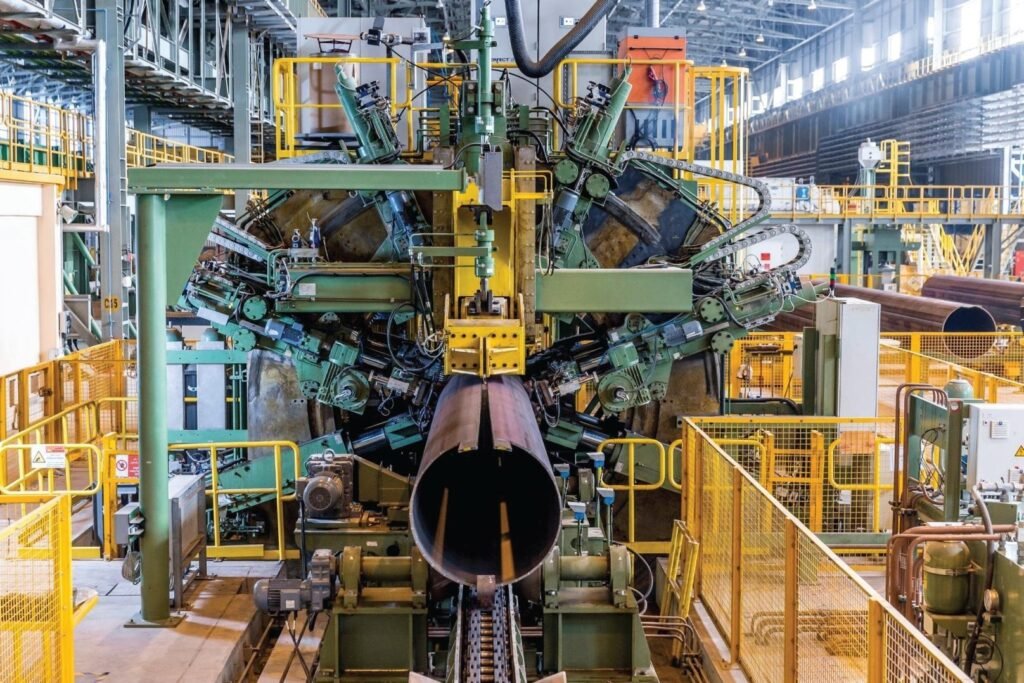
The strip is uncoiled, leveled and fed into a forming system at a controlled angle. As the strip passes through the forming equipment, it gradually takes the shape of a cylinder. Its edges meet along a helical line and are welded continuously.
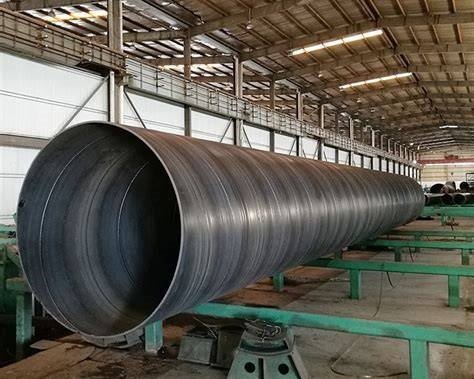
The finished pipe therefore has a clearly visible spiral weld running around its circumference.
In API terminology, the corresponding term is SAWH, or submerged arc helical welded pipe.
One important advantage of spiral forming is diameter flexibility. A mill can manufacture different pipe diameters from coil by changing forming conditions and the helix angle rather than relying entirely on a plate width matched to each pipe circumference.
This makes SSAW particularly practical for large-diameter water pipelines, piling pipe and many infrastructure applications.
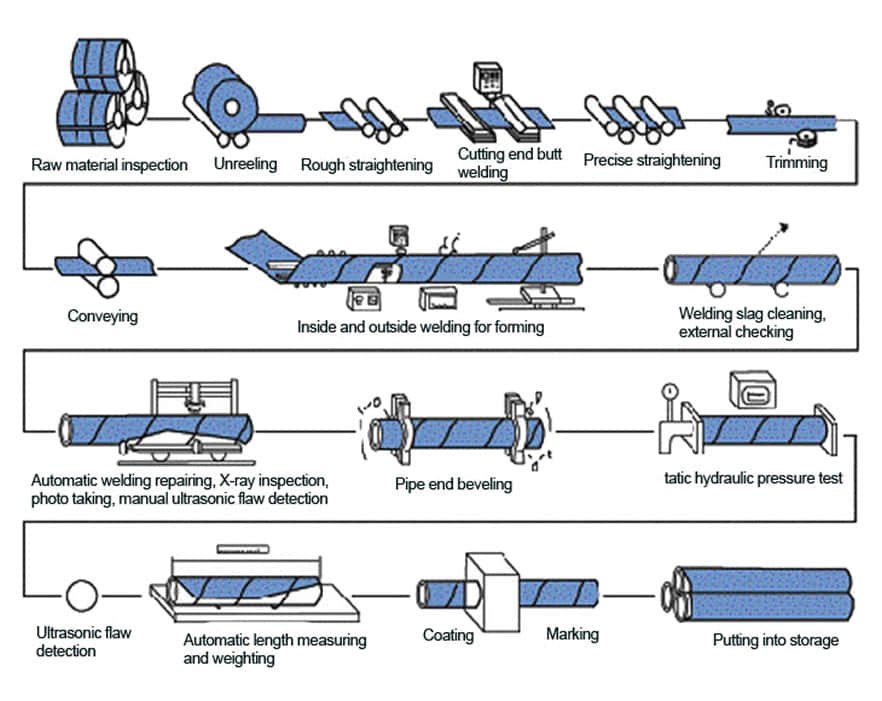
SSAW Pipe Manufacturing Process
| Production Stage | What Happens |
|---|---|
| Coil Inspection | Steel coil is checked before entering production |
| Uncoiling | Continuous strip is fed from the coil |
| Leveling | Strip is flattened and stabilized |
| Edge Preparation | Strip edges are trimmed or prepared for welding |
| Spiral Forming | The strip is formed helically into a cylindrical pipe |
| Internal Welding | The internal spiral joint is welded |
| External Welding | The external spiral joint is welded |
| Cutting | Continuous pipe is cut to the specified length |
| Weld Inspection | The helical seam is inspected according to the applicable specification |
| Hydrostatic Test | Finished pipe may undergo pressure testing |
| End Preparation | Pipe ends are faced or beveled |
| Marking & Final Inspection | Dimensions, identification and documentation are verified |
Because the process is continuous, SSAW production can be efficient for long production runs and very large pipe diameters.
The helical weld visible on these pipes is also the easiest way for a buyer to distinguish SSAW from LSAW when inspecting uncoated finished products.
LSAW vs SSAW: What Is the Main Difference?
The simplest answer is the weld orientation.
With LSAW, the seam runs from one pipe end to the other in a straight line. With SSAW, the seam wraps around the pipe in a helix.
But from a procurement point of view, the difference goes further.
| Feature | LSAW Pipe | SSAW Pipe |
|---|---|---|
| Full Name | Longitudinal Submerged Arc Welded | Spiral Submerged Arc Welded |
| API Terminology | SAWL | SAWH |
| Raw Material | Steel plate | Steel coil / strip |
| Weld Direction | Longitudinal | Helical / spiral |
| Forming | JCOE, UOE, roll bending | Continuous spiral forming |
| Weld Length | Relatively short longitudinal seam | Longer helical seam |
| Diameter Flexibility | Depends strongly on plate and forming equipment | High flexibility through spiral forming |
| Heavy Wall Production | Well suited | More dependent on coil and mill capability |
| Dimensional Control | Excellent with modern forming/expansion | Good with controlled spiral forming |
| Production Method | Plate-by-plate | Continuous coil-fed process |
| Typical Cost Position | Usually higher | Generally more economical for many large-diameter applications |
| Common Applications | Oil & gas transmission, offshore, heavy-duty pipelines | Water pipelines, piling, structural and infrastructure projects |
The exact size and wall-thickness limits should never be treated as universal values. They depend on the mill, steel grade, applicable standard and production equipment.
That is why a procurement specification should state the required outside diameter, wall thickness, grade, manufacturing route and service conditions rather than assuming that every LSAW or SSAW mill has the same capability.
Why Is LSAW Commonly Used for Heavy-Duty Pipelines?
One major reason is the raw material.
LSAW begins with steel plate, making it well suited to large-diameter and heavy-wall pipe production. Modern JCOE and UOE mills can also maintain close control over pipe geometry, especially when mechanical expansion is included after welding.
For high-pressure transmission projects, designers also need reliable mechanical properties, dimensional accuracy, weld inspection and traceability.
This is why LSAW is frequently associated with high-grade API 5L line pipe and demanding pipeline projects. Projectmaterials similarly identifies LSAW as a common option for high-pressure, thicker-wall and offshore applications.
However, “LSAW” alone does not guarantee that a pipe is suitable for high-pressure service. Pressure capability depends on the complete specification, including steel grade, outside diameter, wall thickness, weld quality, testing requirements and pipeline design.
Where Does SSAW Pipe Have an Advantage?
SSAW becomes particularly attractive when the project requires a large outside diameter and cost-efficient production.
Because the pipe is formed continuously from coil, a spiral mill can produce several pipe diameters without requiring steel plate width to correspond directly with each pipe circumference.
That flexibility is valuable in projects such as large water transmission mains and structural piling.
Common SSAW applications include water pipelines, sewage systems, pipe piling, bridge foundations, marine structures and other civil or structural projects.
SSAW is also manufactured for pipeline service under recognized specifications, including API 5L where the ordered grade and manufacturing route meet the standard requirements. API 5L covers both seamless and welded steel line pipe, and the current 47th edition was published in June 2026.
Is LSAW Stronger Than SSAW?
This question appears frequently in steel pipe procurement, but there is no useful answer based only on the abbreviations LSAW and SSAW.
Pipe performance depends on much more than weld direction.
A comparison must consider the steel grade, yield strength, tensile strength, wall thickness, outside diameter, weld procedure, heat input, inspection level and applicable design code.
A properly manufactured SSAW pipe that meets its specified standard should not automatically be described as “weak.” At the same time, LSAW is often selected for more demanding high-pressure projects because its manufacturing route is well suited to thicker plate, controlled geometry and stringent inspection requirements.
The better question is therefore:
Which manufacturing route is permitted and technically suitable for the specified service?
That should be confirmed from the project specification before price comparison begins.
LSAW and SSAW Pipe Quality Inspection
For line pipe and critical welded pipe applications, the weld is one of the most closely controlled areas of the product.
Depending on the specification and purchase order, inspection may include visual inspection, dimensional checks, ultrasonic testing, radiographic examination, hydrostatic testing and mechanical testing.
For demanding projects, buyers may also specify additional inspection or testing requirements related to service conditions.
The current API 5L standard establishes requirements covering pipe manufacture, material properties, inspection, testing, marking and traceability.
For purchasing purposes, it is better to specify required inspection documentation in the RFQ rather than assuming it will automatically be included.
LSAW vs SSAW for Different Applications
| Application | Commonly Considered Option | Why |
|---|---|---|
| Long-distance high-pressure pipeline | LSAW | Heavy wall capability and close dimensional control |
| Oil & gas transmission | LSAW / project-approved SAW pipe | Depends on project specification and service |
| Large water transmission pipe | LSAW or SSAW | Diameter, pressure and project economics determine selection |
| Structural piling | SSAW or LSAW | Both are available; SSAW is common for large-diameter piles |
| Bridge and port construction | SSAW / LSAW | Selected according to structural design |
| Offshore pipeline | Usually project-specified LSAW/SAWL | Strict dimensional, material and testing requirements |
| Sewage or drainage pipeline | SSAW often considered | Large diameter and economical production |
| Very heavy wall large-diameter pipe | LSAW | Plate-based production is advantageous |
This table should be treated as a practical procurement guide rather than a substitute for the project specification.
LSAW vs SSAW Cost
SSAW is often regarded as the more economical manufacturing route for large-diameter pipe.
The continuous coil-forming process offers good production efficiency and diameter flexibility. LSAW, by contrast, begins with individual plates and involves more plate preparation and forming operations.
That does not mean SSAW is automatically the cheaper choice for every order.
Final pipe cost depends on steel grade, wall thickness, diameter, coating, quantity, testing, project specification, plate or coil price and delivery schedule.
For this reason, buyers comparing LSAW and SSAW quotations should make sure both suppliers are pricing the same technical requirements.
A lower price has little value if the offered manufacturing route is not accepted by the project specification.
LSAW and SSAW Standards
One of the most important specifications for line pipe is API Specification 5L.
API announced the 47th Edition of API Spec 5L in June 2026. The specification covers the manufacture of seamless and welded steel pipe used in pipeline transportation systems and includes requirements relating to materials, manufacturing, testing, inspection and traceability.
Other standards may apply to LSAW or SSAW products depending on the intended application.
| Standard | Typical Scope |
|---|---|
| API 5L | Steel line pipe for pipeline transportation |
| ASTM A252 | Welded and seamless steel pipe piles |
| EN 10219 | Cold-formed welded structural hollow sections |
| Project Specifications | Additional dimensional, testing, coating or service requirements |
Always verify the exact manufacturing method permitted by the applicable standard and the purchaser’s specification.
What Should Be Included in an LSAW or SSAW Pipe RFQ?
A quotation request that simply says “large diameter welded pipe” leaves too much room for interpretation.
A useful RFQ should identify the manufacturing route together with the technical requirements.
For example:
Product: LSAW Steel Pipe
Standard: API 5L
Grade: X52 / X60 / X65 or required grade
PSL: PSL1 or PSL2
OD: Required outside diameter
WT: Required wall thickness
Length: Required pipe length
Ends: Plain or beveled
Coating: Bare / 3LPE / FBE / project specification
Inspection: According to standard and project requirements
Quantity: Total length or tonnage
Documentation: MTC and required inspection records
For SSAW, the same principle applies. The buyer should clearly identify spiral or SAWH manufacture rather than assuming that any submerged arc welded pipe is interchangeable.
LSAW or SSAW: Which Pipe Should You Choose?
For many buyers, this decision can be narrowed down quickly.
When the project involves demanding pressure service, heavy wall thickness, strict ovality control or a specification that expressly requires longitudinal SAW pipe, LSAW is usually the relevant manufacturing route.
When the project involves large-diameter water transmission, structural piling or infrastructure where spiral pipe is permitted and production economy is important, SSAW can offer a practical solution.
But the final decision should always begin with the project specification.
LSAW and SSAW are not simply two price levels of the same product. They are different ways of turning steel into large-diameter welded pipe, each with its own production characteristics and areas of strength.
For procurement teams, the safest sequence is straightforward: first confirm the permitted manufacturing route, then compare grade, dimensions, inspection, coating, delivery and price.