
304 and 316 stainless steel often look almost identical. Put two polished pipes next to each other and, without checking the material marking or certificate, it can be difficult to tell which is which.
The real difference is not appearance. It is how the two grades perform once they are exposed to water, salt, chemicals, heat and long-term service conditions.
Both 304 and 316 are widely used austenitic stainless steels, but 316 contains molybdenum—typically around 2–3%—which gives it better resistance to pitting and crevice corrosion, particularly in chloride-containing environments.
For buyers sourcing stainless steel pipe, tube, plate or fittings, that difference can determine whether 304 is perfectly adequate or whether paying more for 316 makes sense.
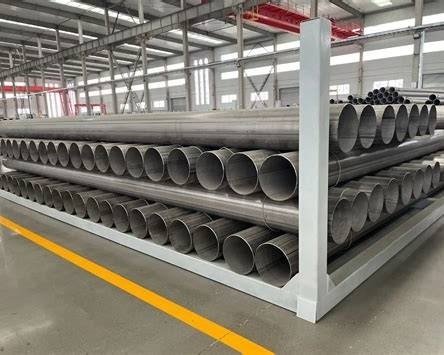
What Is 304 Stainless Steel?
304 stainless steel is one of the most commonly used stainless steel grades for general industrial applications.
It combines good corrosion resistance with excellent formability, weldability and broad availability. Because of this balance, 304 is commonly found in stainless steel pipes, tanks, food processing equipment, architectural components and general industrial fabrication.
Typical applications include:
- Water and utility piping
- Food processing equipment
- Storage tanks
- Architectural structures
- Kitchen equipment
- General industrial pipelines
- Heat exchanger components
For environments without significant chloride exposure or aggressive chemicals, 304 is often the more economical choice.
What Is 316 Stainless Steel?
316 stainless steel belongs to the same austenitic stainless steel family as 304, but its chemistry includes molybdenum.
That relatively small change makes an important difference in corrosive environments.
The molybdenum addition improves resistance to localized corrosion, especially chloride-induced pitting and crevice corrosion. For this reason, 316 is commonly specified for marine environments, coastal installations, brine systems and a range of chemical process applications.
Typical applications include:
- Marine piping
- Coastal equipment
- Chemical processing plants
- Pharmaceutical equipment
- Food processing systems exposed to aggressive cleaning chemicals
- Industrial equipment operating in chloride-containing environments
304 vs 316 Stainless Steel: Chemical Composition
The main difference becomes clear when their alloying elements are compared.
| Element | 304 Stainless Steel | 316 Stainless Steel |
|---|---|---|
| Chromium | Approx. 18–20% | Approx. 16–18% |
| Nickel | Approx. 8–11% | Approx. 10–14% |
| Molybdenum | Normally not added | Approx. 2–3% |
| Main Advantage | General corrosion resistance | Better chloride corrosion resistance |
Composition ranges depend on the applicable product specification, but the key point is simple: 316 contains molybdenum while 304 does not.
This is why the decision between 304 and 316 should not be based only on appearance or initial material cost.
Which Has Better Corrosion Resistance?
Both grades provide good corrosion resistance in normal atmospheric and many industrial environments.
The difference becomes much more noticeable when chloride is present.
Salt water, sea spray, brine and certain industrial process fluids can cause localized corrosion on stainless steel. Instead of uniform rust developing across the entire surface, small pits may form and gradually penetrate the material.
316 has better resistance to this type of attack because of its molybdenum content.
In practical terms:
304 works well in many indoor, freshwater and general industrial environments.
316 is generally a better choice when the material will face salt, coastal exposure or more aggressive chemical conditions.
This does not mean that 316 is completely immune to corrosion. Under sufficiently aggressive chloride concentration, temperature or poorly maintained service conditions, 316 can also suffer corrosion.
That distinction matters when specifying stainless steel for long-term piping systems.

304 vs 316 Stainless Steel Pipe
For stainless steel piping, grade selection depends mainly on the fluid being transported and the external operating environment.
When 304 Stainless Steel Pipe Makes Sense
304 stainless steel pipe is commonly selected for:
- General water service
- Industrial utility lines
- Indoor piping
- Food processing
- Compressed air systems
- Mild chemical environments
Where chloride exposure is limited and the project does not require higher corrosion resistance, 304 can provide a practical balance between performance and cost.
When 316 Stainless Steel Pipe Is Preferred
316 stainless steel pipe becomes more attractive when the system involves:
- Seawater
- Salt spray
- Coastal environments
- Brine
- Chloride-containing process water
- Chemical processing
- More aggressive cleaning media
In these environments, paying more for 316 at the purchasing stage may reduce corrosion-related maintenance and premature replacement later.
Is 316 Stronger Than 304?
This is one of the most common misunderstandings when comparing the two grades.
316 is not simply a “stronger version” of 304.
Their mechanical properties can be similar depending on product form, manufacturing condition and applicable specification. The principal reason for selecting 316 instead of 304 is normally improved corrosion resistance, particularly against chloride-related localized corrosion.
Therefore, if a project requires greater load-bearing or pressure capability, engineers should not simply change from 304 to 316.
Wall thickness, pipe schedule, operating temperature, pressure rating and the applicable design code must also be considered.
What About 304L and 316L?
In stainless steel pipe specifications, buyers frequently encounter:
- 304
- 304L
- 316
- 316L
The “L” means low carbon.
Lower carbon content helps reduce the risk of sensitization around the heat-affected zone during welding. As a result, 304L and 316L are widely specified for welded piping and fabricated equipment where corrosion resistance after welding is important.
For many industrial piping projects, it is therefore more useful to compare 304L with 316L rather than only 304 with 316.
304 vs 316 for Marine Applications
If a stainless steel product will operate near the sea, the material decision deserves particular attention.
Marine and coastal environments continuously expose equipment to chlorides from seawater and airborne salt.
304 may perform adequately in some sheltered or mildly exposed locations, but prolonged chloride exposure increases the risk of staining and localized corrosion.
316 generally provides better resistance and is therefore widely associated with marine and coastal applications.
However, even 316 should not automatically be treated as suitable for every seawater application. Temperature, oxygen availability, flow conditions, chloride concentration, crevices and cleaning practices all affect corrosion performance.
For severe seawater service, higher-alloy stainless steels, duplex stainless steels or other corrosion-resistant alloys may be required.
Is 316 Stainless Steel More Expensive Than 304?
Generally, yes.
316 usually costs more because of its alloy composition, particularly the addition of molybdenum and its generally higher nickel content.
However, the actual price difference changes with:
- Nickel prices
- Molybdenum prices
- Product form
- Pipe size
- Wall thickness
- Quantity
- Market conditions
- Manufacturing method
This means choosing between 304 and 316 purely by price can be misleading.
For an indoor utility line, 316 may add unnecessary material cost.
For a coastal chemical pipeline, using 304 simply because it is cheaper can result in higher maintenance and replacement costs later.
The correct comparison is therefore not simply purchase price, but suitability for the intended service environment.
304 vs 316 Stainless Steel: Quick Comparison
| Item | 304 Stainless Steel | 316 Stainless Steel |
|---|---|---|
| Corrosion resistance | Very good for general service | Better in aggressive environments |
| Chloride resistance | Moderate | Better |
| Molybdenum | No intentional Mo addition | Typically 2–3% |
| Marine use | Limited depending on conditions | More commonly selected |
| General industrial use | Excellent | Excellent |
| Weldability | Good | Good |
| Price | Usually lower | Usually higher |
| Typical choice | General-purpose applications | Chloride, coastal and chemical service |
Which Stainless Steel Should You Choose?
There is no reason to specify 316 everywhere simply because it offers better chloride resistance.
For many ordinary applications, 304 is fully capable of providing long service life and represents the more economical material.
A useful starting point is:
Choose 304 when the service environment is relatively mild and significant chloride exposure is not expected.
Consider 316 when the equipment or piping will be exposed to salt, coastal air, brine, chlorides or more aggressive process conditions.
For critical projects, material selection should also take into account operating temperature, fluid chemistry, concentration, pressure, cleaning method, fabrication requirements and the applicable engineering standard.
Common Stainless Steel Pipe Standards
For industrial pipe procurement, 304/304L and 316/316L are frequently supplied under specifications such as ASTM A312 for seamless and welded austenitic stainless steel pipe. Other standards may apply depending on whether the product is pipe, tube, heat exchanger tubing or structural tubing.
When requesting a quotation, buyers should therefore provide more than simply “304 stainless steel pipe.”
A useful RFQ normally includes:
Material: TP304/304L or TP316/316L
Standard: ASTM A312 or project specification
Outside diameter: OD
Wall thickness / Schedule: SCH
Length: Required length
Manufacturing: Seamless or welded
Surface: Pickled, polished or other requirement
Quantity: Pieces, meters or total weight
Inspection: MTC, PMI, UT or third-party inspection if required
Providing these details from the beginning helps suppliers quote the correct material and reduces unnecessary clarification during procurement.
Final Thoughts
The difference between 304 and 316 stainless steel is easy to summarize but important in practice.
304 is the general-purpose choice. It is widely available, cost-effective and suitable for a large range of industrial applications.
316 is selected when corrosion conditions become more demanding, particularly where chlorides are involved.
For stainless steel pipe buyers, the question should therefore not be simply:
“Is 316 better than 304?”
A more useful question is:
“What environment will this material actually work in?”
Once the service medium, temperature, chloride exposure and fabrication requirements are clear, choosing between 304 and 316 becomes much easier.