
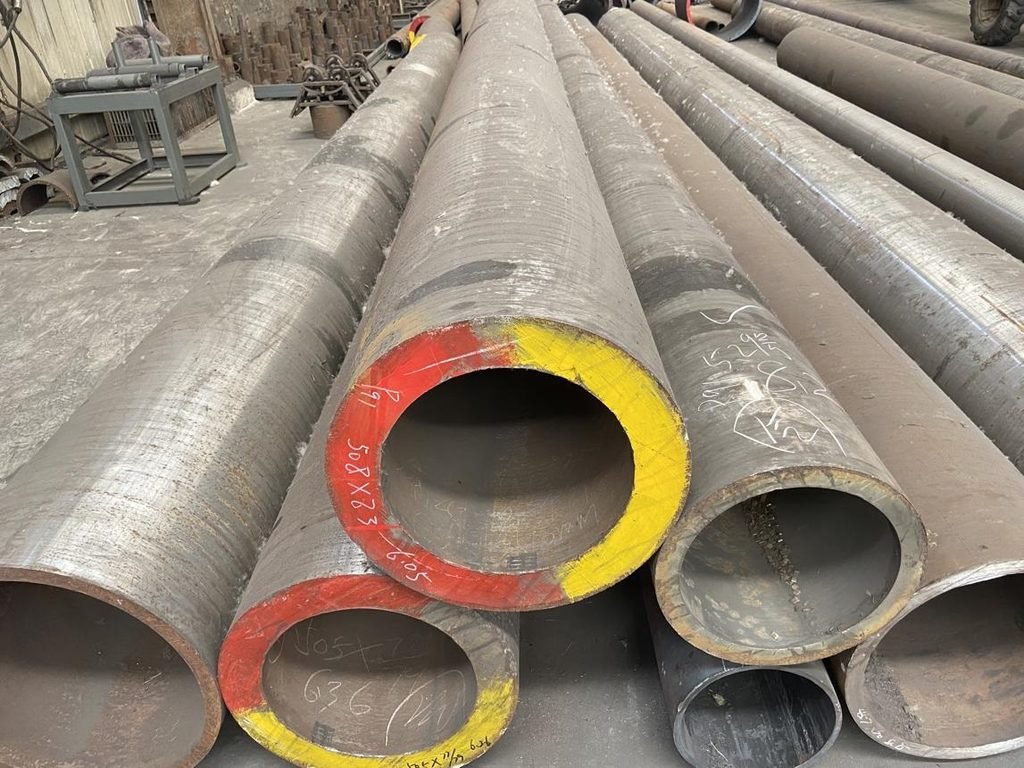
1. What Is ASTM A335 Alloy Steel Pipe?
ASTM A335 is a standard specification covering seamless ferritic alloy-steel pipe intended for high-temperature service.
These pipes are commonly known as chrome-moly steel pipes because chromium (Cr) and molybdenum (Mo) are the principal alloying elements in many of the grades.
Compared with conventional carbon steel pipes, ASTM A335 alloy steel pipes are designed to maintain better mechanical performance under elevated-temperature conditions.
Their main applications include:
- Thermal power plants.
- High-pressure steam pipelines.
- Boiler systems.
- Superheaters and reheaters.
- Oil refineries.
- Petrochemical processing plants.
- Industrial heating systems.
- High-temperature process piping.
Among the different grades covered by ASTM A335, P11, P22 and P91 are particularly important in power generation and high-temperature industrial piping.
Although all three are chromium-molybdenum alloy steels, their chemical compositions, microstructures and performance characteristics are different.
P11 is a relatively low-alloy Cr-Mo steel, P22 contains higher chromium and molybdenum levels, while P91 is a modified 9Cr steel strengthened through vanadium, niobium and controlled heat treatment.
Understanding these differences is essential when selecting materials for high-temperature and high-pressure applications.
2. ASTM A335 P11 vs P22 vs P91: Main Differences
The most important differences between P11, P22 and P91 involve their alloying systems, high-temperature strength, creep resistance and manufacturing requirements.
2.1 ASTM A335 P11 Steel Pipe
ASTM A335 P11 is a 1.25Cr-0.5Mo ferritic alloy steel pipe.
Its chemical composition provides improved high-temperature strength and oxidation resistance compared with conventional carbon steel.
Main characteristics:
- Chromium content: 1.00–1.50%.
- Molybdenum content: 0.44–0.65%.
- Minimum tensile strength: 415 MPa.
- Minimum yield strength: 205 MPa.
- UNS designation: K11597.
Chromium improves oxidation resistance, while molybdenum contributes to high-temperature strength and resistance to creep deformation.
P11 is commonly used in:
- Boiler piping systems.
- Steam pipelines.
- Refinery process piping.
- Heat exchangers.
- Industrial heating equipment.
- Selected superheater and reheater applications.
Its relatively moderate alloy content makes P11 an economical option for applications where its allowable stresses and long-term performance satisfy the design requirements.
2.2 ASTM A335 P22 Steel Pipe
ASTM A335 P22 is a 2.25Cr-1Mo alloy steel pipe.
Compared with P11, it contains higher chromium and molybdenum concentrations.
Main characteristics:
- Chromium content: 1.90–2.60%.
- Molybdenum content: 0.87–1.13%.
- Minimum tensile strength: 415 MPa.
- Minimum yield strength: 205 MPa.
- UNS designation: K21590.
The higher chromium content improves resistance to oxidation and high-temperature scaling.
The increased molybdenum content contributes to high-temperature strength and creep resistance.
Typical applications include:
- Main steam piping.
- High-temperature boiler systems.
- Superheater and reheater piping.
- Petrochemical processing equipment.
- Hydrogen processing systems.
- Refinery process pipelines.
P22 is often considered when P11 does not provide sufficient high-temperature design performance.
However, the final choice must be based on the allowable stress values at the design temperature, not simply on the percentage of chromium and molybdenum.
2.3 ASTM A335 P91 Steel Pipe
ASTM A335 P91 is a modified 9Cr-1Mo-V-Nb ferritic alloy steel pipe.
It contains significantly more chromium than P11 and P22 and uses additional alloying elements to improve high-temperature mechanical performance.
Main characteristics:
- Chromium content: 8.00–9.50%.
- Molybdenum content: 0.85–1.05%.
- Vanadium content: 0.18–0.25%.
- Niobium content: 0.06–0.10%.
- Nitrogen content: controlled according to the specification.
- Minimum tensile strength: 585 MPa.
- Minimum yield strength: 415 MPa.
- UNS designation: K91560.
The most important difference between P91 and conventional Cr-Mo steels is its strengthened tempered martensitic microstructure.
Its performance depends on carefully controlled normalising and tempering.
Vanadium and niobium contribute to the formation of fine strengthening precipitates, which help restrict dislocation movement and improve resistance to creep deformation.
Typical applications include:
- Main steam pipelines.
- Hot reheat steam lines.
- High-pressure headers.
- Supercritical power plants.
- Ultra-supercritical power plants.
- High-temperature industrial piping.
P91 can provide substantially higher high-temperature design strength than P11 and P22.
However, it requires stricter manufacturing, welding, heat treatment and inspection controls.
3. Chemical Composition Comparison of P11, P22 and P91
Chemical composition is one of the main reasons why these three grades exhibit different high-temperature properties.
The following table summarises representative composition requirements for common ASTM A335 grades.
| Chemical Element | P11 (%) | P22 (%) | P91 (%) |
|---|---|---|---|
| Carbon (C) | 0.05–0.15 | 0.05–0.15 | 0.08–0.12 |
| Manganese (Mn) | 0.30–0.60 | 0.30–0.60 | 0.30–0.60 |
| Silicon (Si) | 0.50–1.00 | ≤0.50 | 0.20–0.50 |
| Chromium (Cr) | 1.00–1.50 | 1.90–2.60 | 8.00–9.50 |
| Molybdenum (Mo) | 0.44–0.65 | 0.87–1.13 | 0.85–1.05 |
| Vanadium (V) | Not a specified principal addition | Not a specified principal addition | 0.18–0.25 |
| Niobium (Nb) | Not a specified principal addition | Not a specified principal addition | 0.06–0.10 |
| Nitrogen (N) | Not a specified principal addition | Not a specified principal addition | Controlled addition |
The listed ranges are a technical comparison for common grades. Additional elements, residual limits, heat analysis and product analysis requirements must be checked against the applicable ASTM A335/A335M edition.
3.1 Why Does Chromium Content Matter?
Chromium is an important alloying element in high-temperature steels.
It promotes the formation of protective chromium-rich oxide scales, helping reduce oxidation and high-temperature scaling.
In general:
- P11 contains a relatively low chromium concentration.
- P22 contains approximately twice the chromium concentration of P11.
- P91 contains approximately 9% chromium.
This gives P91 a different oxidation-resistance profile and makes it suitable for more demanding high-temperature environments.
However, chromium content alone does not determine the complete service performance of an alloy.
3.2 Why Is Molybdenum Important?
Molybdenum contributes to high-temperature strength and creep resistance.
Creep is the gradual deformation of a material under sustained stress at elevated temperatures.
Over long operating periods, creep deformation can eventually lead to component failure.
P22 contains more molybdenum than P11, while P91 combines molybdenum with additional strengthening elements.
3.3 Why Does P91 Contain Vanadium and Niobium?
Vanadium and niobium are important microalloying elements in P91.
They contribute to the formation of fine precipitates, including MX-type carbonitrides.
These precipitates help stabilise the microstructure and improve resistance to dislocation movement during high-temperature service.
The result is higher creep strength compared with conventional P11 and P22 steels under suitable design conditions.
4. Mechanical Properties Comparison
Mechanical properties are essential when selecting alloy steel pipes for pressure-bearing applications.
The following table compares the typical minimum tensile requirements for the three grades.
| Mechanical Property | P11 | P22 | P91 |
|---|---|---|---|
| Tensile Strength (MPa) | 415 min. | 415 min. | 585 min. |
| Yield Strength (MPa) | 205 min. | 205 min. | 415 min. |
| Tensile Strength (ksi) | 60 min. | 60 min. | 85 min. |
| Yield Strength (ksi) | 30 min. | 30 min. | 60 min. |
| Hardness | As specified | As specified | Specific hardness limits apply |
These are room-temperature specification requirements, not high-temperature allowable stress values.
4.1 Tensile Strength
P11 and P22 have the same commonly specified minimum tensile strength of 415 MPa.
P91 has a higher minimum tensile strength of 585 MPa.
This reflects the stronger alloy design and heat-treated microstructure of P91.
4.2 Yield Strength
P11 and P22 commonly have a minimum yield strength of 205 MPa.
P91 has a minimum yield strength of 415 MPa.
The higher yield strength can provide advantages in pressure piping design, although actual wall thickness must still be calculated using the applicable design code.
4.3 Creep Resistance
Creep resistance is particularly important in high-temperature steam systems.
When steel operates under sustained stress at elevated temperatures, its microstructure gradually changes and deformation accumulates.
P91 is specifically designed to provide enhanced creep strength through its tempered martensitic structure and controlled precipitation strengthening.
P22 offers improved high-temperature performance over many conventional carbon and lower-alloy steels, while P11 is used in less demanding high-temperature conditions where its design properties are sufficient.
Actual creep performance depends on temperature, stress, exposure time, material condition and fabrication quality.
5. Heat Treatment Requirements for P11, P22 and P91
Heat treatment is essential to obtaining the required microstructure and mechanical properties of ASTM A335 alloy steel pipes.
Different grades require different heat treatment routes.
5.1 P11 Heat Treatment
P11 may be supplied following heat treatment routes permitted by the applicable ASTM specification.
These include:
- Full annealing.
- Isothermal annealing.
- Normalising and tempering.
The selected route affects the final microstructure, hardness and mechanical properties.
Proper heat treatment helps establish consistent material performance and prepares the pipe for subsequent fabrication.
5.2 P22 Heat Treatment
P22 also requires heat treatment in accordance with the product specification.
Common permitted routes include:
- Full annealing.
- Isothermal annealing.
- Normalising and tempering.
Compared with P11, P22 has different transformation and tempering characteristics because of its higher chromium and molybdenum content.
Heat treatment must be performed within the specified temperature range to obtain the required material condition.
5.3 P91 Heat Treatment
P91 requires particularly careful heat treatment.
Its high-temperature strength depends on a properly developed tempered martensitic microstructure.
A common ASTM A335 heat treatment route involves:
Normalising:
Approximately 1040–1080°C.
Tempering:
Approximately 730–800°C.
The exact requirements depend on the applicable standard edition and material type.
Insufficient normalising or tempering can result in an unsuitable microstructure, excessive hardness or reduced long-term creep performance.
Over-tempering can also reduce the strength required for the intended application.
For this reason, temperature uniformity, holding time, cooling conditions and furnace calibration are important manufacturing controls.
6. Welding Differences Between P11, P22 and P91
Welding is another major consideration when comparing these three alloy steel grades.
Although all three can be welded using qualified procedures, their welding requirements are not identical.
6.1 Welding P11
P11 generally requires controlled preheating and appropriate post-weld heat treatment where specified by the governing construction code.
Important considerations include:
- Qualified welding procedures.
- Suitable Cr-Mo filler metals.
- Controlled heat input.
- Preheat temperature.
- Interpass temperature.
- PWHT where required.
6.2 Welding P22
P22 requires similar controls, but its higher alloy content must be considered when selecting welding consumables and procedures.
Welders and engineers should pay attention to:
- Hydrogen control.
- Preheat and interpass temperature.
- Weld metal composition.
- Cooling rate.
- Post-weld heat treatment.
- Hardness and inspection requirements.
6.3 Welding P91
P91 is significantly more demanding to weld.
Its properties depend on a carefully controlled tempered martensitic microstructure.
Incorrect welding and heat treatment may cause:
- Excessive hardness.
- Hydrogen-assisted cracking.
- Unfavourable weld and heat-affected zone microstructures.
- Reduced creep strength.
- Premature long-term joint degradation.
Important controls include:
- Qualified welding procedure specifications.
- Low-hydrogen welding consumables and handling.
- Controlled preheat temperature.
- Strict interpass temperature control.
- Controlled cooling after welding.
- Appropriate post-weld heat treatment.
- Hardness testing where specified.
- Suitable weld inspection and documentation.
P91 welding should be managed by personnel experienced with creep-strength-enhanced ferritic steels.
PWHT temperature and holding time must follow the qualified procedure and governing code. They should not be selected using a generic temperature range alone.
7. Typical Applications of P11, P22 and P91 Steel Pipes
The three grades are widely used in power generation, petrochemical processing and high-temperature industrial piping.
However, their selection depends on the actual design conditions.
7.1 P11 Applications
P11 is commonly used in:
- Industrial boiler piping.
- Steam distribution lines.
- Refinery process piping.
- Heat exchangers.
- Selected superheater and reheater systems.
- Industrial heating equipment.
It is suitable where its allowable stress, oxidation resistance and creep properties meet the engineering requirements.
7.2 P22 Applications
P22 is commonly considered for:
- Main steam systems.
- High-temperature headers.
- Boiler piping.
- Superheater and reheater systems.
- Refinery process lines.
- Hydrogen processing equipment.
Its higher chromium and molybdenum content makes it useful for applications requiring improved high-temperature performance.
7.3 P91 Applications
P91 is frequently used in more demanding power generation systems.
Typical applications include:
- Main steam pipelines.
- Hot reheat pipelines.
- High-temperature headers.
- Supercritical power plants.
- Ultra-supercritical power plants.
- High-pressure steam systems.
Its higher creep strength can help reduce required wall thickness in certain designs, potentially reducing component weight.
However, this benefit must be confirmed by detailed pressure design calculations.
8. P11 vs P22 vs P91: How to Choose the Right Grade?
There is no universally best grade among P11, P22 and P91.
The correct material depends on the operating temperature, pressure, design life, allowable stress, oxidation conditions and fabrication requirements.
8.1 When to Choose P11
P11 may be suitable when:
- The design temperature and pressure are within its allowable limits.
- Its creep strength satisfies the required service life.
- The project requires a cost-effective Cr-Mo alloy steel.
- Its oxidation resistance is sufficient for the process environment.
8.2 When to Choose P22
P22 may be appropriate when:
- Higher chromium and molybdenum content is beneficial.
- The design requires improved high-temperature performance over P11.
- The allowable stress at the operating temperature supports the required wall thickness.
- The project involves demanding steam or refinery service.
8.3 When to Choose P91
P91 may be selected when:
- High-temperature creep strength is a major design requirement.
- High-pressure steam service requires greater allowable stress.
- Reduced wall thickness or component weight is beneficial.
- The manufacturer and fabricator can meet the required P91 processing and welding controls.
P91 should not be selected solely because it has the highest room-temperature yield strength.
Its total lifecycle cost should include manufacturing, welding, heat treatment, inspection and maintenance requirements.
9. ASTM A335 vs ASME SA335: What Is the Difference?
ASTM A335 and ASME SA335 are closely related specifications for seamless ferritic alloy steel pipe intended for high-temperature service.
ASTM A335 is published by ASTM International.
ASME SA335 is included in the ASME Boiler and Pressure Vessel Code material specifications.
The two are commonly referenced together in industrial projects, but their applicable editions and code requirements should be checked.
When preparing a purchase specification, confirm:
- Required standard and edition.
- Exact material grade.
- Pipe dimensions.
- Manufacturing method.
- Heat treatment condition.
- Inspection requirements.
- Supplementary requirements.
- Material certification.
A purchase order should clearly identify whether ASTM A335, ASME SA335 or both are required.
10. Related Standards for P11, P22 and P91 Pipes, Fittings and Flanges
A complete high-temperature piping system requires compatible pipes, fittings and flanges.
The following specifications are commonly encountered.
| Product | Common Standard | Matching Grade |
|---|---|---|
| Seamless Alloy Steel Pipe | ASTM A335 / ASME SA335 | P11 / P22 / P91 |
| Alloy Steel Butt-Welding Fittings | ASTM A234 / ASME SA234 | WP11 / WP22 / WP91 |
| Alloy Steel Forgings and Flanges | ASTM A182 / ASME SA182 | F11 / F22 / F91 |
| Boiler and Superheater Tubes | ASTM A213 / ASME SA213 | T11 / T22 / T91 |
An important distinction is that P11, P22 and P91 are pipe grades, while T11, T22 and T91 are commonly associated with boiler and superheater tube specifications.
They should not be used interchangeably simply because their alloy systems are related.
The complete piping material selection must consider pressure-temperature ratings, mechanical properties, welding compatibility and applicable code requirements.
11. Common Quality Inspection Requirements for ASTM A335 Pipes
Quality inspection is essential for ensuring that P11, P22 and P91 pipes meet the specified requirements.
Typical inspection activities include:
11.1 Chemical Composition Analysis
Verify the chemical composition against the specified grade.
For P91, particular attention should be paid to chromium, molybdenum, vanadium, niobium and nitrogen requirements.
11.2 Mechanical Testing
Common tests include:
- Tensile testing.
- Yield strength verification.
- Elongation testing.
- Hardness testing.
- Other specified mechanical tests.
11.3 Heat Treatment Records
Review the heat treatment process and records.
For P91, the normalising and tempering history is particularly important.
11.4 Non-Destructive Testing
Depending on the product specification and purchase requirements, inspection may include ultrasonic testing and other applicable examination methods.
11.5 Hydrostatic Testing
Hydrostatic testing is performed where required by the applicable product specification or purchase order.
11.6 Material Traceability
Each pipe should be traceable to its heat number and corresponding material test certificate.
The MTC should provide the required chemical and mechanical test results and identify the applicable specification and grade.
12. Frequently Asked Questions About ASTM A335 P11, P22 and P91
What is the main difference between ASTM A335 P11 and P22?
P11 contains approximately 1.25% chromium and 0.5% molybdenum, while P22 contains approximately 2.25% chromium and 1% molybdenum. P22 generally offers improved high-temperature performance and oxidation resistance.
Is P91 stronger than P22?
Yes. P91 has higher specified minimum room-temperature tensile and yield strengths. It also offers enhanced creep strength under suitable high-temperature conditions.
What is the chemical composition of P91 steel?
P91 is a modified 9Cr-1Mo alloy steel containing chromium, molybdenum, vanadium, niobium and controlled nitrogen additions.
Why does P91 require special heat treatment?
P91 relies on a tempered martensitic microstructure for its mechanical and creep properties. Incorrect normalising or tempering can reduce its strength and long-term performance.
Is ASTM A335 P91 suitable for ultra-supercritical power plants?
P91 is commonly used in supercritical and ultra-supercritical power plant piping systems. Its actual suitability depends on design temperature, pressure, allowable stress and the relevant engineering code.
Can P11 be replaced by P22?
Not automatically. A substitution requires engineering review of the allowable stress, wall thickness, material compatibility, welding procedure, heat treatment and applicable code requirements.
Can P22 be replaced by P91?
P91 may provide higher strength, but it also has different fabrication and welding requirements. Material substitution requires formal design approval.
What is the difference between ASTM A335 P91 and ASTM A213 T91?
P91 is a seamless alloy steel pipe grade covered by ASTM A335, while T91 is a boiler, superheater and heat exchanger tube grade covered by ASTM A213. Their alloy systems are related, but their product specifications and dimensional requirements differ.
What are the matching fittings and flanges for P91?
Common matching material grades include ASTM A234 WP91 fittings and ASTM A182 F91 forgings and flanges. Final compatibility must be checked against the piping design specification.
Is P91 more expensive than P11 and P22?
P91 generally has a higher material cost due to its more complex alloy design and processing requirements. However, total project cost should also consider wall thickness, fabrication, heat treatment, inspection and lifecycle requirements.
13. Conclusion
ASTM A335 P11, P22 and P91 are three important chromium-molybdenum alloy steel pipe grades used in high-temperature industrial applications.
P11 provides a cost-effective combination of high-temperature strength and oxidation resistance. P22 offers higher chromium and molybdenum content for more demanding service conditions. P91 provides substantially higher strength and creep resistance through its modified alloy composition and tempered martensitic microstructure.
The correct grade should be selected based on allowable stress, operating temperature, pressure, design life, fabrication requirements and applicable engineering codes.
For buyers, specifying the correct ASTM or ASME standard, material grade, dimensions, heat treatment condition, inspection requirements and material certification is essential.
Looking for ASTM A335 P11, P22 or P91 Seamless Alloy Steel Pipes?
Provide your required grade, outside diameter, wall thickness, length, quantity and applicable standard to receive a technical and commercial quotation for your high-temperature piping project.