
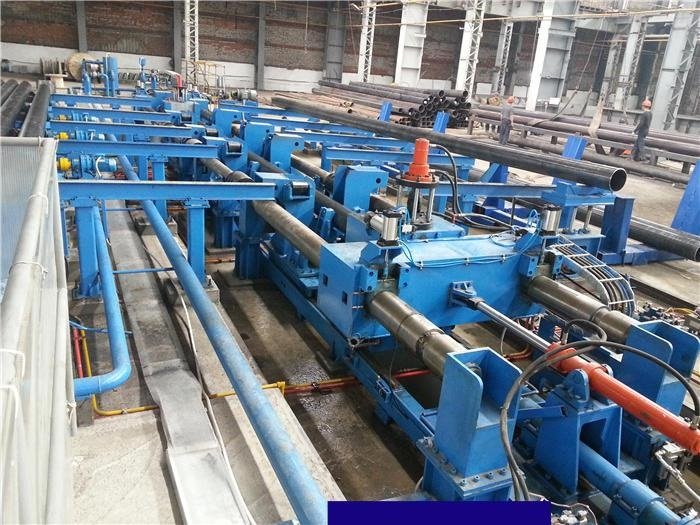
1. What Is Hydrostatic Testing of Steel Pipes?
Hydrostatic testing is a pressure test that uses water or another approved liquid to evaluate the pressure integrity of a steel pipe.
It is widely used during steel pipe manufacturing and pipeline construction to identify leakage and verify that the product or piping system can withstand the specified test pressure.
During the test, the pipe is filled with water, trapped air is removed, and internal pressure is gradually increased to the required level. The pressure is maintained for a specified period, while the pipe is monitored for leakage, abnormal deformation and other signs of failure.
Hydrostatic testing is commonly required for:
- Seamless steel pipes.
- ERW steel pipes.
- LSAW steel pipes.
- SSAW steel pipes.
- Carbon steel pipes.
- Alloy steel pipes.
- Stainless steel pipes.
- Oil and gas line pipes.
- Pressure-bearing industrial piping.
For steel pipe manufacturers, hydrostatic testing is an important part of final product inspection.
For engineering contractors, it is also used to verify the integrity of an installed piping system before commissioning.
It is important to distinguish between these two applications because their test pressures, holding periods and acceptance requirements may be governed by different standards.
2. Why Is Hydrostatic Testing Important for Steel Pipes?
Steel pipes are widely used to transport fluids and gases under pressure.
Even when a pipe meets the required chemical composition and mechanical properties, manufacturing defects or welding problems may affect its pressure integrity.
Hydrostatic testing provides an additional verification step.
2.1 Detect Leakage
The primary purpose of a hydrostatic test is to identify leakage through the pipe body, weld seam or test connections under the specified test conditions.
Potential problems include:
- Through-wall defects.
- Weld seam leakage.
- Inadequate weld integrity.
- Leakage at pipe ends or sealing arrangements.
- Defects affecting pressure containment.
2.2 Verify Pressure Integrity
The test verifies that the pipe can withstand the required internal pressure without unacceptable leakage or failure.
It does not establish the complete service life of the pipe or guarantee that all internal defects have been detected.
Other inspection methods, including ultrasonic testing, radiographic testing and dimensional inspection, may also be required.
2.3 Support Quality Control
Hydrostatic testing is an important part of a manufacturer’s inspection and test plan (ITP).
It helps establish that the finished product has passed the required pressure test before shipment.
For high-value industrial projects, the test records can also support customer inspection and product acceptance.
2.4 Reduce the Risk of Field Leakage
A pipe that fails a required mill hydrostatic test should not be accepted as a conforming product.
Verifying pressure integrity before installation helps reduce the risk of discovering leakage during later construction or commissioning activities.
3. Main Types of Steel Pipe Hydrostatic Testing
Hydrostatic testing can be divided into two main categories according to where and why the test is performed.
3.1 Mill Hydrostatic Testing
Mill hydrostatic testing is performed at the steel pipe manufacturing facility.
It is generally conducted on individual pipe lengths using an industrial hydrostatic testing machine.
The typical process includes:
- Positioning the pipe in the testing machine.
- Sealing both ends.
- Filling the pipe with water.
- Removing trapped air.
- Increasing internal pressure to the specified test pressure.
- Maintaining the pressure for the required duration.
- Checking for leakage.
- Releasing the pressure and draining the water.
- Recording the test results.
The test requirements depend on the applicable product standard.
For example, API 5L specifies hydrostatic testing for each length of line pipe, while ASTM pipe specifications may refer to general requirements such as ASTM A530 or ASTM A999.
3.2 Field Hydrostatic Testing
Field hydrostatic testing is performed after the piping system has been fabricated or installed.
Unlike mill testing, it evaluates the assembled system rather than an individual pipe length.
The test may include:
- Pipes.
- Welded joints.
- Flanges.
- Fittings.
- Valves.
- Other pressure-containing components.
The test pressure is determined by the applicable piping code, design pressure, material allowable stresses and the rating of the weakest component.
For example, ASME B31.3 contains specific requirements for hydrostatic leak testing of process piping.
A field test should therefore not simply use the mill test pressure of the individual pipe.
4. ASTM and API Standards for Steel Pipe Hydrostatic Testing
Different steel pipe products follow different material and product specifications.
The applicable standard should always be identified before determining the test pressure and acceptance requirements.
4.1 ASTM A530/A530M
ASTM A530/A530M covers general requirements for specialised carbon and alloy steel pipes.
It includes requirements relating to:
- Mechanical testing.
- Tensile testing.
- Flattening testing.
- Hydrostatic testing.
- Ultrasonic testing.
- Other applicable inspection requirements.
For products covered by ASTM A530, the relevant product specification determines which general requirements apply.
If the product specification defines different hydrostatic test requirements, those specific requirements take precedence.
4.2 ASTM A999/A999M
ASTM A999/A999M covers general requirements for alloy and stainless steel pipe.
It includes provisions for hydrostatic testing and other inspection requirements.
The hydrostatic test pressure is related to the specified pipe dimensions and material strength.
For applicable ferritic alloy steel and stainless steel pipes, the standard provides a calculation method based on producing a specified percentage of the minimum yield strength in the pipe wall.
The exact requirements and applicable exceptions should be checked against the specified edition.
4.3 API 5L
API Specification 5L covers line pipe used in pipeline transportation systems.
Hydrostatic testing is an important inspection requirement for API 5L pipes.
The requirements include:
- Test pressure.
- Minimum holding time.
- Test equipment.
- Pressure verification.
- Recording and traceability.
- Product-specific acceptance requirements.
API 5L requires each length of pipe to withstand the specified inspection hydrostatic test without leakage.
For the applicable requirements, pressure and holding time depend on pipe dimensions, product type and the selected API 5L edition.
4.4 ASTM A53/A53M
ASTM A53/A53M covers black and hot-dipped zinc-coated welded and seamless steel pipe.
Its hydrostatic test requirements specify that the pipe must withstand the applicable test pressure without leakage through the weld seam or pipe body.
The standard provides different test pressure tables for different pipe conditions.
It also establishes maximum pressure caps for specified size ranges.
An important point is that ASTM A53 hydrostatic inspection pressures are not design or working pressures.
4.5 ASTM A106/A106M
ASTM A106/A106M covers seamless carbon steel pipe for high-temperature service.
Hydrostatic testing requirements are applied in conjunction with the relevant general requirements and product specification provisions.
Buyers should check the applicable ASTM edition and purchase requirements rather than assuming that all ASTM A106 pipe sizes have the same test pressure.
4.6 ASTM A335/A335M
ASTM A335/A335M covers seamless ferritic alloy steel pipe for high-temperature service.
Common grades include:
- P11.
- P22.
- P5.
- P9.
- P91.
Hydrostatic testing is part of the applicable product inspection requirements.
For alloy steel pipes, the specified material grade, dimensions, heat treatment and relevant general requirements must all be considered.
5. How to Calculate Steel Pipe Hydrostatic Test Pressure
The hydrostatic test pressure is not a universal value.
It depends on the product standard, pipe dimensions, material strength and applicable testing requirements.
Two commonly encountered calculation approaches are the pipe-wall stress equation and the piping system design-pressure equation.
5.1 Pipe Wall Stress Equation
For applicable product specifications, hydrostatic test pressure may be calculated using:
P = 2St / D
Where:
- P = Hydrostatic test pressure.
- S = Required pipe wall stress during the test.
- t = Specified wall thickness.
- D = Specified outside diameter.
The equation is based on the thin-wall circumferential stress relationship.
The exact definitions of thickness, diameter and required stress must follow the applicable product specification.
For example, ASTM A999/A999M includes a hydrostatic pressure calculation based on the required pipe wall stress.
The applicable stress percentage differs according to the material category.
This formula should not be applied indiscriminately to every steel pipe standard.
5.2 Hydrostatic Test Pressure for Process Piping
For metallic process piping covered by ASME B31.3, the general hydrostatic test pressure requirement is based on design pressure.
The basic relationship is:
PT ≥ 1.5 × P × (ST / S)
Where:
- PT = Minimum hydrostatic test pressure.
- P = Internal design gauge pressure.
- ST = Allowable stress at test temperature.
- S = Allowable stress at design temperature.
The stress ratio is applied when the design temperature is above the test temperature, subject to the applicable code provisions.
The code also includes limitations to prevent the test pressure from producing excessive stress or exceeding component pressure ratings.
5.3 Example of Hydrostatic Test Pressure Calculation
Assume an industrial process piping system has the following conditions:
- Design pressure: 10 MPa.
- Allowable stress at design temperature: 120 MPa.
- Allowable stress at test temperature: 150 MPa.
Using the ASME B31.3 general relationship:
PT = 1.5 × 10 × (150 / 120)
PT = 18.75 MPa
Therefore, the calculated minimum test pressure is 18.75 MPa before checking the applicable code limitations and component ratings.
Important: This is an illustrative calculation for a process piping system. It is not a universal mill hydrostatic test pressure for ASTM A53, A106, A335 or API 5L steel pipes.
6. How Long Should a Steel Pipe Hydrostatic Test Be Held?
The required holding time depends on the applicable product specification or piping code.
There is no single holding period that applies to all steel pipes.
6.1 API 5L Holding Time
API 5L distinguishes between different pipe types and sizes.
Under the referenced API 5L requirements:
- Seamless pipe and welded pipe in sizes NPS 18 and smaller: at least 5 seconds.
- Welded pipe in sizes NPS 20 and larger: at least 10 seconds.
The applicable edition and product requirements must be verified before applying these values.
6.2 ASTM Product Standards
ASTM product specifications may refer to general requirements or define their own hydrostatic test parameters.
The required holding time should be checked in the relevant standard and purchase specification.
It should not be replaced with an arbitrary 5-minute or 10-minute rule.
6.3 ASME B31.3 Field Testing
For process piping, ASME B31.3 requires the leak test pressure to be maintained for at least 10 minutes, followed by examination of joints and connections for leakage.
The test pressure may be reduced to not less than the design pressure during the subsequent examination, as permitted by the code.
This is a field piping system leak-test requirement, not the same as a mill test of each individual pipe.
7. Steel Pipe Hydrostatic Testing Procedure
A properly controlled hydrostatic test involves several stages.
Step 1: Inspect the Pipe Before Testing
Before testing, confirm:
- Pipe identification.
- Material grade.
- Outside diameter.
- Wall thickness.
- Pipe length.
- Surface condition.
- End preparation.
- Applicable inspection requirements.
The pipe should be free from conditions that would prevent proper sealing or testing.
Step 2: Install the Pipe in the Testing Machine
The pipe is positioned between the machine’s sealing heads.
The end-sealing system must be suitable for the pipe diameter and required test pressure.
The pipe should be properly supported to prevent movement during pressurisation.
Step 3: Fill the Pipe with Water
The pipe is filled with the specified test medium.
Air trapped inside the pipe must be removed through suitable venting arrangements.
Removing trapped air is important because compressed air stores significantly more energy than water and increases the hazards associated with pressure testing.
Step 4: Increase the Pressure Gradually
The pressure should be increased in a controlled manner.
The operator should monitor:
- Pressure gauge readings.
- Pump operation.
- End sealing.
- Pipe movement.
- Abnormal deformation.
- Leakage around connections.
The target pressure must be based on the applicable product standard or approved test procedure.
Step 5: Maintain the Required Test Pressure
Once the specified pressure is reached, it is maintained for the required holding time.
The pressure recorder or data acquisition system should capture the relevant test information.
Step 6: Inspect for Leakage
The pipe is examined for:
- Leakage through the pipe body.
- Leakage through the weld seam.
- Leakage at the end seals.
- Abnormal deformation.
- Visible cracking or other signs of failure.
Test equipment leakage should be distinguished from leakage through the actual pipe.
Step 7: Release Pressure and Drain Water
After the test is completed, pressure must be released in a controlled manner.
The pipe is drained and dried where required by the product specification, service conditions or purchaser requirements.
For stainless steel pipes, water quality and chloride contamination should be considered to prevent corrosion or surface contamination.
Step 8: Record the Test Results
The test record should include the information required by the applicable standard and quality system.
Typical information includes:
- Pipe number.
- Heat number.
- Material grade.
- Pipe dimensions.
- Test date.
- Applied pressure.
- Holding time.
- Test result.
- Equipment identification.
- Pressure gauge calibration status.
- Operator or inspector identification.
8. Hydrostatic Test Acceptance Criteria for Steel Pipes
Acceptance criteria depend on the product standard and whether the test is performed at the manufacturing mill or on an installed piping system.
For mill testing, the most important requirement is that the pipe withstands the specified test pressure without leakage.
8.1 No Visible Leakage
The pipe should not show unacceptable leakage through the pipe body or weld seam during the required test.
For API 5L and ASTM A53, the relevant hydrostatic test requirements explicitly address leakage.
8.2 No Failure During Testing
The pipe must withstand the required test conditions without rupture or other unacceptable failure.
Any failure requires investigation and disposition according to the applicable quality procedures and product standard.
8.3 Pressure and Holding Time Must Meet Requirements
The actual test pressure must reach the specified value and remain applied for the required duration.
A test that does not reach the specified pressure or complete the required holding period cannot be treated as a valid passing test.
8.4 Test Records Must Be Available
For standards requiring pressure recording, the manufacturer must maintain records that demonstrate compliance.
API 5L includes provisions for verifying hydrostatic test pressure and duration for individual pipe lengths.
8.5 Dimensional and Material Requirements Must Also Be Satisfied
Passing the hydrostatic test does not automatically mean the entire product is acceptable.
The pipe must also meet other applicable requirements, including:
- Chemical composition.
- Tensile properties.
- Impact properties, where required.
- Wall thickness.
- Outside diameter.
- Straightness.
- Surface quality.
- NDT requirements.
- Marking and traceability.
A hydrostatic test is one part of the complete product inspection process.
9. Common Problems During Steel Pipe Hydrostatic Testing
Several issues may occur during the testing process.
9.1 Pressure Drops During the Holding Period
Possible causes include:
- Leakage from the pipe.
- Leakage from end seals.
- Pump or valve leakage.
- Inadequate sealing.
- Temperature changes.
- Instrument measurement errors.
- Trapped air or incomplete filling.
A pressure drop does not automatically prove that the pipe body is defective.
The testing system should first be checked to identify the actual source.
9.2 Leakage at Pipe Ends
End leakage may result from:
- Incorrect sealing head selection.
- Damaged sealing elements.
- Poor end preparation.
- Incorrect clamping.
- Improper alignment.
The sealing arrangement should be checked before concluding that the pipe has failed.
9.3 Leakage Through the Weld Seam
For welded steel pipes, leakage through the weld seam may indicate problems with weld integrity.
The affected pipe should be identified, isolated and handled according to the applicable repair and rejection procedures.
9.4 Pipe Deformation
Excessive deformation may indicate that the test pressure or loading conditions have exceeded the permitted limits.
Testing equipment, pipe dimensions, material properties and the specified pressure should be reviewed.
9.5 Inaccurate Pressure Readings
Uncalibrated pressure gauges or unstable recording systems can result in unreliable test records.
Pressure measurement equipment should be calibrated at the required intervals and have a suitable measuring range and accuracy.
10. Hydrostatic Testing vs Pneumatic Testing
Hydrostatic and pneumatic tests are both used to verify pressure integrity, but they use different test media and have different safety characteristics.
| Comparison | Hydrostatic Testing | Pneumatic Testing |
|---|---|---|
| Test Medium | Water or approved liquid | Air, nitrogen or another approved gas |
| Stored Energy | Relatively low | Significantly higher |
| Main Purpose | Pressure integrity and leakage testing | Pressure integrity and leakage testing |
| Safety Risk | Lower stored-energy hazard, but still dangerous | Higher stored-energy hazard |
| Typical Applications | Steel pipes and pressure piping | Systems where liquid testing is unsuitable |
| Leakage Detection | Visual examination and specified methods | Approved gas leak detection methods |
| Preparation | Filling and air removal | Gas supply and controlled pressurisation |
Hydrostatic testing is generally preferred when a suitable liquid can be used.
Pneumatic testing may be considered when water would damage the system, contaminate the process or create other unacceptable problems.
However, pneumatic testing requires additional safety precautions because compressed gas stores much more energy.
The choice of test method must follow the applicable engineering code and approved test procedure.
11. Safety Requirements During Hydrostatic Testing
Hydrostatic testing involves high pressure and can cause serious injuries if equipment or test procedures fail.
Important safety controls include:
11.1 Remove Trapped Air
Air should be removed before pressurisation wherever practicable.
11.2 Check End Seals and Connections
All pressure-containing fittings, hoses, closures and connections should be rated for the test conditions.
11.3 Use Calibrated Pressure Gauges
Pressure gauges and recording instruments should have suitable ranges and current calibration records.
11.4 Establish an Exclusion Zone
Personnel should remain clear of the pressure-test area during pressurisation.
Suitable barriers and warning signs should be installed.
11.5 Prevent Overpressure
Pressure relief devices and controlled pumping procedures should be provided where required.
The pressure must not exceed the permissible limit of the pipe or any component in the test assembly.
11.6 Consider Test Water Temperature
Water and pipe metal temperatures should be suitable for the test.
Low test temperatures can increase brittle-fracture risk in susceptible materials.
11.7 Depressurise Before Disconnecting
All pressure must be released before removing end closures, hoses or connections.
Never attempt to loosen a pressure-containing connection while the system remains pressurised.
12. What Should Buyers Check When Purchasing Steel Pipes?
For international steel pipe buyers, hydrostatic testing is an important part of supplier evaluation.
Before placing an order, consider checking the following:
1. Applicable Product Standard
Confirm whether the pipes must comply with ASTM A53, ASTM A106, ASTM A335, API 5L or another applicable specification.
2. Hydrostatic Test Requirements
Confirm the required test pressure, holding time and any supplementary requirements.
3. Test Equipment
Ask whether the manufacturer has suitable hydrostatic testing equipment for the required pipe dimensions and pressure.
4. Test Records
Request relevant hydrostatic test records and confirm that the records can be linked to the supplied pipes.
5. Pressure Gauge Calibration
Check that pressure measurement equipment is properly calibrated.
6. Material Traceability
Ensure that pipe markings and heat numbers correspond to the relevant material certificates.
7. Third-Party Inspection
For critical projects, consider specifying third-party inspection and witnessing before shipment.
8. Inspection and Test Plan
The purchase order should clearly define inspection stages, acceptance criteria and documentation requirements.
13. Frequently Asked Questions About Steel Pipe Hydrostatic Testing
What is the purpose of a hydrostatic test on steel pipes?
It verifies pressure integrity under specified test conditions and checks for leakage through the pipe body, weld seam or other relevant areas.
Which ASTM standard covers steel pipe hydrostatic testing?
There is no single ASTM standard covering every steel pipe. ASTM A530/A530M and ASTM A999/A999M provide general requirements for different categories of pipe, while product specifications such as ASTM A53, A106 and A335 must also be considered.
What is the standard hydrostatic test pressure for steel pipes?
There is no universal test pressure. It depends on the applicable product standard, pipe dimensions, material strength and test requirements.
How long should steel pipes be hydrostatically tested?
The required duration depends on the product specification. For example, the referenced API 5L requirements specify at least 5 seconds for seamless pipes and welded pipes up to NPS 18, and at least 10 seconds for welded pipes NPS 20 and larger. ASME B31.3 has a separate minimum 10-minute requirement for its process piping leak test.
What is the acceptance criterion for hydrostatic testing?
For mill hydrostatic testing, the pipe must withstand the specified pressure and duration without unacceptable leakage or failure. Field piping systems must meet the applicable code’s leak-test and examination requirements.
Does a pressure drop mean the steel pipe has failed?
Not necessarily. Pressure loss can result from test equipment leakage, end-seal problems, temperature variation, trapped air or instrument errors. The cause must be investigated before determining whether the pipe has failed.
Is hydrostatic testing mandatory for all steel pipes?
The requirement depends on the applicable product standard and purchase specification. Many pressure-bearing steel pipe standards include hydrostatic testing requirements, while certain standards permit specified alternative examinations or arrangements.
Can ultrasonic testing replace hydrostatic testing?
Not automatically. UT and hydrostatic testing serve different purposes. Alternative examination methods are only acceptable when permitted by the applicable product specification and purchase requirements.
What documents should a manufacturer provide after hydrostatic testing?
Typical records include pipe identification, heat number, test pressure, holding time, test date, test result and relevant equipment calibration records. The exact documentation depends on the applicable standard and purchase order.
Is hydrostatic testing the same as a burst test?
No. Hydrostatic testing normally uses a specified inspection pressure to verify pressure integrity. A burst test deliberately increases pressure until failure to determine the failure pressure or assess material performance.
14. Conclusion
Hydrostatic testing is an essential inspection method for many steel pipes used in pressure-bearing applications.
It helps verify that the pipe can withstand the specified internal pressure without unacceptable leakage or failure.
However, the correct test pressure, holding time and acceptance criteria depend on the applicable product specification or piping code.
ASTM A530/A530M and ASTM A999/A999M provide general requirements for different categories of steel pipes, while API 5L, ASTM A53, ASTM A106 and ASTM A335 contain product-specific requirements.
For industrial buyers, it is important to verify not only whether hydrostatic testing has been performed, but also whether the test was conducted in accordance with the correct standard and whether the results are properly documented and traceable.
Looking for Steel Pipes with Hydrostatic Testing and Quality Inspection Records?
Whether you require seamless, ERW, LSAW or SSAW steel pipes, specify your material grade, pipe dimensions, applicable standard, test requirements and quantity.
Request the relevant material test certificates, hydrostatic test records and inspection documentation before shipment.