
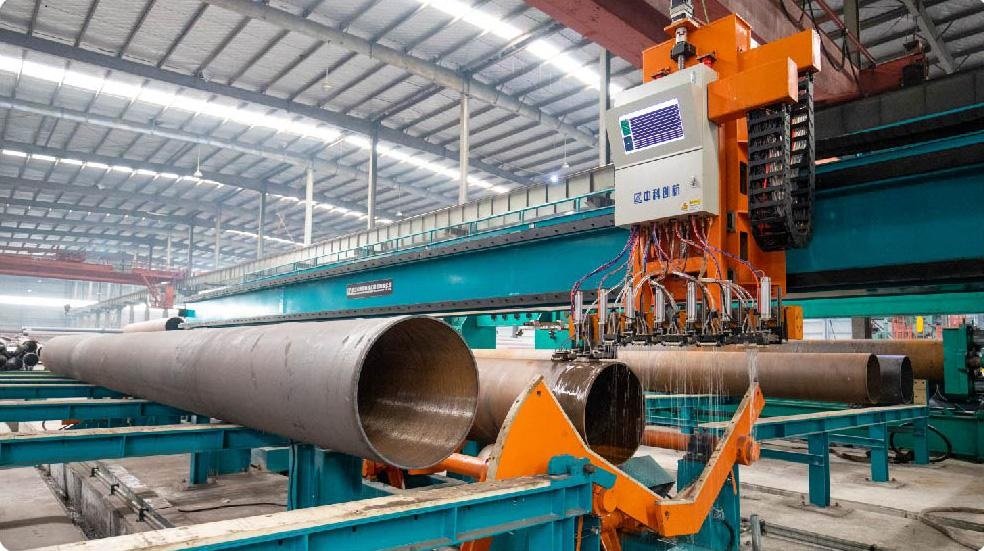
1. Why Is Choosing the Right Steel Pipe Manufacturer Important?
Choosing a steel pipe manufacturer is not simply a matter of comparing prices. The supplier must be able to deliver products that meet the required material specifications, dimensional tolerances, mechanical properties and inspection requirements.
In industrial projects, a steel pipe that does not comply with the purchase specification can cause fabrication delays, failed inspections, installation problems and additional costs.
This is particularly important in industries where steel pipes are used in critical operating conditions, including:
- Oil and gas transportation.
- Petrochemical processing.
- Power generation.
- Offshore engineering.
- Construction and infrastructure.
- Water transportation.
- Pressure piping systems.
- Mechanical and structural applications.
A reliable manufacturer should demonstrate its capabilities through actual production equipment, documented quality procedures, traceable material records and consistent delivery performance.
Before placing an order, buyers should evaluate more than the company’s website or product catalogue.
The following ten factors provide a practical framework for assessing a steel pipe manufacturer.
2. Verify Whether the Company Is a Manufacturer or a Trading Company
One of the first steps is to establish whether the company operates its own steel pipe manufacturing facilities or purchases finished products from other mills.
Both manufacturers and trading companies can supply steel pipes, but their operational responsibilities and capabilities are different.
2.1 Steel Pipe Manufacturer
A genuine manufacturer operates production facilities and controls some or all of the manufacturing processes.
Depending on its product range, these processes may include:
- Raw material preparation.
- Billet heating and piercing.
- Hot rolling and cold drawing.
- ERW pipe forming and welding.
- LSAW or SSAW pipe manufacturing.
- Heat treatment.
- Sizing and straightening.
- Surface treatment.
- Final inspection and testing.
A manufacturer should be able to explain which processes are performed in-house and which are outsourced.
2.2 Steel Pipe Trading Company
A trading company purchases finished steel pipes from manufacturers and resells them to customers.
A professional trading company may provide useful services, including:
- Multi-mill sourcing.
- Inventory management.
- Product consolidation.
- Cutting and processing coordination.
- Export documentation.
- Logistics arrangements.
- Third-party inspection coordination.
Working with a trading company is not necessarily a disadvantage. In some cases, it provides access to a wider range of products and more flexible purchasing quantities.
However, buyers should know the actual manufacturing mill and confirm that the original material certificates are available.
2.3 How to Verify a Steel Pipe Manufacturer
Before signing a contract, consider requesting:
- The registered company name and factory address.
- Factory photographs and production videos.
- A list of manufacturing equipment.
- Product catalogues and technical specifications.
- Relevant production records or project references.
- Quality management certificates.
- Sample material test certificates.
- Information about outsourced processes.
A factory visit or independent factory audit can provide additional evidence of actual manufacturing capabilities.
3. Check Manufacturing Capabilities and Product Range
A reliable steel pipe manufacturer should have production capabilities that match the technical requirements of your project.
Not every factory can manufacture every type of steel pipe.
For example, a mill specialising in small-diameter seamless pipes may not have the equipment required to produce large-diameter LSAW pipes.
3.1 Main Steel Pipe Manufacturing Methods
Different manufacturing processes are suitable for different dimensions, materials and applications.
| Manufacturing Method | Description | Typical Applications |
|---|---|---|
| Seamless Pipe | Produced without a longitudinal weld seam through processes such as piercing, extrusion and drawing | Oil and gas, pressure piping, mechanical applications |
| ERW Pipe | Manufactured by forming steel strip and joining the edges using electric resistance welding | Water transportation, structural and industrial piping |
| LSAW Pipe | Produced by forming steel plate and welding the longitudinal seam using submerged arc welding | Large-diameter oil and gas pipelines |
| SSAW Pipe | Manufactured by forming steel strip into a spiral and welding the seam | Water transmission, piling and selected pipeline applications |
| Cold Drawn Pipe | Produced through cold drawing to achieve controlled dimensions and surface finish | Precision engineering and mechanical components |
3.2 Check the Available Product Range
Ask whether the manufacturer can supply the following products:
By Material:
- Carbon steel pipes.
- Alloy steel pipes.
- Stainless steel pipes.
- Nickel alloy pipes.
- Low-temperature steel pipes.
- Duplex stainless steel pipes.
By Application:
- Line pipes.
- Boiler tubes.
- Heat exchanger tubes.
- Pressure pipes.
- Hydraulic pipes.
- Structural steel pipes.
- Casing and tubing.
- Mechanical steel tubes.
3.3 Verify Size and Production Limits
The manufacturer should confirm its actual production range, including:
- Outside diameter.
- Wall thickness.
- Length.
- Pipe schedule.
- Material grade.
- Manufacturing tolerance.
- Heat treatment capability.
Do not assume that a company can manufacture a particular size simply because it appears in its online catalogue.
For non-standard dimensions or large-volume orders, request confirmation of production equipment, tooling availability and realistic lead times.
4. Evaluate Quality Management Certifications
Certifications provide useful evidence that a manufacturer operates a documented management or product conformity system.
However, different certifications serve different purposes.
4.1 ISO 9001 Certification
ISO 9001 is an international quality management system standard.
It focuses on how an organisation manages processes, controls quality, addresses nonconformities and improves its operations.
For a steel pipe manufacturer, it can provide evidence of a structured quality management system covering areas such as:
- Incoming material inspection.
- Production process control.
- Inspection and testing.
- Document management.
- Nonconformity management.
- Corrective and preventive actions.
When checking an ISO 9001 certificate, verify:
- The legal name of the certified company.
- The manufacturing site covered by the certificate.
- The certification scope.
- The certification body.
- The issue and expiry dates.
- The certificate’s current validity.
An ISO 9001 certificate does not independently prove that every steel pipe meets a particular ASTM or API product specification.
4.2 API 5L Certification
API Specification 5L covers steel line pipe used in pipeline transportation systems.
It establishes requirements relating to manufacturing, material properties, inspection, testing, marking and traceability.
API 5L is particularly relevant to manufacturers supplying:
- Oil and gas line pipes.
- Seamless line pipes.
- ERW line pipes.
- LSAW line pipes.
- SSAW line pipes.
Buyers should verify whether the manufacturer holds the applicable API licence and whether its scope covers the required product, manufacturing route and grade.
An API licence should not be treated as a batch-specific product certificate. The delivered pipes must still meet the purchase specification and be supported by the required inspection records.
4.3 API Q1 Certification
API Specification Q1 establishes quality management system requirements for organisations supplying products and services to the petroleum and natural gas industry.
It focuses on quality management, risk-based process control, supplier evaluation and product realisation.
API Q1 and API 5L are not interchangeable:
- API Q1 concerns the quality management system.
- API 5L specifies requirements for line pipe products.
4.4 Other Relevant Certifications and Requirements
Depending on the destination market and application, buyers may also encounter:
- ISO 14001 – Environmental management.
- ISO 45001 – Occupational health and safety management.
- EN 10204 – Inspection documents for metallic products.
- PED – Pressure Equipment Directive requirements in applicable European projects.
- Project-specific third-party approvals.
The required certification should be determined by the product specification, project contract and destination market.
5. Examine the Manufacturer’s Quality Control and Inspection Capabilities
Quality control is one of the most important factors when choosing a steel pipe manufacturer.
A professional manufacturer should have documented inspection procedures covering raw materials, production processes and finished products.
5.1 Chemical Composition Testing
Chemical analysis verifies whether the steel meets the specified material grade.
Important elements may include:
- Carbon (C).
- Manganese (Mn).
- Silicon (Si).
- Sulphur (S).
- Phosphorus (P).
- Chromium (Cr).
- Nickel (Ni).
- Molybdenum (Mo).
The required elements depend on the steel grade.
Chemical composition is typically checked using optical emission spectroscopy or other suitable analytical methods.
5.2 Mechanical Property Testing
Mechanical testing evaluates the strength and deformation behaviour of the material.
Common tests include:
Tensile Test
Measures properties such as yield strength, tensile strength and elongation.
Hardness Test
Evaluates resistance to indentation and helps verify specified hardness requirements.
Impact Test
Charpy V-notch impact testing evaluates absorbed impact energy at a specified temperature when required.
This is particularly important for low-temperature steel pipes and other applications where fracture toughness is critical.
5.3 Dimensional Inspection
Dimensional inspection verifies whether the finished pipe meets the specified tolerances.
Common inspection items include:
- Outside diameter (OD).
- Wall thickness (WT).
- Inside diameter (ID), where specified.
- Length.
- Straightness.
- Ovality.
- End preparation.
- Surface condition.
Accurate dimensional control is important for pipe installation, welding, threading and equipment connections.
5.4 Non-Destructive Testing (NDT)
Non-destructive testing is used to detect defects without destroying the finished product.
Depending on the applicable standard and product type, inspection methods may include:
| NDT Method | Full Name | Main Purpose |
|---|---|---|
| UT | Ultrasonic Testing | Detects internal and other specified material discontinuities |
| ET | Eddy Current Testing | Detects relevant surface and near-surface discontinuities in suitable products |
| RT | Radiographic Testing | Examines weld quality and internal discontinuities |
| MT | Magnetic Particle Testing | Detects surface and near-surface defects in ferromagnetic materials |
| PT | Liquid Penetrant Testing | Detects surface-breaking defects in suitable materials |
The required inspection method, coverage and acceptance criteria must be defined by the applicable product standard and purchase specification.
5.5 Hydrostatic Testing
Hydrostatic testing is commonly used for steel pipes designed for pressure service.
The pipe is filled with water and subjected to the specified test pressure for the required duration.
The purpose is to assess pressure integrity and identify leakage under the test conditions.
The applicable product standard determines whether hydrostatic testing is mandatory, whether permitted alternatives exist and what test parameters apply.
5.6 Final Inspection
Before shipment, finished pipes should undergo the required final checks.
These may include:
- Visual inspection.
- Dimensional inspection.
- Surface defect examination.
- End protection.
- Marking verification.
- Material identification.
- Documentation review.
A reliable manufacturer should be able to provide inspection records relevant to the ordered products.
6. Verify Material Test Certificates and Traceability
A Material Test Certificate (MTC), also referred to as a Mill Test Certificate (MTR), is an important document in steel pipe procurement.
It provides information about the material and the inspection or test results required by the applicable specification.
6.1 What Should an MTC Include?
Depending on the product standard and certificate type, an MTC may include:
- Manufacturer’s name.
- Product description.
- Material standard and grade.
- Pipe dimensions.
- Heat number.
- Chemical composition.
- Tensile test results.
- Yield strength.
- Elongation.
- Hardness results, where required.
- Impact test results, where required.
- Heat treatment condition.
- Inspection and test results.
6.2 What Is Heat Number Traceability?
A heat number identifies the steelmaking heat from which a product or batch originates.
It connects the physical steel pipe with its manufacturing and inspection records.
For example, if a pipe is marked with a specific heat number, the buyer should be able to match that number with the relevant MTC and inspection documentation.
Traceability should be maintained throughout:
- Raw material receipt.
- Production.
- Cutting and processing.
- Inspection.
- Marking.
- Bundling and packing.
- Shipment.
If pipes are cut into shorter lengths, the manufacturer or processor should maintain identification transfer procedures where required.
6.3 EN 10204 Inspection Documents
EN 10204 defines different types of inspection documents for metallic products.
Two commonly encountered types are:
EN 10204 Type 3.1
An inspection certificate issued by the manufacturer, validated by its authorised inspection representative who is independent of the manufacturing department.
EN 10204 Type 3.2
An inspection certificate validated by the manufacturer’s authorised inspection representative and an independent inspection representative, as specified by the standard.
The required certificate type should be agreed before production.
Buyers should not rely solely on a generic sample certificate. The final documentation must correspond to the actual delivered products and applicable purchase requirements.
7. Evaluate Production Capacity and Delivery Reliability
A manufacturer may have suitable products and certifications but still be unable to meet the project’s delivery schedule.
Production capacity and delivery planning should therefore be evaluated before confirming an order.
7.1 Check Actual Production Capacity
Ask the manufacturer about:
- Monthly production capacity.
- Available production lines.
- Current order backlog.
- Raw material availability.
- Heat treatment capacity.
- Inspection capacity.
- Outsourced processing.
- Available finished-goods inventory.
The stated annual capacity should not be the only basis for evaluation.
A factory with high theoretical production capacity may already be operating close to its available capacity.
7.2 Confirm Production Lead Time
A realistic delivery schedule should identify:
- Raw material procurement.
- Production preparation.
- Manufacturing.
- Heat treatment.
- Inspection and testing.
- Third-party inspection, if applicable.
- Documentation approval.
- Packing and shipment.
For customised steel pipes, additional time may be required for special dimensions, alloy materials, heat treatment and supplementary testing.
7.3 Evaluate Export Experience
For international purchases, the manufacturer or supplier should understand export requirements.
Check whether the company can provide:
- Commercial invoice.
- Packing list.
- Certificate of origin, where required.
- Material test certificates.
- Inspection reports.
- Shipping marks.
- Export packaging.
- Container loading photographs.
- Relevant customs and transport documentation.
Proper packaging is particularly important for long-distance transportation.
Pipe ends should be protected where necessary, and bundles should be secured to prevent movement and handling damage.
8. Compare Price, Product Specifications and Total Purchasing Cost
Price is an important part of procurement, but the lowest quotation does not always represent the lowest total purchasing cost.
Two suppliers may quote the same nominal pipe size but offer different material grades, manufacturing methods, tolerances, inspection levels or delivery conditions.
8.1 Compare Identical Specifications
Before comparing prices, make sure all suppliers are quoting the same:
- Product standard.
- Material grade.
- Manufacturing method.
- Outside diameter.
- Wall thickness.
- Length.
- Quantity.
- Heat treatment condition.
- Inspection requirements.
- Documentation requirements.
- Packaging and delivery terms.
A quotation that does not clearly identify these details should be clarified before evaluation.
8.2 Consider Total Landed Cost
The total purchasing cost may include:
- Base pipe price.
- Cutting and processing charges.
- Additional testing fees.
- Third-party inspection fees.
- Packaging costs.
- Inland transportation.
- Ocean freight.
- Insurance.
- Import duties and taxes.
- Customs clearance.
- Port and handling charges.
The Incoterms rule should also be specified so that buyers understand which party is responsible for transportation costs, risk and delivery obligations.
8.3 Be Careful with Unusually Low Quotations
An unusually low price may result from:
- Different material grades.
- Non-equivalent product standards.
- Reduced inspection requirements.
- Different wall thickness tolerances.
- Unapproved material substitutions.
- Different manufacturing origins.
- Excluded processing or logistics costs.
Buyers should request a detailed technical and commercial clarification before accepting a quotation that is significantly lower than competing offers.
9. Check Industry Experience and Project References
A manufacturer with experience in your specific application may be better equipped to understand project requirements.
However, the number of years a company has been operating does not automatically prove its technical capability.
What matters is relevant experience with comparable products and service conditions.
9.1 Evaluate Relevant Industry Experience
For example:
| Industry | Relevant Steel Pipe Products |
|---|---|
| Oil and Gas | API 5L line pipe, casing and tubing |
| Petrochemical | Seamless carbon steel and alloy steel pipes |
| Power Generation | Boiler tubes and high-temperature alloy pipes |
| Marine Engineering | Stainless steel and corrosion-resistant pipes |
| Construction | Structural steel pipes |
| LNG and Cryogenic Projects | Low-temperature steel and stainless steel pipes |
| Chemical Processing | Stainless steel and nickel alloy pipes |
9.2 Request Relevant Project References
Where commercial confidentiality permits, request:
- Similar project supply records.
- Product specifications previously supplied.
- Project inspection experience.
- Relevant customer references.
- Export market experience.
- Third-party inspection records.
For critical projects, buyers may also request a factory audit or a pre-production technical meeting.
10. Assess Communication and After-Sales Support
Communication is often overlooked during supplier selection.
However, steel pipe orders involve detailed technical and commercial requirements.
A reliable manufacturer or supplier should be able to respond clearly to questions about:
- Material grades.
- Manufacturing methods.
- Technical deviations.
- Product availability.
- Inspection procedures.
- Delivery schedules.
- Documentation.
- Nonconforming products.
10.1 Technical Support
The supplier should be able to clarify product specifications and identify potential mismatches before production.
For example, if a buyer requests ASTM A106 Grade B but specifies a requirement associated with another material standard, the supplier should identify the discrepancy rather than simply confirm the order.
10.2 Handling Quality Complaints
Ask how the company manages:
- Nonconforming products.
- Missing documentation.
- Transportation damage.
- Dimensional deviations.
- Failed inspection results.
- Replacement or corrective actions.
A documented complaint and corrective-action process is a positive indication of an organised quality system.
11. Warning Signs When Choosing a Steel Pipe Manufacturer
The following issues should be investigated before placing an order.
| Warning Sign | Potential Risk | Recommended Action |
|---|---|---|
| Cannot identify the actual manufacturing mill | Unclear product origin | Request factory and mill details |
| Cannot provide relevant certificates | Unverified quality system | Verify certificates independently |
| MTC does not match product markings | Traceability problems | Check heat numbers and documents |
| Vague product specifications | Material substitution risk | Require a detailed quotation |
| Unrealistically short lead time | Delivery or quality risk | Request a production schedule |
| No documented inspection procedure | Uncertain product conformity | Request an inspection and test plan |
| Refuses reasonable inspection access | Limited transparency | Agree on inspection arrangements before ordering |
| Frequently changes delivery commitments | Supply-chain uncertainty | Require written delivery milestones |
A professional supplier should be willing to explain its manufacturing route, quality controls and documentation process.
12. Steel Pipe Manufacturer Evaluation Checklist
Before confirming a purchase order, use the following checklist to compare shortlisted manufacturers.
| Evaluation Item | What Buyers Should Verify |
|---|---|
| Company Background | Registered business and factory address |
| Manufacturing Capability | Actual production equipment and processes |
| Product Range | Grades, sizes, wall thicknesses and product forms |
| Quality Certifications | Applicable and valid ISO/API certificates |
| Product Compliance | Correct ASTM, API, ASME or EN standard |
| Quality Control | Chemical, mechanical and dimensional testing |
| NDT Capability | Applicable UT, ET, RT, MT or PT inspection |
| Hydrostatic Testing | Applicable pressure testing procedures |
| Material Traceability | Heat numbers and MTC records |
| Production Capacity | Confirmed equipment and production availability |
| Delivery Reliability | Written production and shipping schedule |
| Export Experience | Relevant documentation and packaging |
| After-Sales Support | Complaint handling and corrective actions |
For high-value or critical projects, a factory audit and third-party inspection can provide additional confidence before shipment.
13. Frequently Asked Questions About Choosing a Steel Pipe Manufacturer
How do I know if a steel pipe company is a real manufacturer?
Check its registered factory address, production equipment, manufacturing processes, inspection facilities and relevant production records. A factory visit or independent audit can provide further verification.
What certifications should a reliable steel pipe manufacturer have?
ISO 9001 is a common quality management certification. Manufacturers supplying oil and gas line pipe may also require applicable API certifications, such as API Q1 and an API 5L licence. Requirements depend on the product and project.
Is an ISO 9001 certificate enough to prove steel pipe quality?
No. ISO 9001 demonstrates that an organisation operates a quality management system. It does not independently certify every pipe. Product compliance must be demonstrated through the applicable material specifications, inspection and testing records.
What is the difference between a steel pipe manufacturer and a supplier?
A manufacturer produces steel pipes in its own manufacturing facilities. A supplier is a broader term that can include manufacturers, stockists, distributors and trading companies.
What documents should I request before purchasing steel pipes?
Typical documents include product specifications, applicable certificates, sample MTCs, quality procedures, inspection plans and relevant production or project references. Final MTCs and inspection reports should correspond to the actual delivered products.
How can I verify a steel pipe MTC?
Check the manufacturer’s identity, product standard, material grade, dimensions, heat number, chemical composition and mechanical test results. Match the heat number on the certificate with the actual pipe markings.
Should I choose a manufacturer with the lowest price?
Not automatically. Compare technical compliance, inspection requirements, documentation, delivery conditions and total landed cost. A lower quotation is only meaningful when the specifications and commercial terms are equivalent.
Is third-party inspection necessary?
It depends on the project specification, risk level and contractual requirements. Third-party inspection can provide independent verification of manufacturing, testing, documentation and shipment before dispatch.
Can a trading company be a reliable steel pipe supplier?
Yes. A professional trading company can provide reliable sourcing, inventory and export services. Buyers should verify the original manufacturing mill, material traceability and product documentation.
What should I include in a steel pipe RFQ?
Include the material standard, grade, manufacturing method, NPS or outside diameter, wall thickness, length, quantity, inspection requirements, documentation, destination port and required delivery date.
14. Conclusion: Choose a Steel Pipe Manufacturer Based on Verifiable Capability
Choosing a reliable steel pipe manufacturer requires more than reviewing a product catalogue or comparing quotations.
The most important factors are actual manufacturing capability, product compliance, quality management, material traceability, inspection procedures and delivery performance.
A qualified manufacturer should be able to demonstrate how its pipes are produced, how quality is controlled and how each delivered product can be linked to its material and inspection records.
For buyers, the most effective approach is to define the technical specification first, verify the manufacturer’s capabilities, review the relevant certifications and compare quotations on an equivalent basis.
A well-qualified supplier can help reduce material substitution, inspection disputes, delivery delays and unnecessary procurement costs.
Looking for a Reliable Steel Pipe Manufacturer?
Whether you require seamless steel pipes, welded steel pipes, carbon steel pipes, stainless steel pipes or alloy steel pipes, provide your required material grade, dimensions, applicable standard, quantity and delivery destination.
Request a detailed technical and commercial quotation, including material certification, inspection requirements and delivery arrangements, before confirming your order.