
1. What Is the Difference Between ASME SA106 and ASTM A106?
ASME SA106 and ASTM A106 refer to specifications for seamless carbon steel pipes designed for high-temperature service.
Although the two designations are closely related, they are published within different standards systems.
ASTM A106/A106M is published by ASTM International and covers seamless carbon steel pipe intended for high-temperature service.
ASME SA-106/SA-106M is included in ASME Boiler and Pressure Vessel Code (BPVC), Section II, Part A, which contains specifications for ferrous materials used in pressure equipment.
In many cases, the technical requirements of SA-106 are identical to those of the corresponding ASTM A106 edition. For example, ASME BPVC II.A-2023 identifies SA-106/SA-106M as identical to ASTM A106/A106M-19a.
The main distinction is therefore the governing standards system and its application, rather than an inherent difference in the steel material.
The key points are:
- ASTM A106 is an ASTM material specification.
- ASME SA-106 is the corresponding material specification adopted into ASME BPVC Section II, Part A.
- Both cover seamless carbon steel pipes for high-temperature service.
- Their chemical composition and mechanical property requirements are equivalent when the corresponding adopted texts are identical.
- The applicable standard edition must be checked before confirming equivalence.
- ASME construction codes determine how materials are accepted and used in boilers, pressure vessels and piping systems.
For steel pipe buyers, understanding this distinction is important when preparing technical specifications, reviewing material test certificates and supplying pipes for ASME-regulated projects.
2. What Is ASTM A106/A106M?
ASTM A106/A106M is the Standard Specification for Seamless Carbon Steel Pipe for High-Temperature Service.
It covers seamless carbon steel pipes intended for elevated-temperature applications.
The pipes are suitable for:
- Welding.
- Bending.
- Flanging.
- Similar forming operations.
When welding is required, an appropriate welding procedure must be selected according to the material grade and intended service.
2.1 ASTM A106 Grades
ASTM A106 includes three commonly specified grades:
- Grade A.
- Grade B.
- Grade C.
Each grade has different chemical composition and mechanical property requirements.
Grade B is particularly common in industrial piping systems because it offers a practical combination of strength, availability and fabrication characteristics.
2.2 Typical Applications of ASTM A106 Pipes
ASTM A106 seamless pipes are widely used in:
- Oil refineries.
- Petrochemical plants.
- Power generation facilities.
- Steam distribution systems.
- Industrial process piping.
- High-temperature fluid transportation.
- Boiler-related piping systems.
The actual suitability of a pipe depends on its grade, dimensions, design temperature, pressure and applicable engineering code.
3. What Is ASME SA-106/SA-106M?
ASME SA-106/SA-106M is included in Section II, Part A of the ASME Boiler and Pressure Vessel Code.
Section II, Part A contains material specifications for ferrous products used in ASME pressure equipment construction.
These material specifications provide requirements relating to:
- Chemical composition.
- Mechanical properties.
- Heat treatment.
- Manufacturing.
- Testing.
- Material acceptance.
SA-106 is the ASME designation corresponding to ASTM A106.
3.1 Why Does ASME Use the SA Prefix?
The SA prefix identifies material specifications adopted or established for use within the ASME Boiler and Pressure Vessel Code.
For example:
| ASTM Designation | ASME Designation |
|---|---|
| ASTM A106 | ASME SA-106 |
| ASTM A53 | ASME SA-53 |
| ASTM A335 | ASME SA-335 |
| ASTM A333 | ASME SA-333 |
| ASTM A312 | ASME SA-312 |
These designations indicate corresponding material specifications, but the exact equivalence must be verified against the applicable editions.
3.2 Where Is SA-106 Used?
SA-106 is commonly specified for materials used in ASME-regulated construction, including:
- Power plant piping.
- Boiler systems.
- Pressure equipment.
- Refinery process piping.
- High-temperature industrial piping.
- Pressure-related equipment constructed under applicable ASME codes.
It is particularly relevant when material selection and documentation must comply with ASME construction requirements.
4. ASME SA106 vs ASTM A106: Main Differences
The following table summarises the differences between the two specifications.
| Comparison | ASTM A106 | ASME SA-106 |
|---|---|---|
| Publishing Organization | ASTM International | ASME |
| Standard System | ASTM material specifications | ASME Boiler and Pressure Vessel Code |
| Standard Location | ASTM A106/A106M | BPVC Section II, Part A |
| Product Type | Seamless carbon steel pipe | Seamless carbon steel pipe |
| Intended Service | High-temperature service | High-temperature service |
| Material Grades | Grade A, B and C | Corresponding adopted grades |
| Chemical Composition | Grade-specific requirements | Corresponding adopted requirements |
| Mechanical Properties | Grade-specific requirements | Corresponding adopted requirements |
| Manufacturing | Seamless | Seamless |
| Typical Applications | General industrial and high-temperature piping | ASME-regulated boilers, pressure equipment and piping |
| Edition Control | ASTM publication edition | ASME BPVC edition and adopted specification edition |
4.1 Are Their Chemical Composition Requirements Different?
When the corresponding ASTM and ASME specification texts are identical, their chemical composition requirements are equivalent.
However, buyers should compare the actual editions rather than assume that all historical and current editions are identical.
4.2 Are Their Mechanical Properties Different?
Under an identical adopted specification, the specified mechanical property requirements are the same.
For example, the corresponding Grade B requirements include the same minimum tensile and yield strength values.
4.3 Is SA-106 More Stringent Than A106?
Not inherently.
The SA designation does not automatically mean that the pipe has higher strength, greater toughness or a higher quality steel composition.
The distinction lies in the applicable standards framework and the requirements of the construction code and project specification.
Additional inspection, documentation or acceptance requirements may arise from the applicable ASME construction code, purchaser specification or project requirements.
They should not be incorrectly attributed to the SA prefix itself.
5. Chemical Composition of ASTM A106 and ASME SA-106
The chemical composition of the corresponding ASTM and ASME specifications is equivalent when the adopted editions are identical.
The following table shows commonly specified chemical composition limits for ASTM A106 Grade B.
All values are expressed in weight percent.
| Chemical Element | Grade B Requirement |
|---|---|
| Carbon (C) | 0.30% max. |
| Manganese (Mn) | 0.29–1.06% |
| Phosphorus (P) | 0.035% max. |
| Sulfur (S) | 0.035% max. |
| Silicon (Si) | 0.10% min. |
These are Grade B values, not universal limits for all three grades.
Actual acceptance must follow the specified edition and applicable product analysis requirements.
5.1 Carbon Content
Carbon contributes to steel strength and hardness.
Higher carbon content generally increases hardenability and can make welding more demanding.
For Grade B, the maximum carbon content is 0.30%.
5.2 Manganese Content
Manganese contributes to strength and hardenability and helps control the effects of sulfur during steelmaking.
Grade B has a specified manganese range of 0.29% to 1.06%.
5.3 Phosphorus and Sulfur
Phosphorus and sulfur are controlled because excessive amounts may adversely affect ductility, toughness and processing performance.
The maximum specified levels for Grade B are 0.035% for each element.
5.4 Silicon Content
Silicon acts as a deoxidizing element during steelmaking and contributes to material strength.
Grade B specifies a minimum silicon content of 0.10%.
6. Mechanical Properties of ASTM A106 and ASME SA-106
The corresponding mechanical property requirements are the same when the adopted specification texts are identical.
The following table presents the commonly specified minimum values.
| Mechanical Property | Grade A | Grade B | Grade C |
|---|---|---|---|
| Minimum Tensile Strength | 48,000 psi | 60,000 psi | 70,000 psi |
| Minimum Yield Strength | 30,000 psi | 35,000 psi | 40,000 psi |
| Minimum Tensile Strength (MPa) | 330 MPa | 415 MPa | 485 MPa |
| Minimum Yield Strength (MPa) | 205 MPa | 240 MPa | 275 MPa |
The table shows the common minimum tensile and yield strength values for the three grades.
Elongation requirements and their calculation depend on specimen dimensions and the applicable standard provisions.
6.1 Tensile Strength
Tensile strength is the maximum stress that a material can withstand during a tensile test before fracture.
Grade B requires a minimum tensile strength of 60,000 psi (415 MPa).
6.2 Yield Strength
Yield strength represents the stress at which permanent deformation begins.
Grade B requires a minimum yield strength of 35,000 psi (240 MPa).
6.3 Why Are These Properties Important?
Mechanical properties determine whether the pipe can meet the required service conditions.
They are particularly important for:
- Internal pressure resistance.
- Elevated-temperature operation.
- Structural stability.
- Fabrication and welding.
- Long-term service performance.
Actual allowable stress for pressure design must be taken from the applicable ASME construction code and material tables. It should not be inferred directly from minimum tensile strength.
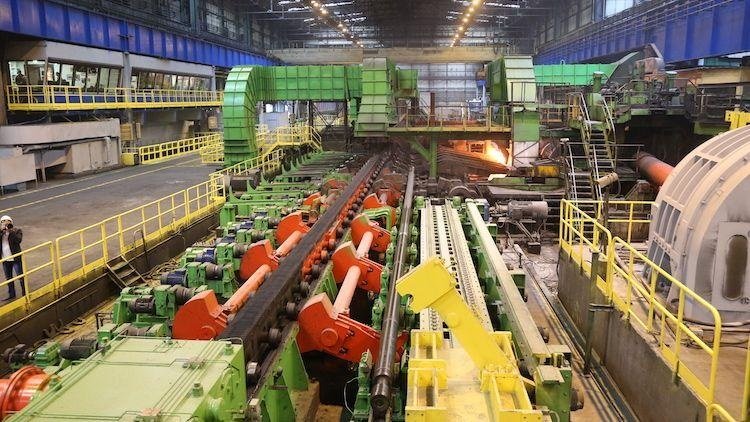
7. Manufacturing Process of ASTM A106 and ASME SA-106 Pipes
Both specifications cover seamless carbon steel pipes.
The manufacturing process is therefore based on seamless pipe production rather than welded pipe forming.
A typical manufacturing route includes:
7.1 Steel Billet Preparation
Solid round billets are selected according to the required steel grade and production specifications.
The billets undergo inspection and preparation before heating.
7.2 Billet Heating
The billets are heated in a furnace to the appropriate temperature for hot working.
Temperature control is important for achieving suitable deformation and material quality.
7.3 Rotary Piercing
A rotary piercing mill forms a hollow shell from the heated billet.
This is a key stage in seamless steel pipe manufacturing.
7.4 Elongation and Rolling
The hollow shell passes through rolling equipment to achieve the required outside diameter and wall thickness.
7.5 Sizing and Reducing
Sizing or reducing mills control the final dimensions and dimensional accuracy.
7.6 Heat Treatment
Heat treatment requirements depend on the manufacturing route, pipe dimensions and applicable specification.
Hot-finished products may be supplied without a separate final heat treatment when permitted.
Cold-drawn products have specific heat treatment requirements under the applicable standard.
7.7 Inspection and Testing
Finished pipes undergo the required dimensional, mechanical and other inspections.
Typical checks include:
- Chemical analysis.
- Tensile testing.
- Flattening testing.
- Bending testing, where applicable.
- Hydrostatic testing.
- Nondestructive electric testing.
- Visual and dimensional inspection.
The specific tests and frequency must follow the applicable edition.
8. ASTM A106 and ASME SA-106 Grade B: Are They Equivalent?
In many engineering and procurement situations, ASTM A106 Grade B and ASME SA-106 Grade B are treated as equivalent material specifications.
However, equivalence should be established through the applicable editions and project requirements.
For example, the SA-106/SA-106M text included in ASME BPVC II.A-2023 identifies itself as identical to ASTM A106/A106M-19a.
This is a clear example of edition-specific equivalence.
It does not mean that a material certificate showing an older ASTM edition automatically satisfies every requirement of a newer ASME construction code.
Before accepting equivalence, buyers and engineers should confirm:
- The ASTM edition specified in the purchase order.
- The ASME BPVC edition applicable to the project.
- The adopted edition of SA-106.
- Whether the technical texts are identical or contain differences.
- Whether supplementary requirements apply.
- Whether the material is permitted by the applicable construction code.
For pressure equipment, material acceptance must be evaluated against the governing construction code and project requirements.
9. What Is Dual Certification for A/SA106 Steel Pipes?
Dual certification means that a material is documented as complying with two corresponding specifications.
For example, a seamless carbon steel pipe may be supplied with documentation identifying both:
- ASTM A106/A106M Grade B.
- ASME SA-106/SA-106M Grade B.
This is commonly referred to as A/SA106 Grade B.
9.1 Why Is Dual Certification Used?
Dual certification can simplify procurement and material inventory management.
It is useful for distributors and manufacturers supplying different types of industrial projects.
Potential benefits include:
- Broader project compatibility.
- Reduced need for separate material inventories.
- Easier procurement documentation.
- Improved material identification.
- Simplified specification review.
9.2 Does Dual Certification Mean Automatic ASME Approval?
No.
Dual certification confirms compliance with the stated material specifications when properly documented.
It does not automatically mean that the pipe is approved for every ASME pressure equipment application.
The project must still comply with the relevant ASME construction code, material acceptance rules, design conditions and documentation requirements.
9.3 What Should Buyers Check on the MTC?
The Material Test Certificate should identify:
- ASTM specification and edition.
- ASME specification and edition, where applicable.
- Material grade.
- Heat number.
- Chemical composition.
- Mechanical test results.
- Manufacturing method.
- Heat treatment condition, where applicable.
- Required inspection results.
The certificate should clearly demonstrate compliance with both specifications rather than simply display both designations without supporting test data.
10. Can ASTM A106 Pipes Be Used in ASME Pressure Equipment?
This is one of the most important questions for engineering contractors and pipe buyers.
The answer depends on the applicable ASME construction code, the material edition accepted by that code and the specific project requirements.
ASME BPVC Section II, Part A contains material specifications used in conjunction with the other sections of the Boiler and Pressure Vessel Code.
For example:
- ASME Section I covers Power Boilers.
- ASME Section VIII covers Pressure Vessels.
- ASME Section IX covers Welding, Brazing and Fusing Qualifications.
For process piping, ASME B31.3 is commonly used, while ASME B31.1 covers Power Piping.
The applicable material requirements must be checked in the relevant construction code.
10.1 When Is SA-106 Specified?
SA-106 is commonly specified when the project documentation directly references ASME material specifications.
10.2 Can ASTM A106 Be Accepted?
ASTM A106 may be acceptable when the applicable construction code permits the corresponding material specification and edition.
However, this must be verified by the responsible design authority or code compliance engineer.
10.3 Why Does the Standard Edition Matter?
ASME and ASTM standards are periodically revised.
The ASME BPVC identifies acceptable material specification editions for code construction.
A pipe manufactured to one edition should not automatically be assumed to comply with every later edition.
For this reason, the purchase order should identify the required standard and edition whenever the project requires strict code compliance.
11. How to Select ASTM A106 or ASME SA-106 for Your Project
The correct designation depends on the project requirements rather than an assumed difference in steel quality.
Choose ASTM A106 When:
- The project specifies ASTM material standards.
- The application requires seamless carbon steel pipe for high-temperature service.
- The applicable engineering code permits the specified ASTM edition.
- Material documentation is required according to ASTM and purchase order requirements.
Choose ASME SA-106 When:
- The project directly references ASME BPVC material specifications.
- The pipe is intended for applicable ASME-regulated construction.
- The required SA-106 edition is identified in the project documentation.
- ASME material compliance is part of the procurement requirements.
Choose Dual-Certified A/SA106 When:
- Both ASTM and ASME material specifications are required.
- The product must support different project documentation requirements.
- The manufacturer can demonstrate compliance with both specified editions.
- The buyer requires a single inventory suitable for multiple approved applications.
12. Frequently Asked Questions About ASME SA106 and ASTM A106
Is ASME SA106 the same as ASTM A106?
They are corresponding specifications for seamless carbon steel pipes for high-temperature service. Their technical requirements may be identical for specific adopted editions. The edition must always be checked.
What is the difference between A106 and SA106?
ASTM A106 is published by ASTM International, while ASME SA-106 is included in ASME BPVC Section II, Part A. The distinction is primarily the governing standards system and applicable code context.
Is SA106 stronger than A106?
No. The SA designation does not automatically indicate higher strength. When the adopted specifications are identical, the specified mechanical property requirements are the same.
What does A/SA106 Grade B mean?
A/SA106 Grade B generally identifies a pipe certified to both ASTM A106 Grade B and the corresponding ASME SA-106 Grade B requirements.
Is SA106 a seamless steel pipe?
Yes. SA-106 covers seamless carbon steel pipe for high-temperature service.
What are the grades of ASME SA106?
The specification includes Grade A, Grade B and Grade C, subject to the applicable edition.
Can ASTM A106 Grade B be used for boilers?
It may be used in applicable boiler-related piping systems when permitted by the governing ASME construction code and project specifications. Material acceptance must be verified against the applicable code edition.
Does ASME SA106 require additional inspection compared with ASTM A106?
Not automatically. When the corresponding texts are identical, their material specification testing requirements are equivalent. Additional requirements may arise from the applicable ASME construction code, purchaser specification or project inspection plan.
What is the difference between SA106 and SA335?
SA106 covers seamless carbon steel pipes for high-temperature service, while SA335 covers seamless ferritic alloy steel pipes for high-temperature service. SA335 includes alloy grades such as P11, P22 and P91.
What documents should buyers request for A/SA106 pipes?
Buyers should request the MTC, chemical composition results, mechanical test reports, applicable hydrostatic and nondestructive test records, manufacturing information and traceability documentation.
13. Conclusion
ASME SA106 and ASTM A106 are closely related specifications covering seamless carbon steel pipes for high-temperature service.
ASTM A106 is published by ASTM International, while ASME SA-106 is included in ASME BPVC Section II, Part A for use within the ASME materials framework.
For corresponding editions with identical technical text, their chemical composition, mechanical properties, manufacturing requirements and material testing requirements are equivalent.
The main consideration is not whether SA106 is inherently stronger or better than A106. It is whether the specified material edition is accepted under the applicable construction code and whether the product documentation satisfies the project requirements.
For steel pipe procurement, buyers should confirm the applicable ASTM and ASME editions, material grade, manufacturing condition, inspection requirements and certification scope before placing an order.
Looking for ASTM A106 or ASME SA-106 Seamless Steel Pipes?
Whether your project requires ASTM A106 Grade A, Grade B or Grade C, ASME SA-106, or dual-certified A/SA106 seamless carbon steel pipes, provide the required grade, outside diameter, wall thickness, schedule, quantity and applicable code edition.
Request a quotation with material test certificates, chemical composition, mechanical test results and inspection documentation.