
1. Why Does Material Selection Matter for High-Temperature Steel Pipes?
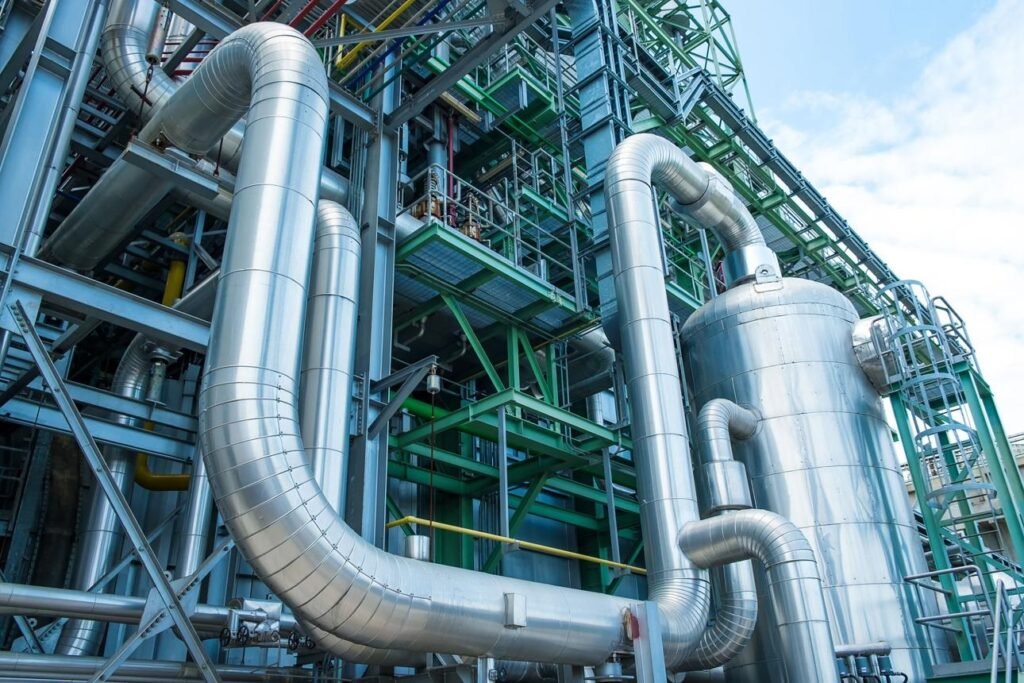
Steel pipes used in power plants, boilers, refineries and petrochemical facilities often operate under high temperatures and internal pressure for extended periods.
Unlike ordinary piping systems, high-temperature pipelines must maintain their mechanical properties and dimensional stability throughout long operating cycles.
As temperature increases, the mechanical strength of steel generally decreases. Under sustained stress, some materials also experience creep deformation, which can eventually lead to excessive deformation or rupture.
In addition, oxidation, corrosion and repeated temperature changes may gradually affect the integrity of the pipe.
Selecting an unsuitable material can result in:
- Excessive creep deformation.
- Loss of high-temperature strength.
- Oxidation and wall thinning.
- Thermal fatigue cracking.
- Weld-related failures.
- Premature pipe replacement.
- Unexpected maintenance and shutdown costs.
Common high-temperature steel pipe applications include:
- Main steam and reheater pipelines.
- Boiler superheater systems.
- Power generation facilities.
- Oil refineries.
- Petrochemical processing plants.
- Heat exchangers.
- Industrial furnaces.
- High-temperature process piping.
For these applications, material selection should be based on operating temperature, design pressure, service life, process medium and the applicable piping code.
The most suitable material is not necessarily the steel with the highest alloy content. It is the material that satisfies the engineering requirements while providing reliable long-term performance.
2. What Happens to Steel Pipes at High Temperatures?
Understanding the behavior of steel at elevated temperatures is essential before choosing a material grade.
Four factors deserve particular attention: high-temperature strength, creep, oxidation and thermal fatigue.
2.1 Reduction in Mechanical Strength
Steel generally loses strength as temperature increases.
Its yield strength and allowable stress decrease, which means a pipe may require a greater wall thickness to withstand the same internal pressure.
For pressure piping, the allowable stress values specified by the applicable design code must be used.
A material that performs adequately at room temperature may not provide sufficient strength under sustained high-temperature loading.
2.2 Creep Deformation
Creep is the gradual, time-dependent deformation of a material under sustained stress.
It becomes increasingly important at elevated temperatures.
Even when the applied stress remains below the material’s room-temperature yield strength, steel can gradually deform during prolonged exposure to high temperature.
Creep generally develops through three stages:
Primary Creep
The creep rate initially decreases as the material undergoes deformation and internal structural changes.
Secondary Creep
The deformation rate becomes relatively stable. This stage is particularly important in engineering life assessment because components may spend a substantial part of their service life in this region.
Tertiary Creep
The creep rate accelerates as damage accumulates, eventually leading to rupture.
For long-term steam pipelines and boiler systems, creep rupture strength is therefore an important material selection parameter.
2.3 Oxidation and High-Temperature Corrosion
At elevated temperatures, steel surfaces can react with oxygen and form oxide scales.
Depending on the environment and material composition, oxidation may cause:
- Surface scale formation.
- Metal loss.
- Wall thickness reduction.
- Scale detachment.
- Reduced heat transfer efficiency.
Chromium-containing alloy steels generally offer better oxidation resistance than conventional carbon steel under comparable conditions.
However, actual performance depends on temperature, oxygen potential, steam chemistry and the presence of other corrosive substances.
2.4 Thermal Fatigue
Industrial piping systems frequently experience heating and cooling cycles.
During startup, shutdown and changes in operating load, different sections of the pipe may expand and contract at different rates.
These temperature variations can generate thermal stresses.
Repeated thermal cycling may eventually initiate cracks, particularly around:
- Weld joints.
- Pipe bends.
- Branch connections.
- Supports and restraints.
- Areas with significant temperature gradients.
Material selection should therefore consider not only steady-state operating temperature but also the expected operating cycle.
3. What Factors Should Be Considered When Selecting High-Temperature Steel Pipes?
Selecting a suitable material requires more than identifying the maximum operating temperature.
The following parameters should be evaluated together.
3.1 Operating Temperature
Operating temperature directly affects material strength, creep behavior and oxidation resistance.
Buyers should distinguish between:
- Normal operating temperature.
- Maximum continuous operating temperature.
- Design temperature.
- Short-term temperature excursions.
- Startup and shutdown temperatures.
The design metal temperature used for code calculations may differ from the nominal process fluid temperature.
3.2 Design Pressure
Internal pressure creates circumferential and longitudinal stresses in the pipe wall.
As temperature increases, the allowable stress of many steel materials decreases.
Consequently, a pipe that is suitable at a particular pressure under normal conditions may require a different grade or wall thickness at a higher temperature.
Material selection and wall thickness calculations should follow the applicable design code, such as ASME B31.1 for power piping or ASME B31.3 for process piping.
3.3 Service Life
High-temperature piping is often expected to operate for many years.
A material that performs adequately during short-term testing may not necessarily provide the required long-term creep resistance.
Engineers should consider:
- Expected operating hours.
- Creep rupture data.
- Allowable stress at design temperature.
- Planned maintenance intervals.
- Inspection and remaining-life assessment requirements.
3.4 Process Medium and Corrosion Conditions
The process medium can be just as important as temperature.
Different environments may introduce:
- Oxidation.
- Sulfidation.
- Carburization.
- Nitridation.
- Steam oxidation.
- Chloride-related corrosion.
- High-temperature chemical attack.
For example, a chromium-molybdenum alloy steel may be suitable for a high-temperature steam line, while an austenitic stainless steel or a nickel-based alloy may be more appropriate for a particular corrosive process environment.
The material must be selected according to the actual chemistry and operating conditions.
3.5 Manufacturing and Welding Requirements
The selected steel must also be suitable for fabrication and installation.
Important considerations include:
- Pipe manufacturing method.
- Heat treatment condition.
- Weldability.
- Preheating requirements.
- Post-weld heat treatment (PWHT).
- Nondestructive examination.
- Dimensional tolerances.
Certain alloy steel grades, especially P91, require carefully controlled welding procedures and heat treatment.
4. Common Steel Pipe Materials for High-Temperature Applications
Different steel grades are designed for different temperature, pressure and service conditions.
The following materials are commonly encountered in industrial high-temperature piping.
4.1 ASTM A106 Grade B Carbon Steel Pipe
ASTM A106 Grade B is a seamless carbon steel pipe specification for high-temperature service.
It is widely used in:
- Steam distribution.
- Refineries.
- Petrochemical plants.
- General process piping.
- Industrial power systems.
Its main advantages include:
- Established manufacturing processes.
- Good weldability with suitable procedures.
- Broad commercial availability.
- Relatively economical material cost.
However, conventional carbon steel has limitations in long-term high-temperature strength and oxidation resistance.
For applications where creep governs the design, a chromium-molybdenum alloy steel may be more appropriate.
ASTM A106 should not be selected based on a single universal temperature limit. The applicable design code, allowable stress tables, material condition and service requirements must be checked.
4.2 ASTM A335 P11 Alloy Steel Pipe
ASTM A335 P11 is a chromium-molybdenum alloy steel pipe grade.
Its typical nominal alloy composition is approximately 1.25% chromium and 0.5% molybdenum, subject to the specified chemical composition limits.
The chromium addition improves oxidation resistance, while molybdenum contributes to high-temperature strength.
Common applications include:
- Boiler piping.
- Steam pipelines.
- Refinery process piping.
- Heat exchanger systems.
- Industrial high-temperature piping.
P11 is often considered when conventional carbon steel does not provide sufficient high-temperature performance.
4.3 ASTM A335 P22 Alloy Steel Pipe
ASTM A335 P22 is a higher-alloy chromium-molybdenum steel pipe.
Its nominal composition is approximately 2.25% chromium and 1% molybdenum.
Compared with P11, P22 offers different high-temperature strength and oxidation characteristics.
Typical applications include:
- Main steam pipelines.
- Reheater piping.
- Boiler systems.
- High-temperature refinery equipment.
- Power generation facilities.
P22 is widely used in demanding steam systems where long-term elevated-temperature performance is required.
4.4 ASTM A335 P91 Alloy Steel Pipe
P91 is a creep-strength-enhanced ferritic steel, generally described as a modified 9Cr-1Mo-V-Nb alloy.
It contains approximately 9% chromium, together with molybdenum, vanadium, niobium and other controlled alloying elements.
Its microstructure and heat treatment are designed to provide high creep strength at elevated temperatures.
Common applications include:
- Supercritical power plants.
- Main steam pipelines.
- Hot reheat systems.
- High-temperature headers.
- Critical power generation piping.
P91 can provide higher allowable stresses than conventional P22 in relevant elevated-temperature design conditions.
However, its performance depends strongly on correct heat treatment, welding and fabrication practices.
Incorrect welding procedures, insufficient preheating or improper PWHT can compromise the properties of P91 components.
4.5 ASTM A335 P92 Alloy Steel Pipe
P92 is another creep-strength-enhanced ferritic-martensitic alloy steel.
It contains chromium, molybdenum, tungsten and other alloying elements.
P92 was developed for demanding high-temperature applications where improved creep strength is required.
Potential applications include:
- Advanced power plants.
- Main steam systems.
- High-temperature headers.
- Superheater and reheater systems.
As with P91, manufacturing, heat treatment and welding control are critical to achieving the specified properties.
5. Is Stainless Steel Suitable for High-Temperature Applications?
Stainless steel is often considered when higher oxidation resistance, corrosion resistance or high-temperature strength is required.
However, not all stainless steel grades are suitable for the same operating conditions.
5.1 Type 304H Stainless Steel
304H is a higher-carbon version of 304 stainless steel designed for elevated-temperature service.
It is used in selected applications where high-temperature strength and oxidation resistance are important.
Typical applications include:
- Heat exchangers.
- Furnace components.
- High-temperature process piping.
- Selected boiler components.
5.2 Type 316H Stainless Steel
316H is an elevated-temperature version of 316 stainless steel.
Its molybdenum content provides improved resistance to certain corrosive environments compared with 304H.
However, its suitability must be evaluated against the specific process chemistry and temperature.
5.3 Type 321H Stainless Steel
321H is a titanium-stabilized austenitic stainless steel designed for elevated-temperature service.
Titanium stabilization helps reduce the risk of sensitization-related problems under certain exposure conditions.
It is used in selected high-temperature piping and equipment applications.
5.4 Type 347H Stainless Steel
347H is a niobium-stabilized austenitic stainless steel.
It is used in high-temperature applications requiring suitable elevated-temperature mechanical properties and resistance to certain forms of intergranular corrosion.
5.5 Comparison of Common High-Temperature Materials
| Material | Material Type | Main Characteristics | Typical Applications |
|---|---|---|---|
| ASTM A106 Gr. B | Carbon steel | Economical, established high-temperature piping grade | Steam and process piping |
| ASTM A335 P11 | Cr-Mo alloy steel | Improved high-temperature strength and oxidation resistance | Boilers and steam lines |
| ASTM A335 P22 | Cr-Mo alloy steel | Higher chromium and molybdenum content | Main steam and reheater systems |
| ASTM A335 P91 | 9Cr creep-strength-enhanced steel | High creep strength | Advanced power plants |
| ASTM A335 P92 | 9Cr-W creep-strength-enhanced steel | High creep strength for demanding service | Advanced steam systems |
| ASTM A312 TP304H | Austenitic stainless steel | Elevated-temperature strength and oxidation resistance | High-temperature process equipment |
| ASTM A312 TP316H | Austenitic stainless steel | Molybdenum-bearing stainless steel | Selected corrosive high-temperature systems |
| ASTM A312 TP347H | Stabilized austenitic stainless steel | Elevated-temperature applications | Boiler and furnace-related piping |
The table is a preliminary material comparison, not a design selection table. Actual product specifications, allowable stresses and service limitations must be checked before procurement.
6. P11 vs P22 vs P91: Which Alloy Steel Pipe Should You Choose?
These three ASTM A335 grades are frequently compared when selecting high-temperature seamless steel pipes.
Their differences mainly relate to alloy composition, creep strength, oxidation behavior, fabrication requirements and intended service conditions.
P11
P11 is a lower-alloy chromium-molybdenum steel.
It can be considered for selected elevated-temperature steam and process piping applications where its allowable stress and long-term performance meet the design requirements.
P22
P22 contains more chromium and molybdenum than P11.
It is commonly used in higher-temperature steam and boiler systems where improved high-temperature performance is required.
P91
P91 has a more complex alloy composition and a carefully controlled martensitic microstructure.
It is designed to provide high creep strength and is used in critical power generation systems.
Comparison Table
| Parameter | P11 | P22 | P91 |
|---|---|---|---|
| Approx. Chromium | 1.25% | 2.25% | 9% |
| Approx. Molybdenum | 0.5% | 1.0% | 1.0% |
| Additional Alloying | Limited | Limited | V, Nb and other controlled additions |
| Creep Performance | Suitable for specified elevated-temperature service | Higher-temperature alloy steel service | High creep strength |
| Welding Control | Controlled procedures required | Controlled procedures required | Particularly stringent |
| Common Applications | Boilers and steam pipes | Main steam and reheater systems | Critical high-temperature power piping |
These approximate alloy descriptions are not substitutes for the chemical composition limits in the applicable ASTM specification.
There is no universal rule that P91 should always replace P22 or that P22 is always preferable to P11.
The final choice must be based on design-code allowable stress, design temperature, pressure, required service life, fabrication and economic considerations.
7. How Does Operating Temperature Affect Steel Pipe Selection?
Temperature is one of the most important factors in high-temperature pipe material selection.
However, it is not appropriate to select a material using fixed temperature bands alone.
Two projects operating at the same temperature may require different materials because their pressure, process medium, design life and corrosion conditions differ.
A practical preliminary selection approach is shown below.
| Operating Condition | Materials to Evaluate | Main Considerations |
|---|---|---|
| Moderate elevated temperature | ASTM A106 Grade B | Allowable stress, pressure and oxidation |
| Higher-temperature steam service | ASTM A335 P11 | Creep strength and design-code limits |
| More demanding elevated-temperature service | ASTM A335 P22 | Long-term strength and service conditions |
| Critical high-temperature power piping | ASTM A335 P91/P92 | Creep strength, fabrication and PWHT |
| Oxidizing high-temperature environments | 304H, 321H, 347H or specialized alloys | Oxidation and corrosion resistance |
| Severe chemical and high-temperature environments | Specialized stainless or nickel-based alloys | Process compatibility and corrosion testing |
This is a preliminary screening guide only. It does not define universal operating-temperature limits or authorize material substitution.
The final material grade should be selected using the applicable code’s allowable stress values and the actual service conditions.
8. Why Is Creep Resistance Important for High-Temperature Steel Pipes?
Creep resistance is one of the most important properties of steel pipes used in long-term high-temperature service.
A pipeline may operate continuously for tens of thousands of hours under sustained pressure and temperature.
Even relatively small creep deformation can become significant over time.
8.1 Creep Rupture Strength
Creep rupture strength refers to the stress required to cause material failure after a specified period at a given temperature.
It is generally evaluated using long-term creep testing and statistical material data.
The relevant design data depend on:
- Temperature.
- Applied stress.
- Required service duration.
- Material grade.
- Heat treatment condition.
8.2 Why Do Alloying Elements Matter?
Different alloying elements contribute to high-temperature performance in different ways.
Chromium (Cr)
Improves oxidation resistance by promoting the formation of protective chromium-rich oxide scales.
Molybdenum (Mo)
Contributes to high-temperature strength and creep resistance.
Vanadium (V)
Can contribute to precipitation strengthening through the formation of fine alloy carbides and nitrides.
Niobium (Nb)
Helps control precipitation behavior and microstructural stability.
Tungsten (W)
Contributes to solid-solution strengthening and high-temperature creep performance in certain alloy systems.
The combined effects of alloying elements, heat treatment and microstructure determine the actual performance of the steel.
9. How Does Heat Treatment Affect High-Temperature Steel Pipe Performance?
Heat treatment is an important part of manufacturing high-temperature alloy steel pipes.
It influences microstructure, hardness, strength and creep-related properties.
9.1 Normalizing
Normalizing involves heating the steel to an appropriate temperature followed by controlled cooling, usually in air.
It can refine the microstructure and produce a more uniform material condition.
9.2 Tempering
Tempering is commonly performed after hardening or normalizing-related processing, depending on the material grade and specified delivery condition.
It helps establish the required balance of strength, hardness and toughness.
9.3 Normalizing and Tempering
P91 and P92 pipes require carefully controlled heat treatment to achieve their specified microstructural and mechanical properties.
The correct normalizing and tempering conditions are essential for their creep performance.
9.4 Post-Weld Heat Treatment
PWHT is often required for high-temperature alloy steel piping.
Its purpose and requirements depend on the material, thickness, welding procedure and applicable construction code.
For P91 piping, welding and PWHT require particularly careful control.
Incorrect heat treatment can lead to unsuitable hardness, reduced toughness or long-term service problems.
10. What Inspection and Testing Are Required for High-Temperature Steel Pipes?
High-temperature steel pipes must meet the inspection and testing requirements specified by their product standards and purchase orders.
Common quality control procedures include the following.
10.1 Chemical Composition Analysis
Chemical analysis confirms that the material meets the specified grade.
For alloy steel, chromium, molybdenum, vanadium, niobium and other specified elements are particularly important.
10.2 Tensile Testing
Tensile testing evaluates:
- Yield strength.
- Tensile strength.
- Elongation.
These results help verify that the pipe meets its specified mechanical properties.
10.3 Hardness Testing
Hardness testing is important for verifying the material condition and identifying potential heat treatment problems.
It is particularly relevant for selected alloy steel grades.
10.4 Hydrostatic Testing
Hydrostatic testing evaluates the pressure integrity of the pipe under the specified test conditions.
The test requirements should follow the applicable product specification.
10.5 Nondestructive Testing
Depending on the material specification and purchase order, inspection may include:
- Ultrasonic Testing (UT).
- Eddy Current Testing (ET).
- Magnetic Particle Testing (MT).
- Radiographic Testing (RT), where applicable.
10.6 Positive Material Identification (PMI)
PMI can be used to verify alloy composition and help prevent material mix-ups.
It is particularly useful when different alloy steel grades are supplied in the same project.
10.7 Material Test Certificates
The Material Test Certificate (MTC) should identify the supplied material and report the relevant chemical and mechanical test results.
Buyers should check:
- Product standard.
- Steel grade.
- Heat number.
- Dimensions.
- Heat treatment condition.
- Chemical composition.
- Mechanical test results.
- Required inspection records.
For high-temperature alloy steel pipes, traceability between the pipe marking, heat number and inspection documentation is particularly important.
11. Common Mistakes When Selecting High-Temperature Steel Pipes
Several material selection mistakes can lead to premature equipment failure and unnecessary project costs.
Mistake 1: Selecting Materials Based Only on Temperature
Temperature alone cannot determine material suitability. Pressure, stress, corrosion and service life must also be evaluated.
Mistake 2: Ignoring Creep Behavior
A material may have adequate short-term strength but insufficient long-term creep resistance.
Mistake 3: Assuming P11, P22 and P91 Are Interchangeable
These grades have different alloy compositions, heat treatment requirements and mechanical properties.
Mistake 4: Choosing Stainless Steel Without Evaluating the Process Medium
Stainless steel does not provide universal resistance to high-temperature corrosion. Sulfidation, carburization and other environmental conditions may require specialized alloys.
Mistake 5: Ignoring Welding and PWHT
Poorly controlled welding and heat treatment can compromise high-temperature alloy steel performance.
Mistake 6: Using Room-Temperature Mechanical Properties for High-Temperature Design
Allowable stress and material performance must be evaluated at the relevant design temperature.
Mistake 7: Ignoring Thermal Cycling
Repeated startup and shutdown operations can generate thermal stresses and fatigue damage.
Mistake 8: Purchasing Without Checking Material Traceability
Missing or inconsistent heat numbers and MTC information can create serious material verification problems.
12. Frequently Asked Questions
Which steel pipe is best for high-temperature applications?
There is no single best material for every application. ASTM A106 Grade B, ASTM A335 P11, P22, P91 and P92, as well as selected stainless steel grades, are used under different temperature, pressure and corrosion conditions.
What is the difference between ASTM A106 and ASTM A335?
ASTM A106 covers seamless carbon steel pipe for high-temperature service. ASTM A335 covers seamless ferritic alloy steel pipe intended for high-temperature service. Their alloy compositions, mechanical properties and application requirements are different.
Is ASTM A106 Grade B suitable for high-temperature steam pipelines?
It can be suitable for certain steam piping applications, provided its allowable stress, wall thickness and other design requirements are satisfied. For more demanding long-term creep conditions, alloy steel grades may be more appropriate.
What is the difference between P11, P22 and P91?
P11 and P22 are chromium-molybdenum alloy steels with different chromium and molybdenum contents. P91 is a creep-strength-enhanced 9Cr alloy steel with additional alloying elements and more demanding fabrication requirements.
Why is P91 used in power plants?
P91 offers high creep strength under suitable elevated-temperature conditions. It is commonly specified for critical steam piping, headers and other demanding power plant applications.
Is stainless steel always better than alloy steel at high temperatures?
No. Stainless steel may offer better oxidation and corrosion resistance in certain environments, but its thermal expansion, mechanical properties, cost and process compatibility must also be considered.
What is creep rupture strength?
Creep rupture strength is the stress a material can withstand at a specified temperature for a specified time before failure due to creep deformation.
Does wall thickness affect high-temperature pipe selection?
Yes. Wall thickness is determined by design pressure, allowable stress, corrosion allowance, manufacturing tolerances and applicable code requirements. High-temperature strength reduction may require a different wall thickness or material grade.
What inspection documents should buyers request?
Typical documents include material test certificates, chemical analysis reports, mechanical test results, heat treatment records, hydrostatic test records and specified NDT reports. Additional project-specific documentation may also be required.
What information should be provided when requesting a high-temperature steel pipe quotation?
Buyers should provide the material standard and grade, outside diameter, wall thickness, length, design temperature, design pressure, quantity, heat treatment requirements, inspection scope and delivery destination.
13. Conclusion
Selecting the right steel pipe material for high-temperature applications requires a complete understanding of operating conditions and long-term material behavior.
Temperature and pressure determine the mechanical demands on the pipe, while creep, oxidation, corrosion and thermal fatigue influence its long-term service performance.
ASTM A106 carbon steel may be suitable for certain high-temperature applications, while ASTM A335 P11, P22, P91 and P92 provide additional alloying and creep-related performance for more demanding service conditions.
Austenitic stainless steel grades such as 304H, 321H and 347H may also be considered where oxidation resistance and elevated-temperature properties are required.
The final selection should always be verified against the applicable design code, allowable stress data, process environment and fabrication requirements.
Looking for High-Temperature Alloy Steel Pipes?
Whether your project requires ASTM A106 Grade B, ASTM A335 P11, P22, P91 or P92 seamless steel pipes, provide the required material grade, dimensions, design temperature, pressure and inspection requirements.
A detailed technical inquiry allows the supplier to identify the appropriate product specification and prepare a quotation that matches the project requirements.