
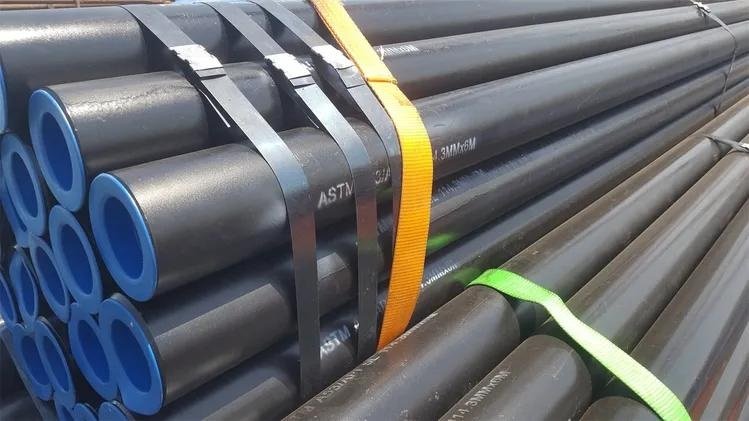
1. What Is the Difference Between ASTM A106 Grade B and ASTM A53 Grade B?
ASTM A106 Grade B and ASTM A53 Grade B are two widely used carbon steel pipe grades in industrial piping systems.
Both are designed for applications involving fluids and gases, and both have similar minimum tensile and yield strength requirements.
However, they are not identical products.
The main difference is their intended service and manufacturing scope.
ASTM A106 Grade B is a seamless carbon steel pipe specification designed primarily for high-temperature service. It is commonly used in power plants, refineries, petrochemical facilities and industrial process piping.
ASTM A53 Grade B covers black and hot-dipped zinc-coated welded and seamless steel pipes. It is intended for mechanical and pressure applications and is also widely used in steam, water, gas and air lines.
The key differences include:
- Manufacturing methods.
- Chemical composition requirements.
- Product forms and available coatings.
- Intended operating conditions.
- Inspection and testing requirements.
- Typical industrial applications.
For buyers, selecting between ASTM A106 Grade B and ASTM A53 Grade B should be based on the project specification, operating temperature, manufacturing requirements and applicable piping code.
2. ASTM A106 Grade B Pipe: Specification and Characteristics
ASTM A106/A106M is the standard specification for seamless carbon steel pipe for high-temperature service.
It covers seamless carbon steel pipes in Grades A, B and C.
Grade B is one of the most commonly specified grades because it provides a practical combination of strength, availability and suitability for industrial piping.
2.1 Manufacturing Process
ASTM A106 Grade B pipes are manufactured using a seamless production process.
The typical manufacturing route includes:
- Steel billet preparation.
- Billet heating.
- Rotary piercing.
- Hollow shell formation.
- Elongation and rolling.
- Sizing or reducing.
- Heat treatment, where required.
- Straightening and cutting.
- Inspection and testing.
Because the pipe is seamless, it does not contain a longitudinal or spiral weld seam.
This manufacturing characteristic makes it suitable for many demanding pressure and temperature applications.
2.2 Main Characteristics
ASTM A106 Grade B pipes offer:
- Seamless construction.
- Suitability for high-temperature service.
- Good weldability with an appropriate welding procedure.
- Good performance in industrial pressure piping.
- Compatibility with bending and flanging operations when properly processed.
The actual service suitability depends on pipe dimensions, operating conditions, material certification and the applicable design code.
2.3 Typical Applications
ASTM A106 Grade B seamless pipes are commonly used in:
- Power generation facilities.
- Steam distribution systems.
- Oil refineries.
- Petrochemical plants.
- High-temperature process piping.
- Industrial boilers and associated piping systems.
- General refinery and chemical process applications.
For projects involving elevated temperatures, A106 Grade B is generally a more directly relevant specification than A53 Grade B.
3. ASTM A53 Grade B Pipe: Specification and Characteristics
ASTM A53/A53M covers black and hot-dipped zinc-coated welded and seamless steel pipes.
It is widely used in mechanical and pressure applications, as well as ordinary steam, water, gas and air lines.
Unlike ASTM A106, ASTM A53 includes more than one manufacturing method.
3.1 Manufacturing Types
ASTM A53 includes different pipe manufacturing types.
Type E – Electric Resistance Welded
Type E pipes are manufactured by forming steel strip or coil into a cylindrical shape and joining the longitudinal edges using electric resistance welding.
They are available in Grades A and B.
Type S – Seamless
Type S pipes are manufactured from solid steel billets through heating, piercing and rolling without a welded seam.
They are available in Grades A and B.
Type F – Furnace-Butt Welded, Continuous Welded
Type F represents a furnace-butt-welded continuous production route. Its permitted grade availability must be checked against the applicable edition of ASTM A53/A53M.
Grade B buyers commonly focus on Type E and Type S.
3.2 Main Characteristics
ASTM A53 Grade B pipes offer:
- Welded and seamless product options.
- Black or hot-dipped zinc-coated finishes.
- Suitability for specified mechanical and pressure applications.
- Applications in steam, water, gas and air distribution.
- Broad availability for industrial and construction projects.
Galvanized A53 pipes are particularly useful in applications where zinc coating is specified for corrosion protection.
However, coating suitability must be evaluated against the fluid, temperature and operating environment.
3.3 Typical Applications
ASTM A53 Grade B pipes are commonly used in:
- Water distribution systems.
- Gas piping.
- Steam and air lines within their permitted service conditions.
- Fire protection systems.
- Mechanical piping.
- Building construction.
- Structural applications.
- General industrial piping.
For high-temperature process piping, the applicable design code and project specification must be checked before selecting A53.
4. ASTM A106 Grade B vs ASTM A53 Grade B: Key Differences
The following table summarises the major differences between these two specifications.
| Comparison | ASTM A106 Grade B | ASTM A53 Grade B |
|---|---|---|
| Standard Scope | Seamless carbon steel pipe for high-temperature service | Black and hot-dipped zinc-coated welded and seamless pipe |
| Manufacturing | Seamless only | Type E welded and Type S seamless for Grade B |
| Product Type | Seamless pipe | Welded or seamless pipe |
| Main Service Focus | High-temperature service | Mechanical and pressure applications |
| Chemical Requirements | Grade-specific requirements | Grade-specific requirements |
| Minimum Tensile Strength | 60 ksi (415 MPa) | 60 ksi (415 MPa) |
| Minimum Yield Strength | 35 ksi (240 MPa) | 35 ksi (240 MPa) |
| Surface Condition | Generally supplied as black pipe | Black or hot-dipped zinc-coated |
| Typical Applications | Refineries, power plants, high-temperature process piping | Water, gas, steam, air and mechanical piping |
| Cost Considerations | Generally higher for comparable products when seamless production is required | Can be more economical when Type E welded pipe is suitable |
The mechanical strength values shown are the common minimum requirements for Grade B. Other requirements, including elongation, test frequency and acceptance criteria, must be checked in the applicable standard edition.
The most important distinction is not simply strength. It is the product scope and suitability for the intended service.
5. Chemical Composition: ASTM A106 Grade B vs ASTM A53 Grade B
Chemical composition is an important factor affecting weldability, strength, hardness and material performance.
Although the two grades have similar carbon limits, their composition requirements are not identical.
The following table presents commonly specified maximum or minimum values for the main elements. Values are in weight percent.
| Chemical Element | ASTM A106 Grade B | ASTM A53 Grade B |
|---|---|---|
| Carbon (C) | 0.30 max. | 0.30 max. |
| Manganese (Mn) | 0.29–1.06 | 1.20 max. |
| Phosphorus (P) | 0.035 max. | 0.050 max. |
| Sulfur (S) | 0.035 max. | 0.045 max. |
| Silicon (Si) | 0.10 min. | Not generally specified as a minimum |
These values should be checked against the applicable edition and product requirements before being used as contractual acceptance limits.
5.1 Carbon Content
Carbon influences steel strength, hardness and weldability.
Both grades have a maximum carbon content of 0.30%.
However, actual carbon content may differ between individual heats.
5.2 Manganese Content
Manganese contributes to strength and hardenability and also helps control the effects of sulphur.
The specifications use different manganese limits, so buyers should not assume identical chemical composition.
5.3 Phosphorus and Sulfur
Phosphorus and sulfur are controlled because excessive levels can negatively affect toughness, ductility and hot-working behaviour.
A106 Grade B specifies tighter maximum limits for these elements in the commonly referenced requirements.
5.4 Why Does Chemical Composition Matter?
Differences in chemical composition may influence:
- Weldability.
- Heat treatment response.
- Strength and hardness.
- Toughness.
- Material consistency.
For critical piping applications, chemical analysis should be verified through the material test certificate rather than inferred from the grade designation alone.
6. Mechanical Properties: Are A106 Grade B and A53 Grade B the Same?
One of the most common questions from steel pipe buyers is whether ASTM A106 Grade B is mechanically stronger than ASTM A53 Grade B.
The minimum tensile and yield strength requirements for Grade B are generally the same.
| Mechanical Property | ASTM A106 Grade B | ASTM A53 Grade B |
|---|---|---|
| Minimum Tensile Strength | 60 ksi (415 MPa) | 60 ksi (415 MPa) |
| Minimum Yield Strength | 35 ksi (240 MPa) | 35 ksi (240 MPa) |
| Elongation | Standard-specific | Standard-specific |
| Flattening Test | Applicable requirements | Applicable requirements |
| Hydrostatic Test | Required as specified | Required as specified |
6.1 Tensile Strength
Both grades require a minimum tensile strength of approximately 415 MPa.
Tensile strength represents the maximum stress a material can withstand during a tensile test before fracture.
6.2 Yield Strength
Both grades have a minimum yield strength of approximately 240 MPa.
Yield strength represents the stress at which permanent deformation begins under the specified test conditions.
6.3 Does A106 Grade B Have Better Mechanical Performance?
Not necessarily.
The similar minimum tensile and yield strengths do not establish that one grade is universally stronger or tougher than the other.
Actual performance depends on:
- Chemical composition.
- Manufacturing route.
- Heat treatment.
- Pipe dimensions.
- Actual test results.
- Operating temperature.
A106 Grade B is selected primarily because of its high-temperature service specification, not because its minimum strength values are inherently higher than A53 Grade B.
7. Manufacturing Differences: Seamless vs ERW Steel Pipes
Manufacturing method is one of the most practical differences when comparing these two standards.
7.1 Seamless Steel Pipe Manufacturing
ASTM A106 Grade B is seamless.
ASTM A53 Grade B Type S is also seamless.
The typical production process includes billet heating, rotary piercing, elongation, rolling and sizing.
Seamless pipes do not contain a longitudinal weld seam.
They are widely used in industrial pressure piping and applications where the project specification requires seamless construction.
7.2 ERW Steel Pipe Manufacturing
ASTM A53 Grade B Type E is manufactured using electric resistance welding.
The process typically involves:
- Steel coil preparation.
- Strip forming.
- High-frequency or electric resistance welding.
- Weld seam inspection and treatment.
- Sizing and straightening.
- Cutting.
- Final testing.
ERW manufacturing can offer high production efficiency and cost advantages for suitable pipe sizes and applications.
Modern ERW production uses controlled welding processes and specified inspection procedures.
7.3 Which Manufacturing Method Is Better?
Neither manufacturing method is universally better.
Seamless pipe is appropriate when required by the product specification or project design.
ERW pipe can provide a cost-effective solution where the applicable standard permits it and the weld quality meets the required acceptance criteria.
The selection should be based on the project specification rather than an assumption that all seamless pipes are superior to welded pipes.
8. Applications: When Should You Choose A106 Grade B or A53 Grade B?
The correct material depends on operating temperature, pressure, fluid, design code and project requirements.
8.1 Choose ASTM A106 Grade B When:
- The piping system operates at elevated temperatures.
- Seamless construction is required.
- The project involves refinery or petrochemical process piping.
- The piping design specifies ASTM A106.
- The material must meet the applicable high-temperature service requirements.
Typical applications include steam lines, refinery piping, process piping and power generation systems.
8.2 Choose ASTM A53 Grade B When:
- The application involves general mechanical or pressure piping.
- Water, gas, air or other permitted services are involved.
- ERW or seamless manufacturing is acceptable.
- Black or hot-dipped galvanized pipe is required.
- The project specification explicitly permits ASTM A53.
Typical applications include water distribution, building services, fire protection and general industrial piping.
8.3 Can ASTM A53 Grade B Replace ASTM A106 Grade B?
Not automatically.
Although the two grades have similar minimum tensile and yield strengths, ASTM A53 is not a direct substitute for ASTM A106 in high-temperature service.
The applicable piping code, design conditions and project specification must permit the alternative material.
Any proposed substitution should be reviewed and approved by the responsible engineering authority.
9. Can ASTM A106 Grade B and A53 Grade B Be Used Interchangeably?
This is an important purchasing and engineering question.
The answer is that they may overlap in some applications, but they are not automatically interchangeable.
The following points should be considered:
1. Service Temperature
A106 is specifically intended for high-temperature service. A53 has a broader general mechanical and pressure application scope.
2. Manufacturing Requirements
A106 is seamless only, while A53 Grade B can be supplied as Type E welded or Type S seamless.
3. Chemical Composition
The chemical composition limits are not identical.
4. Inspection Requirements
Testing requirements, sampling and acceptance criteria must be checked against the relevant specification.
5. Design Code Requirements
The piping design code determines which materials are acceptable for a particular service.
A material substitution should never be made based only on nominal strength values.
10. Inspection and Quality Requirements
Regardless of whether a buyer selects ASTM A106 Grade B or ASTM A53 Grade B, quality inspection is essential.
Typical inspection requirements include the following.
10.1 Chemical Composition Testing
Chemical analysis verifies that the material complies with the specified grade.
Testing may include:
- Carbon.
- Manganese.
- Silicon.
- Phosphorus.
- Sulfur.
- Other specified elements.
10.2 Mechanical Testing
Mechanical testing may include:
- Tensile testing.
- Yield strength verification.
- Elongation testing.
- Flattening testing.
- Bend testing, where applicable.
10.3 Hydrostatic Testing
Hydrostatic testing verifies the pressure integrity of the pipe under the conditions specified by the product standard.
The test pressure and duration must follow the applicable specification.
10.4 Nondestructive Examination
For welded A53 Type E pipes, the applicable weld examination requirements must be verified.
Depending on the specification and manufacturing route, this may involve nondestructive electric testing or other specified inspection procedures.
10.5 Dimensional Inspection
Important dimensional checks include:
- Outside diameter.
- Wall thickness.
- Length.
- Straightness.
- Ovality.
- End preparation.
- Surface condition.
10.6 Material Test Certificate (MTC)
The MTC should identify:
- Product standard.
- Material grade.
- Manufacturing type.
- Heat number.
- Chemical composition.
- Mechanical test results.
- Applicable inspection information.
For project procurement, the certificate should be consistent with the purchase order and applicable standard edition.
11. ASTM A106 Grade B vs ASTM A53 Grade B: Which Is More Cost-Effective?
Price is another important factor in steel pipe procurement.
The actual price difference depends on the manufacturing method, dimensions, quantity, market conditions and inspection requirements.
ASTM A53 Grade B Type E can be more economical than seamless products when the application permits welded pipe.
ASTM A53 Grade B Type S and ASTM A106 Grade B are both seamless products, so their prices may be closer for comparable dimensions and specifications.
However, neither standard is automatically cheaper.
The following factors affect the final quotation:
- Pipe outside diameter.
- Wall thickness and schedule.
- Manufacturing method.
- Material availability.
- Heat treatment requirements.
- Surface treatment.
- Testing and inspection.
- Order quantity.
- Delivery location.
For an accurate comparison, buyers should request quotations based on the same outside diameter, wall thickness, length, material condition and inspection requirements.
12. Frequently Asked Questions
Is ASTM A106 Grade B stronger than ASTM A53 Grade B?
Both grades have the same commonly specified minimum tensile strength of 60 ksi and minimum yield strength of 35 ksi. Their main differences relate to product scope, manufacturing and intended service rather than minimum strength.
Is ASTM A106 Grade B seamless?
Yes. ASTM A106 covers seamless carbon steel pipe for high-temperature service.
Is ASTM A53 Grade B seamless or welded?
Both options are available. Type S is seamless, while Type E is electric resistance welded.
Can ASTM A53 Grade B be used for high-temperature service?
Its suitability depends on the actual design temperature, applicable code and project specification. ASTM A53 should not automatically be substituted for ASTM A106 in high-temperature process piping.
Which pipe is better for steam lines?
ASTM A106 Grade B is commonly specified for high-temperature steam piping. However, the final material selection must comply with the applicable piping code and design conditions.
Can ASTM A53 Grade B be galvanized?
Yes. ASTM A53 covers black and hot-dipped zinc-coated steel pipe, subject to the applicable specification requirements.
What is the difference between A53 Type E and Type S?
Type E is electric resistance welded, while Type S is seamless. Both are available in Grade B.
Do A106 Grade B and A53 Grade B have the same chemical composition?
No. Their chemical composition requirements differ, even though their carbon limits and several mechanical strength requirements are similar.
Which is cheaper, ASTM A106 or ASTM A53?
ASTM A53 Grade B Type E is often more economical where welded pipe is acceptable. Actual prices depend on dimensions, manufacturing route, quantity and project requirements.
Can A106 Grade B and A53 Grade B use the same pipe dimensions?
They can share common nominal pipe sizes and schedules, but dimensional compatibility does not mean specification equivalence. Material certification and product requirements must still be satisfied.
13. Conclusion
ASTM A106 Grade B and ASTM A53 Grade B are both widely used carbon steel pipe grades, but they are designed for different product scopes and service requirements.
ASTM A106 Grade B is a seamless carbon steel pipe specification primarily intended for high-temperature service. ASTM A53 Grade B covers both welded and seamless products for mechanical and pressure applications, including steam, water, gas and air lines.
Although their minimum tensile and yield strength requirements are similar, their manufacturing methods, chemical composition limits, inspection requirements and intended applications are different.
For buyers, the correct choice should be based on operating temperature, pressure, manufacturing method, project specifications and applicable piping codes.
Looking for ASTM A106 Grade B or ASTM A53 Grade B Steel Pipes?
Whether your project requires seamless ASTM A106 Grade B pipes or ASTM A53 Grade B Type E and Type S pipes, provide the required outside diameter, wall thickness, schedule, length, quantity and applicable standard.
Request a quotation with material test certificates, chemical composition and mechanical test results.