
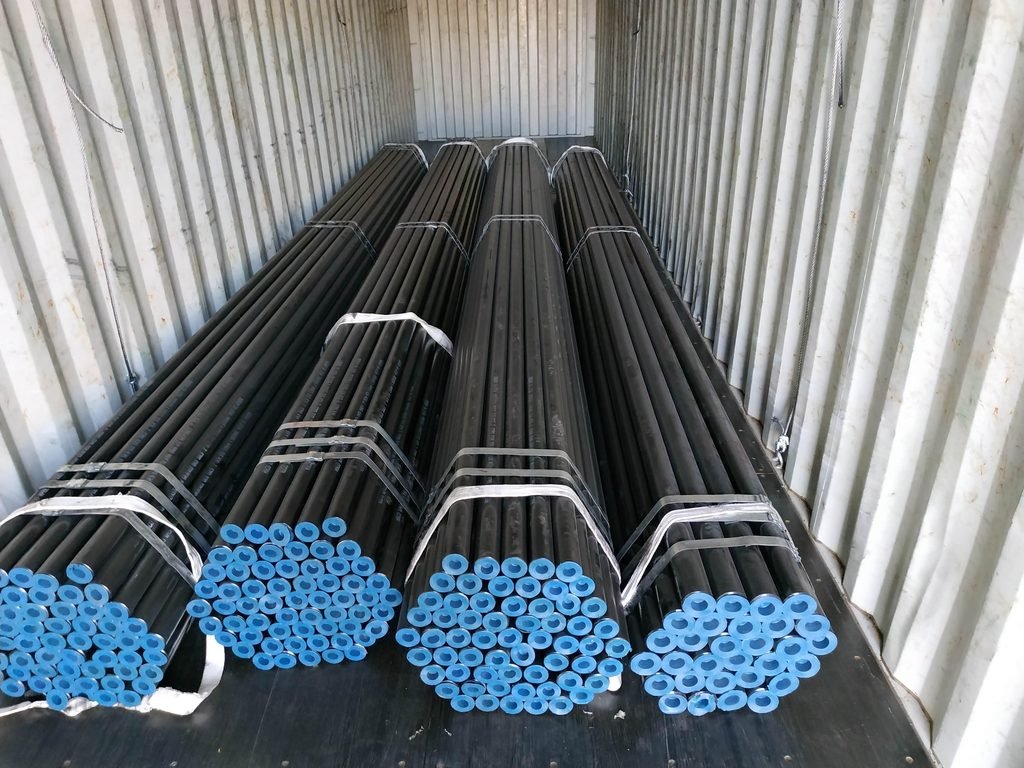
1. Why Is a Detailed Steel Pipe Purchase Order Important?
A steel pipe purchase order (PO) is more than a document confirming the product price and delivery date. It is the formal instruction that defines what the supplier must manufacture or deliver, how the products will be inspected, and which commercial conditions both parties have agreed to follow.
In international steel pipe procurement, even a small mistake in the purchase order can create significant problems.
For example:
- An incorrect material grade may make the pipes unsuitable for the intended application.
- An unclear wall thickness requirement may result in products with the wrong pressure capacity.
- Missing inspection requirements may lead to additional testing costs.
- Unspecified pipe end preparation may cause installation problems.
- Incomplete certification requirements may delay project acceptance.
- Unclear delivery terms may result in disputes over freight, insurance and transportation responsibilities.
These problems are particularly important for oil and gas pipelines, boiler systems, petrochemical facilities, power plants and structural engineering projects.
A properly prepared steel pipe PO should establish the technical, quality, commercial and logistical requirements before production begins.
This guide explains the essential information buyers should include when ordering seamless steel pipes, ERW pipes, LSAW pipes, SSAW pipes, stainless steel pipes and alloy steel pipes.
2. Basic Information of the Steel Pipe Purchase Order
Every purchase order should begin with clear identification of the transaction.
The following information should normally be included:
| Information | Details to Include |
|---|---|
| Purchase Order Number | Unique PO identification number |
| Purchase Order Date | Date of order issuance |
| Buyer Information | Company name, address and contact details |
| Supplier Information | Manufacturer or trading company’s legal name and address |
| Project Name | Project or end-user reference |
| Quotation Reference | Supplier quotation number and revision |
| Contract Reference | Related contract number, if applicable |
| Currency | USD, EUR or another agreed currency |
| Authorized Signatures | Authorized representatives of both parties, where required |
The purchase order number should be referenced in subsequent communications, production records, inspection reports, invoices and shipping documents.
For large projects, the buyer should also include a project number, equipment reference or piping line number to maintain traceability.
3. Specify the Steel Pipe Type and Manufacturing Process
One of the first technical requirements is identifying the exact type of steel pipe being purchased.
Steel pipes are manufactured through different processes, and the manufacturing method can affect their mechanical properties, dimensional characteristics, inspection requirements and applications.
Common manufacturing types include:
3.1 Seamless Steel Pipes
Seamless steel pipes are manufactured without a longitudinal welded seam.
They are widely used in:
- Oil and gas production.
- High-pressure piping systems.
- Boiler and heat exchanger applications.
- Mechanical engineering.
- Power generation.
A purchase order should clearly identify the product as seamless rather than simply stating carbon steel pipe.
3.2 ERW Steel Pipes
Electric Resistance Welded (ERW) pipes are manufactured by forming steel strip or coil into a tubular shape and joining the edges through resistance welding.
They are commonly used in structural applications, fluid transportation and certain industrial piping systems.
3.3 LSAW Steel Pipes
Longitudinal Submerged Arc Welded (LSAW) pipes are manufactured by forming steel plate into a pipe and welding the longitudinal seam using submerged arc welding.
They are commonly used in large-diameter pipeline projects and demanding industrial applications.
3.4 SSAW Steel Pipes
Spiral Submerged Arc Welded (SSAW) pipes are manufactured by forming steel strip into a spiral configuration and welding the seam.
They are frequently used in water transportation, infrastructure and certain pipeline applications.
Example of clear PO wording:
ASTM A106 Grade B Seamless Carbon Steel Pipe
Avoid vague descriptions such as:
Carbon Steel Pipe, Grade B
The manufacturing process and product specification should be explicitly identified.
4. Specify the Applicable Standard and Material Grade
The product standard and material grade are among the most important items in a steel pipe purchase order.
Different standards define different requirements for chemical composition, mechanical properties, manufacturing, testing and acceptance.
Common standards include:
| Standard | Product / Application |
|---|---|
| ASTM A106/A106M | Seamless carbon steel pipe for high-temperature service |
| ASTM A53/A53M | Black and galvanized welded and seamless steel pipe |
| ASTM A335/A335M | Seamless alloy steel pipe for high-temperature service |
| ASTM A312/A312M | Seamless and welded austenitic stainless steel pipe |
| ASTM A333/A333M | Seamless and welded steel pipe for low-temperature service |
| ASTM A213/A213M | Seamless alloy-steel and stainless-steel boiler, superheater and heat-exchanger tubes |
| API 5L | Line pipe for pipeline transportation systems |
| EN 10216 | Seamless steel tubes for pressure purposes |
| EN 10217 | Welded steel tubes for pressure purposes |
The purchase order should also specify the exact material grade.
Examples include:
- ASTM A106 Grade B.
- ASTM A53 Grade B.
- ASTM A335 P11.
- ASTM A335 P22.
- ASTM A335 P91.
- ASTM A312 TP304.
- ASTM A312 TP316L.
- API 5L X42.
- API 5L X52.
- API 5L X65.
For API 5L products, the applicable Product Specification Level (PSL 1 or PSL 2) should also be stated.
For standards with different editions, buyers should identify the applicable edition or revision required by the project.
If an equivalent material grade is permitted, the PO should define the approval procedure. A supplier should not independently substitute another grade simply because its mechanical properties appear similar.
5. Specify Pipe Dimensions, Wall Thickness and Tolerances
Incorrect dimensions are a common source of problems in steel pipe procurement.
The purchase order should clearly specify the pipe diameter, wall thickness, length and applicable dimensional tolerances.
5.1 Outside Diameter (OD)
Outside diameter is the measurement across the external surface of the pipe.
It may be specified in millimeters or inches.
For example:
- 60.3 mm.
- 88.9 mm.
- 114.3 mm.
- 168.3 mm.
- 219.1 mm.
The buyer should avoid relying on nominal pipe size alone when the governing standard or project specification requires an actual outside diameter.
5.2 Wall Thickness (WT)
Wall thickness determines the thickness of the pipe wall.
It may be specified directly in millimeters or through a Schedule designation.
For example:
- 6.35 mm.
- 8.18 mm.
- 10.31 mm.
- Schedule 40.
- Schedule 80.
When using Schedule designations, the applicable nominal pipe size and governing dimensional standard should also be specified.
5.3 Length
The buyer should state whether fixed or random lengths are required.
Common length descriptions include:
- Single Random Length (SRL).
- Double Random Length (DRL).
- Fixed Length.
The permitted length range and tolerance should be stated in the purchase order.
5.4 Dimensional Tolerances
The PO should identify the applicable dimensional tolerance requirements for:
- Outside diameter.
- Wall thickness.
- Length.
- Straightness.
- Ovality.
- End preparation.
These tolerances should be taken from the governing product standard or an agreed supplementary project specification.
Example: Pipe Dimension Specification
| Parameter | Required Specification |
|---|---|
| Product | Seamless Carbon Steel Pipe |
| Standard | ASTM A106/A106M |
| Grade | Grade B |
| Outside Diameter | 114.3 mm |
| Wall Thickness | 8.56 mm |
| Length | 6,000 mm |
| End Type | Beveled End |
| Quantity | 500 Pieces |
| Dimensional Tolerances | According to applicable ASTM requirements |
This level of detail makes it easier for the manufacturer to confirm production feasibility and reduces the risk of dimensional misunderstandings.
6. Specify Quantity and Unit of Measurement
The purchase order should state the total quantity and the unit used for ordering and commercial settlement.
Steel pipes are commonly purchased by:
- Metric tons (MT).
- Kilograms (kg).
- Pieces (pcs).
- Meters (m).
- Linear feet (ft).
For example:
Total Quantity: 100 MT
or
Quantity: 500 Pieces, 6 meters each
For mixed-size orders, each pipe specification should have a separate line item.
A typical order table may look like this:
| Item | Pipe Specification | Quantity |
|---|---|---|
| 1 | ASTM A106 Gr. B, 114.3 × 8.56 mm | 20 MT |
| 2 | ASTM A106 Gr. B, 168.3 × 10.97 mm | 30 MT |
| 3 | ASTM A106 Gr. B, 219.1 × 12.70 mm | 50 MT |
| Total | 100 MT |
The buyer should also clarify whether the agreed commercial quantity is based on theoretical weight or actual measured weight.
If a quantity tolerance is permitted, the acceptable percentage and its effect on final invoicing should be stated.
7. Specify Pipe End Preparation and Surface Treatment
Pipe ends and surface conditions affect installation, welding, connection compatibility and corrosion protection.
These requirements should be included in the PO.
7.1 Pipe End Types
Common pipe end configurations include:
Plain End (PE)
The pipe ends are supplied without special beveling or threading.
Beveled End (BE)
The pipe ends are prepared with a bevel for welding.
Threaded End (TE)
The pipe ends are machined with threads for threaded connections.
Threaded and Coupled (T&C)
The pipe is supplied with threaded ends and couplings.
The buyer should specify the thread standard, connection type, coupling requirements and protective accessories where applicable.
7.2 Surface Treatment
Common surface conditions include:
- Black or bare steel.
- Shot-blasted surface.
- Painted surface.
- Hot-dip galvanized coating.
- Fusion-bonded epoxy (FBE).
- Three-layer polyethylene (3LPE).
- Other specified internal or external coatings.
For coated pipes, the PO should state the coating system, applicable standard, coating thickness, surface preparation, inspection and acceptance criteria.
The coating manufacturer or approved coating specification may also need to be identified for project-specific orders.
8. Specify Inspection and Testing Requirements
Quality inspection is a critical part of steel pipe procurement.
A purchase order should clearly state which inspection and testing activities are required.
The buyer should distinguish between tests required by the product standard and additional tests requested by the project.
Common requirements include:
8.1 Chemical Composition Testing
Chemical composition testing verifies the content of carbon, manganese, silicon and other alloying elements.
Depending on the material grade, additional elements such as chromium, nickel, molybdenum, vanadium and copper may need to be checked.
8.2 Mechanical Testing
Mechanical testing may include:
- Tensile testing.
- Yield strength testing.
- Elongation testing.
- Hardness testing.
- Charpy impact testing.
- Flattening testing.
- Flaring testing.
Not all tests apply to every pipe product.
8.3 Hydrostatic Testing
Hydrostatic testing verifies pressure integrity under the specified test conditions.
The applicable standard and any additional test requirements should be stated.
8.4 Nondestructive Testing (NDT)
Depending on the product and project, NDT may include:
- Ultrasonic Testing (UT).
- Eddy Current Testing (ET).
- Magnetic Particle Testing (MT).
- Radiographic Testing (RT).
- Electromagnetic Inspection (EMI).
The PO should specify the required inspection method, extent of coverage, applicable procedure and acceptance criteria where these are additional or more specific than the standard requirements.
8.5 Third-Party Inspection
For major projects, buyers may require inspection by an independent third-party inspection agency.
Examples include SGS, Bureau Veritas, TÜV and other approved inspection organizations.
The PO should specify:
- Inspection agency.
- Inspection scope.
- Inspection stages.
- Hold points and witness points.
- Notification requirements.
- Inspection report requirements.
- Release documentation.
Third-party inspection requirements should be agreed before production starts because inspection scheduling can affect manufacturing and delivery lead time.
9. Specify Required Certificates and Technical Documents
Steel pipe procurement should include clear documentation requirements.
A common mistake is to request only a certificate without specifying which document or information is required.
Typical documents include:
9.1 Material Test Certificate (MTC)
The MTC provides material and test information associated with the supplied product.
Depending on the product standard and purchase requirements, it may include:
- Chemical composition.
- Mechanical properties.
- Heat treatment information.
- Heat number.
- Product identification.
- Relevant test results.
9.2 EN 10204 Inspection Documents
When EN 10204 certification is specified, the buyer should identify the required document type.
Type 2.2
A test report containing results based on non-specific inspection.
Type 3.1
An inspection certificate issued by the manufacturer’s authorized inspection representative independent of the manufacturing department, confirming conformity with the order based on specific inspection.
Type 3.2
An inspection certificate validated by both the manufacturer’s authorized inspection representative and the purchaser’s authorized inspection representative or an inspector designated by official regulations.
The required certification type should be confirmed in the PO rather than assumed.
9.3 Other Documents
Depending on the order, additional documents may include:
- Certificate of Conformity (COC).
- Hydrostatic Test Report.
- NDT Inspection Report.
- Dimensional Inspection Report.
- Heat Treatment Report.
- Coating Inspection Report.
- Third-Party Inspection Report.
- Packing List.
- Commercial Invoice.
- Certificate of Origin.
- Shipping Documents.
The buyer should specify the required number of copies, language, format and submission timing where necessary.
10. Specify Packaging, Marking and Identification Requirements
Packaging is important for preventing damage during handling, storage and transportation.
The purchase order should define how the pipes must be protected and identified.
10.1 Steel Pipe Packaging
Common packaging requirements include:
- Steel strapping or suitable bundling.
- Wooden supports or pallets.
- Plastic end caps.
- Thread protectors.
- Waterproof wrapping.
- Protective coating.
- Suitable lifting and handling arrangements.
Packaging should be appropriate for the pipe dimensions, weight, surface condition and shipping method.
For export orders, buyers should consider humidity, salt exposure, storage duration and transportation conditions.
10.2 Pipe Marking
Each pipe or bundle should carry the identification required by the product specification and purchase order.
Typical marking information includes:
- Manufacturer’s name or identification.
- Product standard.
- Steel grade.
- Outside diameter.
- Wall thickness.
- Heat number.
- Length.
- Batch or production number.
For large project orders, additional project references and bundle numbers may be required.
Correct marking helps maintain traceability during inspection, transportation, receiving and installation.
11. Specify Delivery Terms and Shipping Requirements
For international steel pipe orders, delivery requirements should be clearly stated.
Important information includes:
- Delivery destination.
- Required delivery date.
- Port of loading.
- Port of destination.
- Shipping method.
- Incoterms rule and named place or port.
- Partial shipment requirements.
- Transshipment requirements.
- Cargo insurance responsibilities.
- Required shipping documents.
Common Incoterms include:
EXW – Ex Works
The seller makes the goods available at the agreed location. The buyer generally assumes substantial transportation and export-related responsibilities, subject to the agreed arrangement.
FOB – Free on Board
The seller delivers the goods on board the vessel at the named port of shipment, with the relevant risk transferring according to the Incoterms rule.
CFR – Cost and Freight
The seller arranges and pays for freight to the named destination port, while risk transfers when the goods are on board at the port of shipment.
CIF – Cost, Insurance and Freight
The seller arranges and pays for freight and the required insurance to the named destination port, with risk transferring at the port of shipment.
The PO should state the applicable Incoterms edition, such as Incoterms 2020, and the exact named place or port.
For example:
Delivery Term: CIF Singapore, Incoterms 2020
12. Specify Price, Payment Terms and Contractual Conditions
Commercial terms should be confirmed before the supplier accepts the order.
The purchase order should include:
12.1 Unit Price and Total Amount
Specify the price per metric ton, piece or meter.
For example:
Unit Price: USD 1,250/MT
Total Quantity: 100 MT
Total Order Value: USD 125,000
The order should clarify whether the quoted price includes packaging, inspection, coating, transportation and other additional services.
12.2 Payment Terms
Common payment arrangements include:
- Advance payment and balance before shipment.
- Letter of Credit (L/C).
- Telegraphic Transfer (T/T).
- Other mutually agreed payment arrangements.
The exact payment schedule, bank charges and relevant payment milestones should be documented.
12.3 Delivery and Delay Provisions
The PO should identify:
- Production lead time.
- Required shipment date.
- Delivery schedule.
- Permitted partial shipments.
- Procedures for delivery delays.
- Agreed remedies or contractual provisions, where applicable.
12.4 Order Changes and Deviations
Any changes to the original specification should be documented and approved by both parties.
This includes:
- Material grade substitutions.
- Dimensional changes.
- Quantity adjustments.
- Additional inspection requirements.
- Delivery schedule changes.
- Packaging changes.
A supplier should not treat an unapproved deviation as an accepted alternative.
13. Steel Pipe Purchase Order Checklist
Before issuing the final PO, buyers can use the following checklist.
| Category | Required Information | Checked |
|---|---|---|
| Order Details | PO number, date and project reference | Yes / No |
| Product | Seamless, ERW, LSAW or SSAW | Yes / No |
| Material | Grade and product standard | Yes / No |
| Standard Edition | Applicable revision or edition | Yes / No |
| Dimensions | OD, wall thickness and length | Yes / No |
| Tolerances | Dimensional acceptance requirements | Yes / No |
| Quantity | Pieces, meters or metric tons | Yes / No |
| End Preparation | Plain, beveled, threaded or coupled | Yes / No |
| Surface Treatment | Bare, galvanized, painted or coated | Yes / No |
| Inspection | Hydrostatic test and NDT requirements | Yes / No |
| Certification | MTC, EN 10204 and other certificates | Yes / No |
| Third-Party Inspection | Agency and inspection scope | Yes / No |
| Packaging | Bundling and end protection | Yes / No |
| Marking | Grade, size, heat number and bundle ID | Yes / No |
| Delivery | Destination, date and Incoterms | Yes / No |
| Payment | Currency, price and payment schedule | Yes / No |
| Deviations | Approved technical and commercial exceptions | Yes / No |
This checklist can be used for both standard commercial orders and larger project-based procurement.
14. Example of a Steel Pipe Purchase Order Specification
The following example illustrates how the technical requirements can be presented in an order.
Product: Seamless Carbon Steel Pipe
Applicable Standard: ASTM A106/A106M
Material Grade: Grade B
Outside Diameter: 114.3 mm
Wall Thickness: 8.56 mm
Length: 6,000 mm
Pipe Ends: Beveled Ends
Quantity: 100 MT
Inspection Requirements: Applicable standard-required tests, including hydrostatic testing and any agreed supplementary NDT requirements.
Certification: EN 10204 Type 3.1 Inspection Certificate
Packaging: Steel bundles with protective end caps.
Marking: Manufacturer identification, ASTM standard, grade, dimensions and heat number.
Delivery Term: CIF Singapore, Incoterms 2020
Payment Terms: As mutually agreed in the signed contract.
Required Documents: MTC, hydrostatic test report, dimensional inspection report, packing list and commercial invoice.
This is an illustrative procurement specification, not a universal ASTM A106 acceptance template. Actual test requirements, tolerances and certification should be confirmed against the applicable standard edition and project specification.
15. Common Mistakes When Preparing Steel Pipe Purchase Orders
Even experienced buyers can overlook important details when preparing a steel pipe PO.
The following mistakes are particularly common.
1. Specifying Only the Material Grade
Writing ASTM A106 Grade B without identifying dimensions, length, quantity and end preparation does not provide a complete product specification.
2. Confusing Nominal Size with Actual Dimensions
The purchase order should identify the required NPS or DN together with the applicable outside diameter and wall thickness requirements.
3. Omitting the Standard Edition
Different standard editions may contain revised technical requirements. The governing edition should be clearly identified.
4. Leaving Inspection Requirements Undefined
Buyers should specify supplementary inspection requirements and avoid relying on general statements such as “100% inspection” without defining the method, coverage and acceptance criteria.
5. Requesting Certificates Too Late
MTC, NDT reports and third-party inspection requirements should be agreed before production begins.
6. Ignoring Pipe End and Connection Requirements
Incorrect bevel angles, threads or couplings can cause installation delays and additional machining costs.
7. Leaving Delivery Terms Incomplete
FOB, CIF and CFR should be accompanied by a named port or location and the applicable Incoterms edition.
8. Failing to Record Approved Deviations
All agreed departures from the original specification should be documented to avoid disputes during inspection and delivery.
16. Frequently Asked Questions About Steel Pipe Purchase Orders
What information is essential in a steel pipe purchase order?
A complete PO should include product type, material grade, standard, dimensions, wall thickness, length, quantity, inspection requirements, certification, packaging, delivery and payment terms.
Should the steel pipe standard be included in the PO?
Yes. The applicable standard and material grade define the technical requirements for the supplied product. The required edition should also be identified where relevant.
Should buyers specify the manufacturing process?
Yes, particularly when the manufacturing method is specified by the project or affects the product’s suitability. Seamless, ERW, LSAW and SSAW pipes should not be treated as automatically interchangeable.
What documents should a steel pipe supplier provide?
Depending on the order, these may include an MTC, chemical and mechanical test records, hydrostatic test report, NDT report, dimensional inspection report, coating records and shipping documents.
What is the difference between an MTC and a Certificate of Conformity?
An MTC provides material-specific test information and traceability. A COC is a declaration that the supplied product conforms to specified requirements. A COC does not automatically replace an MTC.
Should third-party inspection be included in the purchase order?
If independent inspection is required, the agency, inspection scope, timing, witness points, acceptance criteria and reporting requirements should be agreed in advance.
What is the difference between FOB and CIF in steel pipe procurement?
Under FOB, the seller delivers the goods on board at the named shipment port. Under CIF, the seller also arranges and pays for freight and the required insurance to the named destination port. Risk transfers at the port of shipment under both rules.
Can a supplier substitute an equivalent steel grade?
Only when the purchase agreement or buyer’s approved technical process permits it. Any proposed substitution should be formally reviewed and approved before production or delivery.
When should a steel pipe purchase order be issued?
A PO should be issued after the buyer and supplier have agreed on the technical specification, quantity, price, inspection, documentation and delivery terms.
Why is heat number traceability important?
Heat number traceability links supplied pipes to their manufacturing batch and material test records. It helps verify material identity and supports quality control throughout inspection, delivery and installation.
17. Conclusion
A steel pipe purchase order should do more than confirm the price and quantity of an order. It should establish the exact technical specification, inspection requirements, documentation and commercial conditions that govern the supply.
The most important details include the pipe manufacturing process, material grade, applicable standard, outside diameter, wall thickness, length, quantity, end preparation, coating, inspection, certification, packaging and delivery terms.
For international steel pipe procurement, these requirements should be agreed before production begins. Clear specifications reduce misunderstandings, prevent incorrect material supply, simplify inspection and help avoid unnecessary delivery delays.
Whether purchasing seamless carbon steel pipes, stainless steel pipes, alloy steel pipes or welded line pipes, a detailed purchase order provides a common reference for the buyer, manufacturer, inspector and logistics provider.
Looking for a Reliable Steel Pipe Manufacturer or Supplier?
When requesting a quotation, provide the required product standard, material grade, dimensions, quantity, inspection requirements and delivery destination.
A complete technical inquiry allows the manufacturer to evaluate production feasibility, confirm compliance requirements and prepare a more accurate quotation.
Request a quotation with the relevant material certificates, inspection reports and delivery documentation.