
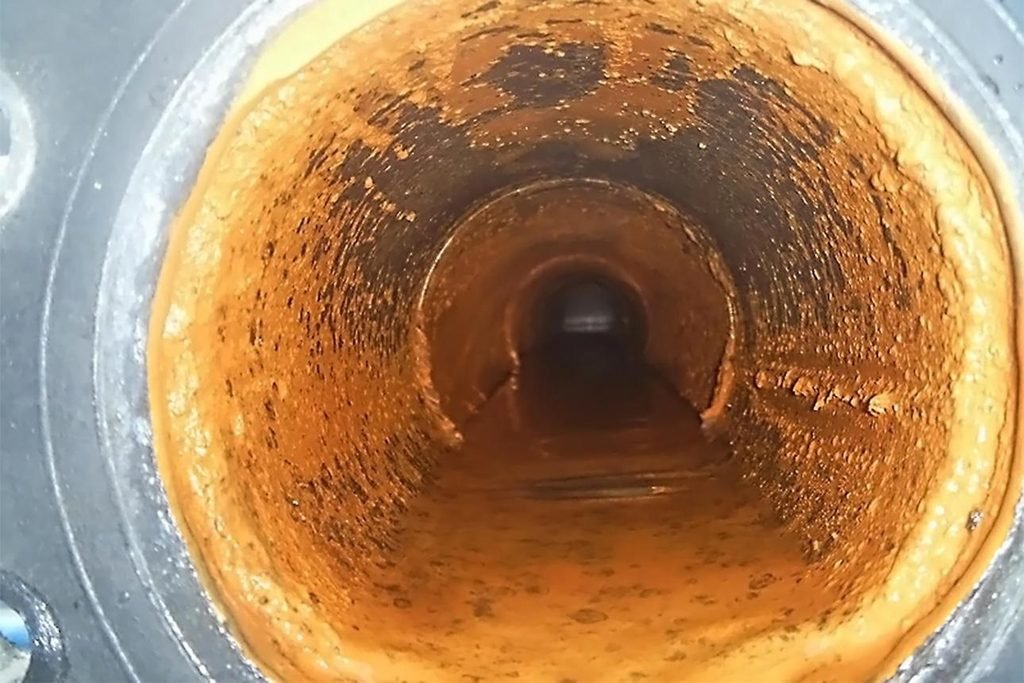
1. What Is Internal Corrosion in Carbon Steel Pipes?
Carbon steel pipes are widely used in oil and gas transportation, petrochemical plants, water supply systems, power generation and industrial processing. Their relatively low cost, good mechanical strength and availability in different grades make them a common choice for industrial piping systems.
However, carbon steel is susceptible to corrosion when its internal surface is exposed to water, dissolved gases, salts, chemicals and other corrosive substances.
Internal corrosion occurs on the inside surface of a pipe as a result of chemical or electrochemical reactions between the steel and the transported medium.
Unlike external corrosion, which is influenced by soil, atmospheric conditions or surrounding water, internal corrosion is primarily related to the composition and operating conditions of the fluid inside the pipeline.
If left uncontrolled, internal corrosion can cause:
- Reduction in pipe wall thickness.
- Localized pitting and deep metal loss.
- Leakage and pressure containment problems.
- Increased maintenance and inspection costs.
- Unplanned shutdowns.
- Premature replacement of pipeline sections.
For pipelines transporting oil, natural gas, produced water, seawater or industrial chemicals, selecting the right corrosion protection strategy is essential.
In practice, effective internal corrosion control usually involves a combination of fluid management, corrosion inhibitors, internal coatings, regular cleaning, material selection and condition monitoring.
2. What Causes Internal Corrosion in Carbon Steel Pipes?
Understanding the corrosion mechanism is the first step in selecting an appropriate protection method.
Several factors can accelerate internal corrosion in carbon steel pipelines.
2.1 Water and Moisture
Water is one of the most important factors contributing to internal corrosion.
When water contacts carbon steel, an electrochemical corrosion process can occur. The steel acts as the anode in localized corrosion cells, resulting in the dissolution of iron.
The corrosion rate depends on several factors, including:
- Water chemistry.
- Dissolved oxygen concentration.
- pH.
- Temperature.
- Chloride concentration.
- Flow conditions.
- Presence of dissolved CO2 and H2S.
In gas transmission systems, free water or condensed water can create localized wet areas on the internal pipe surface.
In oil and gas production systems, produced water can accumulate at the bottom of pipelines, creating conditions for localized corrosion.
Prevention: Control water content, remove accumulated free water, improve drainage and maintain appropriate dehydration systems.
2.2 Carbon Dioxide (CO2) Corrosion
CO2 corrosion, commonly called sweet corrosion in oil and gas operations, is a major degradation mechanism in carbon steel pipelines.
When carbon dioxide dissolves in water, it forms carbonic acid and changes the chemical environment at the steel surface.
This can promote electrochemical iron dissolution.
The severity of CO2 corrosion depends on factors such as:
- CO2 partial pressure.
- Temperature.
- Water chemistry.
- pH.
- Flow velocity.
- Formation and stability of corrosion product films.
Under certain conditions, iron carbonate (FeCO3) can form on the steel surface.
This corrosion product may provide some protection when a sufficiently stable and adherent layer develops. However, its protective performance varies with operating conditions.
Changes in flow, temperature and water chemistry can destabilize the layer and expose fresh steel.
Prevention: Apply an appropriate corrosion inhibitor, control free water, monitor fluid chemistry and consider corrosion-resistant materials where operating conditions justify them.
2.3 Hydrogen Sulfide (H2S) Corrosion
H2S is another important corrosion factor in oil and gas production.
When hydrogen sulfide dissolves in water, it creates a corrosive environment and can promote the formation of iron sulfide corrosion products.
Although some iron sulfide films may provide partial protection, they are not necessarily stable under all operating conditions.
Localized breakdown can lead to pitting corrosion.
H2S-containing environments also introduce the risk of hydrogen-related damage, including sulfide stress cracking (SSC) in susceptible materials under appropriate combinations of material properties, stress and environmental conditions.
The severity of H2S-related damage depends on:
- H2S partial pressure.
- pH.
- Temperature.
- Chloride concentration.
- Material hardness and strength.
- Applied and residual stress.
- Exposure conditions.
For sour service, material selection must consider the applicable requirements of ISO 15156/NACE MR0175, where relevant.
Prevention: Evaluate sour-service conditions, select suitable materials, control corrosion through qualified chemical treatment and maintain appropriate inspection and monitoring programs.
2.4 Dissolved Oxygen Corrosion
Oxygen can significantly accelerate corrosion in carbon steel pipelines, particularly in water transportation systems and systems exposed to air during operation or maintenance.
Dissolved oxygen acts as a cathodic reactant and supports electrochemical corrosion.
It can also contribute to localized attack, especially when oxygen concentration varies across the pipe surface.
Potential sources include:
- Air entering through leaks.
- Inadequate deaeration.
- Water injection systems.
- Maintenance and pipeline commissioning.
- Oxygen contamination in process fluids.
Prevention: Use suitable deaeration systems, minimize air ingress and apply oxygen scavengers where compatible with the process chemistry.
2.5 Microbiologically Influenced Corrosion (MIC)
Microbiologically influenced corrosion occurs when microorganisms and their associated metabolic activities influence corrosion processes.
It is particularly relevant in systems containing stagnant water, deposits, biofilms and suitable nutrients.
Sulfate-reducing bacteria (SRB) are frequently discussed in relation to oilfield corrosion. Other microbial groups can also contribute to localized corrosion.
MIC may cause:
- Localized pitting.
- Under-deposit corrosion.
- Biofilm formation.
- Accelerated metal loss in susceptible environments.
An important feature of MIC is that severe localized damage can occur even when the average corrosion rate appears relatively low.
Prevention: Maintain effective cleaning and water management, assess microbial activity, and use compatible biocide treatment when supported by water analysis and an appropriate treatment program.
2.6 Deposits and Under-Deposit Corrosion
Sand, scale, corrosion products, wax and other solid deposits can accumulate inside carbon steel pipes.
These deposits can create local differences in oxygen concentration, chemistry and flow conditions.
The resulting environment may promote localized corrosion beneath the deposits.
Deposits can also reduce the effective flow area and interfere with corrosion inhibitor distribution.
Prevention: Establish an appropriate pipeline cleaning and pigging program, manage solids production and monitor deposit accumulation.
3. Main Methods for Preventing Internal Corrosion in Carbon Steel Pipes
There is no single corrosion protection method suitable for every pipeline.
The appropriate solution depends on the transported medium, operating temperature, pressure, fluid chemistry, flow regime and maintenance requirements.
The following methods are commonly used in industrial pipeline systems.
3.1 Corrosion Inhibitor Injection
Corrosion inhibitors are chemicals added to the transported fluid to reduce the corrosion rate of carbon steel.
For many oil and gas applications, organic film-forming inhibitors are used.
These chemicals can adsorb onto the steel surface and form a protective film that reduces the interaction between the metal and corrosive species.
Common inhibitor categories include:
- Film-forming organic inhibitors.
- Imidazoline-based inhibitors.
- Amine-based inhibitors.
- Quaternary ammonium compounds.
- Other application-specific inhibitor formulations.
The selection of an inhibitor should consider:
- Fluid composition.
- Water cut and water chemistry.
- CO2 and H2S concentrations.
- Operating temperature.
- Flow velocity.
- Compatibility with production chemicals.
- Emulsion and separation behavior.
- Dosage and injection equipment.
A typical treatment system includes a chemical storage tank, metering pump, injection point and suitable monitoring arrangement.
The effectiveness of the inhibitor should be verified through corrosion coupons, probes, fluid analysis and inspection data.
It is important not to assume that one inhibitor formulation or dosage is suitable for every carbon steel pipeline.
3.2 Internal Epoxy Coating
Internal coatings provide a physical barrier between the carbon steel surface and the transported medium.
Epoxy-based coatings are commonly used in selected water, oil and gas pipeline applications.
A properly selected and applied internal coating can reduce direct contact between the steel substrate and corrosive fluids.
Potential benefits include:
- Reduced direct exposure of steel to water and corrosive chemicals.
- Improved resistance to selected chemical environments.
- Reduced internal surface roughness.
- Better control of certain corrosion mechanisms.
- Easier cleaning in some applications.
However, coating performance depends on the coating formulation, surface preparation, application conditions, curing, adhesion and operating environment.
Before specifying an internal coating, buyers should consider:
- Operating temperature.
- Fluid composition.
- Chemical compatibility.
- Flow velocity.
- Abrasion and erosion risks.
- Coating thickness.
- Holiday detection requirements.
- Repair procedures.
Coatings should not be selected solely because they are described as epoxy or corrosion-resistant. The actual coating system must be qualified for the intended service.
3.3 Pipeline Pigging and Internal Cleaning
Pipeline pigging is an important part of internal corrosion management.
A pipeline pig is a device inserted into a pipeline and transported by the flowing medium or another driving force.
Different pigs perform different functions.
Cleaning Pigs
Used to remove accumulated wax, sand, scale and other deposits.
Brush Pigs
Equipped with brushes for removing certain deposits and loose corrosion products.
Foam Pigs
Used for cleaning, drying and separating fluids, depending on their design.
Intelligent Inspection Pigs
Equipped with sensors to assess pipeline conditions and identify selected defects.
Common intelligent inspection technologies include:
- Magnetic Flux Leakage (MFL).
- Ultrasonic Testing (UT).
- Geometry measurement tools.
Regular pigging can improve flow conditions, remove deposits and support corrosion management.
However, cleaning alone does not eliminate the underlying corrosion mechanism. It should be combined with water management, chemical treatment and inspection.
3.4 Water Removal and Dehydration
Removing free water is one of the most effective approaches to reducing corrosion risk in many gas transmission and oil production systems.
Water can act as the electrolyte required for electrochemical corrosion.
Dehydration systems are therefore used to reduce water content and prevent liquid water accumulation.
Depending on the application, methods include:
- Gas dehydration using glycol systems.
- Molecular sieve dehydration.
- Water separation.
- Drainage of accumulated liquids.
- Dehydration of process streams.
For gas pipelines, the required water specification should be established according to operating conditions and the risk of liquid condensation.
For multiphase pipelines, liquid water management is more complex because water can accumulate at low points and create localized corrosion conditions.
3.5 Material Selection and Corrosion Allowance
Material selection should be based on the actual operating environment.
Carbon steel is often selected because of its mechanical properties, availability and cost.
However, in highly corrosive environments, a higher corrosion allowance alone may not provide sufficient protection.
Potential material strategies include:
- Increasing the specified corrosion allowance where justified.
- Selecting a more corrosion-resistant carbon steel grade where appropriate.
- Using corrosion-resistant alloys (CRAs).
- Selecting stainless steel.
- Using clad or lined pipe systems.
- Applying qualified internal coatings.
For sour service, the material must also satisfy the relevant environmental cracking resistance requirements.
A higher strength steel grade should not automatically be considered more corrosion-resistant.
The selection should account for corrosion rate, localized corrosion, hydrogen-related damage, mechanical loading and total lifecycle cost.
3.6 Flow Velocity and Operating Condition Control
Flow conditions influence the distribution of water, deposits, corrosion products and inhibitors inside a pipeline.
Very low flow velocities may encourage liquid accumulation and deposit formation.
Excessively high velocities, particularly in the presence of sand or other solids, can contribute to erosion-corrosion.
Therefore, flow velocity should be evaluated together with:
- Fluid composition.
- Water cut.
- Solid particle concentration.
- Pipe geometry.
- Temperature.
- Pressure.
- Pipeline operating regime.
There is no universal velocity that guarantees corrosion prevention.
The appropriate operating range should be determined through engineering assessment and operating data.
4. Comparison of Internal Corrosion Protection Methods
Different protection methods address different corrosion mechanisms.
| Protection Method | Main Function | Typical Applications | Important Limitation |
|---|---|---|---|
| Corrosion Inhibitors | Reduce electrochemical corrosion | Oil and gas pipelines | Requires continuous and effective chemical treatment |
| Internal Epoxy Coating | Provide a physical barrier | Water and selected industrial pipelines | Coating defects and damage can expose steel |
| Pipeline Pigging | Remove deposits and support inspection | Oil, gas and multiphase pipelines | Does not independently stop corrosion |
| Water Removal | Reduce electrolyte availability | Gas and process pipelines | Requires control of water sources and condensation |
| Biocide Treatment | Control susceptible microorganisms | Water and oilfield systems | Requires compatibility and microbial assessment |
| Material Upgrade | Improve resistance to specific environments | Aggressive chemical and sour service | Higher initial material cost |
| Flow Control | Reduce deposition and erosion-corrosion risks | Industrial process pipelines | Requires operating-condition assessment |
For many operating pipelines, a combination of methods provides more reliable protection than relying on one treatment alone.
5. Internal Coating vs Corrosion Inhibitors: Which Is Better?
Both internal coatings and corrosion inhibitors are used to protect carbon steel pipelines, but their working principles are different.
Internal coatings create a physical barrier, while inhibitors modify the corrosion reactions occurring at the metal-fluid interface.
| Comparison | Internal Coating | Corrosion Inhibitor |
|---|---|---|
| Protection Principle | Physical barrier | Chemical protection film or reaction modification |
| Application | Applied to the pipe surface | Injected into the process fluid |
| Protection Distribution | Depends on coating continuity | Depends on chemical transport and surface coverage |
| Maintenance | Coating inspection and repair | Chemical monitoring and replenishment |
| Typical Use | New pipe manufacture and selected rehabilitation projects | Operating oil and gas systems |
| Main Risk | Holidays, damage and poor adhesion | Incorrect dosage or poor chemical distribution |
When Should Internal Coating Be Used?
Internal coatings are suitable when the transported fluid and operating conditions are compatible with the selected coating system.
They are particularly useful when the pipeline is being manufactured or rehabilitated and the internal surface can be properly prepared and coated.
When Should Corrosion Inhibitors Be Used?
Corrosion inhibitors are useful when corrosion is occurring in an operating pipeline and chemical injection can be implemented effectively.
They are particularly relevant to oil and gas systems containing water and corrosive gases.
Can Both Methods Be Used Together?
Yes.
In suitable applications, internal coatings and corrosion inhibitors can provide complementary protection.
However, their compatibility and actual contribution to corrosion control must be evaluated rather than assumed.
6. Corrosion Monitoring and Inspection of Carbon Steel Pipelines
Corrosion prevention should be supported by regular monitoring.
Without reliable inspection data, it is difficult to determine whether a protection program is effective.
Common monitoring methods include the following.
6.1 Corrosion Coupons
Corrosion coupons are metal specimens exposed to the process environment.
After a specified exposure period, the coupons are removed, cleaned and evaluated to estimate metal loss and average corrosion rate.
They can provide useful information about corrosion trends.
However, coupon results represent the local exposure conditions and may not capture every localized corrosion mechanism.
6.2 Electrical Resistance (ER) Probes
ER probes monitor changes in electrical resistance as the sensing element loses metal through corrosion.
They provide information about metal loss over time and can support continuous or periodic monitoring.
6.3 Linear Polarization Resistance (LPR)
LPR is an electrochemical technique used to estimate corrosion rates under suitable conditions.
It is commonly applied in conductive aqueous environments where the measurement assumptions are appropriate.
6.4 Intelligent Pipeline Inspection
Intelligent pigging can help identify and characterize selected pipeline defects.
Common technologies include MFL and ultrasonic inspection.
Depending on the tool and operating conditions, these methods can provide information about:
- Internal metal loss.
- External metal loss.
- Localized corrosion.
- Wall thickness reduction.
- Certain deformation and geometry anomalies.
The results should be evaluated by qualified pipeline integrity personnel and compared with previous inspection data where available.
6.5 Visual Inspection and Deposit Analysis
Recovered deposits, corrosion products and pigging debris can provide useful information about pipeline condition.
Laboratory analysis may help identify:
- Iron oxides.
- Iron sulfides.
- Scale deposits.
- Sand and other solids.
- Evidence of microbial activity.
This information can help identify the likely corrosion mechanism and improve treatment selection.
7. How to Develop an Internal Corrosion Prevention Program
A successful corrosion prevention program should be based on operating data rather than a generic treatment recommendation.
A practical approach includes the following stages.
Step 1: Evaluate the Transported Medium
Identify water content, CO2, H2S, dissolved oxygen, chloride concentration, pH and suspended solids.
Step 2: Identify the Corrosion Mechanisms
Determine whether the main risks involve CO2 corrosion, H2S corrosion, oxygen corrosion, MIC, under-deposit corrosion or erosion-corrosion.
Step 3: Assess Operating Conditions
Review pressure, temperature, flow velocity, water accumulation and operating changes.
Step 4: Select Protection Methods
Evaluate the suitability of corrosion inhibitors, internal coatings, dehydration, pigging, material upgrades and other measures.
Step 5: Establish Monitoring Requirements
Select suitable corrosion coupons, probes, fluid analysis and pipeline inspection methods.
Step 6: Review Performance
Compare inspection results, corrosion rates, chemical consumption and operating records.
Step 7: Adjust the Program
Modify chemical treatment, cleaning frequency, operating conditions or material specifications when the monitoring data indicate that changes are necessary.
A corrosion management program should be reviewed whenever the transported medium, operating conditions or pipeline configuration changes significantly.
8. How to Choose Carbon Steel Pipes for Corrosion-Prone Environments
When purchasing carbon steel pipes for corrosive service, buyers should not select products based on material grade and dimensions alone.
The following information should be reviewed before ordering:
| Selection Factor | What Buyers Should Check |
|---|---|
| Material Standard | ASTM, API or applicable EN specification |
| Steel Grade | Grade and mechanical property requirements |
| Fluid Composition | Water, CO2, H2S, oxygen and chlorides |
| Operating Temperature | Normal and maximum design temperatures |
| Operating Pressure | Design and operating pressure |
| Wall Thickness | Required thickness and corrosion allowance |
| Internal Protection | Coating, lining or chemical treatment |
| Inspection | Hydrostatic testing and applicable NDT |
| Documentation | MTC, inspection reports and coating records |
| Service Conditions | Flow regime, solids and maintenance access |
For applications involving H2S, buyers should evaluate sour-service material requirements.
For water and chemical transportation, the compatibility of the steel grade and internal coating with the actual fluid chemistry should be confirmed.
For highly aggressive environments, corrosion-resistant alloys or lined and clad pipe systems may offer better long-term performance than conventional carbon steel.
The final decision should consider both initial purchase cost and lifecycle cost.
9. Common Mistakes in Carbon Steel Pipeline Corrosion Protection
Several mistakes can reduce the effectiveness of an internal corrosion prevention program.
Mistake 1: Treating All Corrosion as Uniform Rusting
Internal corrosion can be localized. Pitting and under-deposit corrosion may cause serious wall loss even when the overall corrosion rate appears moderate.
Mistake 2: Selecting Corrosion Inhibitors Without Fluid Analysis
Inhibitor performance depends on water chemistry, temperature, gas composition and chemical compatibility.
Mistake 3: Relying Only on Internal Coating
Coating defects, damage and unprotected areas can become corrosion initiation sites.
Mistake 4: Ignoring Microbiologically Influenced Corrosion
Deposits and stagnant water can support microbial activity and localized corrosion.
Mistake 5: Using Cathodic Protection as the Main Solution for Internal Corrosion
Conventional pipeline cathodic protection is primarily used to control external corrosion on buried or submerged metallic pipelines. It should not be treated as a substitute for internal corrosion control.
Mistake 6: Ignoring Corrosion Monitoring Data
A protection program should be evaluated through inspection, corrosion monitoring and operating records.
Mistake 7: Choosing a Higher Strength Steel Grade Without Environmental Assessment
Higher strength does not automatically mean better corrosion resistance or better performance in sour service.
10. Frequently Asked Questions
What is the main cause of internal corrosion in carbon steel pipes?
Water is a key factor because it provides an electrolyte for electrochemical corrosion. Dissolved CO2, H2S, oxygen, chlorides, microorganisms and deposits can further influence corrosion severity.
How can internal corrosion in carbon steel pipelines be prevented?
Common approaches include water removal, corrosion inhibitor injection, internal coatings, pipeline pigging, microbial control, appropriate material selection and regular monitoring.
Which coating is best for the inside of carbon steel pipes?
Epoxy-based systems are commonly used in selected applications. However, the best coating depends on the transported medium, temperature, pressure, chemical compatibility and application requirements.
Are corrosion inhibitors effective for carbon steel pipes?
Yes, appropriately selected inhibitors can significantly reduce corrosion under suitable conditions. Their effectiveness depends on chemical formulation, dosage, fluid composition, temperature and distribution throughout the pipeline.
What is the difference between CO2 corrosion and H2S corrosion?
CO2 corrosion involves carbon dioxide dissolved in water and associated electrochemical reactions. H2S corrosion involves hydrogen sulfide and can produce iron sulfide films as well as hydrogen-related material damage under susceptible conditions.
Can stainless steel completely eliminate internal corrosion?
No material is immune to every corrosive environment. Stainless steel can offer improved resistance in suitable applications, but its performance depends on grade, temperature, chloride concentration and other environmental conditions.
Does pipeline pigging prevent corrosion?
Pigging removes deposits and accumulated liquids and supports inspection. It can reduce conditions that promote corrosion, but it does not independently eliminate the need for chemical treatment or water management.
What is microbiologically influenced corrosion (MIC)?
MIC is corrosion influenced by microbial activity and associated biofilms or metabolic products. It can produce localized pitting and under-deposit corrosion in susceptible pipeline environments.
What is the difference between internal and external pipeline corrosion?
Internal corrosion occurs on the pipe’s inside surface due to the transported fluid and its contaminants. External corrosion results from exposure to surrounding soil, air, water or other external environments.
How often should carbon steel pipelines be inspected for internal corrosion?
There is no universal inspection interval. It should be established through a risk-based integrity assessment considering corrosion mechanisms, operating history, inspection results, applicable regulations and the consequences of failure.
11. Conclusion
Internal corrosion is one of the main degradation risks for carbon steel pipelines used in oil and gas production, chemical processing, water transportation and industrial systems.
Water, CO2, H2S, oxygen, microorganisms and accumulated deposits can contribute to different corrosion mechanisms.
Effective protection requires more than selecting a corrosion-resistant material or applying a single chemical treatment.
A reliable strategy should combine fluid management, corrosion inhibitors, internal coatings where suitable, pipeline cleaning, appropriate material selection and continuous condition monitoring.
For new carbon steel pipe projects, corrosion protection requirements should be considered during material selection and procurement. For existing pipelines, inspection data and operating conditions should guide the selection and adjustment of mitigation measures.
Looking for Carbon Steel Pipes for Corrosive Service?
When selecting carbon steel pipes for industrial pipelines, confirm the applicable ASTM or API standard, material grade, dimensions, wall thickness, operating conditions and internal corrosion protection requirements.
A clear technical specification helps manufacturers supply products that meet project requirements and supports more effective pipeline corrosion management.