
1. What Are Steel Pipe Delivery Conditions?
Steel pipe delivery condition refers to the final manufacturing and metallurgical condition of a pipe when it is supplied to the buyer.
It describes the processing route used before delivery, including hot finishing, cold working and any specified final heat treatment.
Delivery condition is important because the same steel grade can exhibit different mechanical properties depending on its manufacturing and thermal history.
Common steel pipe delivery conditions include:
- Hot Finished or As-Rolled (HF/AR).
- Normalized (N).
- Annealed (A).
- Quenched and Tempered (Q&T or QT).
- Normalized and Tempered (N&T).
- Solution Annealed (SA), mainly for stainless steel pipes.
These conditions are not interchangeable. Each involves different heating, cooling or deformation processes and produces a different combination of strength, hardness, ductility and toughness.
For example, hot-finished seamless pipes may be supplied without a separate final heat treatment when the product specification permits it. Normalized pipes undergo a defined heating and air-cooling cycle, while annealed pipes are treated to achieve a specified softer or more stable metallurgical condition.
Quenched and tempered pipes undergo two successive treatments to obtain the required balance of strength and toughness.
For steel pipe buyers, the delivery condition should be confirmed before ordering and verified through the applicable product standard, material test certificate (MTC) and heat treatment records.
2. Why Does Steel Pipe Delivery Condition Matter?
Selecting the correct delivery condition is important for manufacturing quality, fabrication and service performance.
2.1 Mechanical Properties
Heat treatment changes the microstructure of steel and therefore affects:
- Yield strength.
- Tensile strength.
- Hardness.
- Elongation.
- Impact toughness.
- Ductility.
The final properties depend on the steel composition, pipe dimensions, heating temperature, holding time and cooling conditions.
2.2 Microstructure and Grain Refinement
Different thermal cycles produce different microstructures.
Normalizing is commonly used to refine and improve the uniformity of the microstructure in suitable carbon and low-alloy steels.
Annealing can soften the material and reduce residual stresses.
Quenching can produce a hardened structure, often containing martensite, while subsequent tempering adjusts its hardness and toughness.
2.3 Machinability and Fabrication
Delivery condition also affects downstream processing.
- Annealed steel is generally easier to machine and form.
- Normalized steel often offers a useful balance of strength and machinability.
- Quenched and tempered steel may require more carefully controlled machining and welding procedures.
- Hot-finished pipes may require additional processing depending on dimensional and surface requirements.
2.4 Service Performance
Different applications require different combinations of mechanical properties.
For example:
- General industrial piping may use a permitted hot-finished condition.
- Pressure-bearing applications require compliance with the relevant product specification.
- Low-temperature service requires specified impact toughness.
- High-temperature alloy steel pipes require controlled metallurgical properties.
- High-strength applications may require a quenched and tempered condition.
The correct delivery condition must therefore be determined by the material grade, design requirements and applicable standard.
3. Hot Rolled Steel Pipes: Manufacturing Process and Characteristics
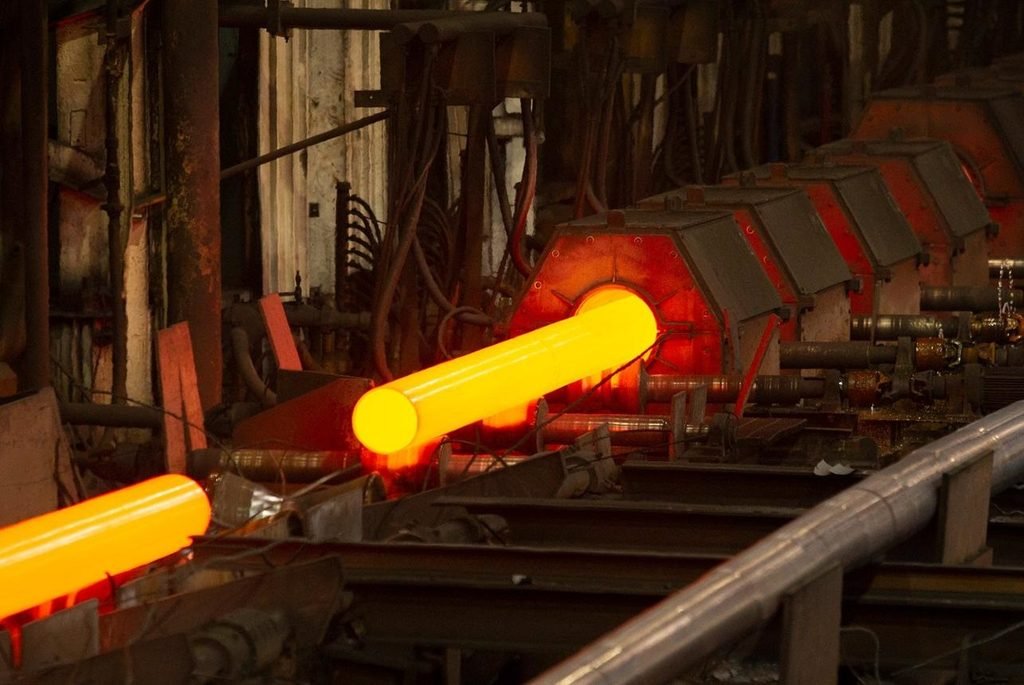
Hot rolling is a metal forming process performed at elevated temperatures, generally above the steel’s recrystallization temperature range.
For seamless steel pipes, the manufacturing process usually begins with a heated round billet.
The billet is pierced to form a hollow shell, which is then elongated and rolled to the required dimensions.
After hot finishing, the pipe is cooled according to the specified manufacturing route.
3.1 Hot Finished Steel Pipe Manufacturing Process
A typical seamless hot-finished pipe production route includes:
- Steel billet preparation.
- Billet heating.
- Rotary piercing.
- Hollow shell formation.
- Elongation and rolling.
- Sizing or reducing.
- Cooling.
- Straightening and cutting.
- Inspection and testing.
3.2 Characteristics of Hot Rolled Steel Pipes
Typical characteristics include:
- Efficient manufacturing.
- A wide range of available dimensions.
- No longitudinal weld seam in seamless products.
- Surface conditions influenced by high-temperature processing.
- Mechanical properties dependent on the steel grade and rolling schedule.
Hot-finished products may be supplied without an additional final heat treatment if permitted by the relevant product specification.
However, hot finished and normalized are not automatically equivalent.
Normalizing requires a specified heat treatment cycle, whereas hot finishing involves controlled hot working and subsequent cooling.
3.3 Advantages
Manufacturing Efficiency
Hot rolling is an established and efficient process for producing seamless steel pipes.
Wide Product Range
Hot-finished seamless pipes are available in various diameters and wall thicknesses.
Cost Considerations
Where additional heat treatment is not required, hot-finished products may avoid the cost and lead time associated with a separate heat treatment operation.
3.4 Limitations
Depending on the manufacturing route, hot-finished pipes may have:
- Less precise dimensional tolerances than cold-finished pipes.
- A relatively rough surface finish.
- Oxide scale.
- Property variations associated with rolling and cooling conditions.
3.5 Typical Applications
Hot-finished steel pipes are used in:
- General industrial piping.
- Mechanical engineering.
- Structural applications.
- Oil and gas facilities.
- Pressure piping where the applicable standard permits the condition.
4. Normalized Steel Pipes: Process and Characteristics
Normalizing is a heat treatment process used to refine the microstructure and improve the consistency of mechanical properties.
The steel is heated into the appropriate austenitizing temperature range, held for the specified period and then cooled in still air or under the specified air-cooling conditions.
For many carbon and low-alloy steels, normalizing produces a refined ferrite-pearlite microstructure.
The actual structure depends on the steel composition, dimensions and cooling conditions.
4.1 Normalizing Process
The typical process includes:
- Heating the steel pipe to the specified normalizing temperature.
- Holding the pipe until the required thermal conditions are achieved.
- Cooling in air under controlled conditions.
- Inspecting the final mechanical properties.
The required temperature and holding time must be determined according to the material grade, pipe dimensions and applicable specification.
There is no single normalizing temperature suitable for every steel pipe.
4.2 Advantages of Normalized Steel Pipes
Refined Microstructure
Normalizing can refine the grain structure and improve microstructural uniformity.
Improved Mechanical Consistency
A properly controlled cycle can improve consistency in strength and ductility.
Suitable Toughness
Normalizing is commonly used when a controlled strength-toughness balance is required.
Preparation for Further Processing
It can provide a suitable starting condition for subsequent machining or other heat treatment operations.
4.3 Limitations
Normalizing requires additional heating and cooling operations.
It may increase:
- Energy consumption.
- Manufacturing costs.
- Production time.
- Surface oxidation.
- Risk of distortion.
4.4 Typical Applications
Normalized steel pipes are used in:
- Pressure piping.
- Boiler and heat exchanger applications.
- Structural engineering.
- Selected low-temperature applications.
- Carbon and low-alloy steel components requiring specified mechanical properties.
5. Annealed Steel Pipes: Process and Characteristics
Annealing is a family of heat treatment processes used to soften steel, improve ductility, reduce residual stress or establish a required microstructure.
The steel is heated to a specified temperature, held for the required duration and cooled according to the selected annealing procedure.
Unlike normalizing, full annealing generally involves slower controlled cooling, often in a furnace.
The cooling route depends on the type of annealing.
5.1 Common Types of Annealing
Full Annealing
Steel is heated into the appropriate transformation range and slowly cooled, commonly in a furnace, to obtain a relatively soft condition.
Process Annealing
Used mainly to restore ductility in cold-worked steel before further forming operations.
Stress Relief Annealing
Performed below the main transformation temperature range to reduce residual stresses without necessarily producing a complete phase transformation.
Isothermal Annealing
Uses a controlled cooling and holding sequence to obtain a more uniform transformation structure.
Solution Annealing
Particularly important for stainless steel pipes. The material is heated to dissolve specified precipitates and then rapidly cooled according to the applicable specification.
These treatments have different objectives and should not be treated as one identical process.
5.2 Advantages of Annealed Steel Pipes
Improved Machinability
A suitable annealed condition can reduce hardness and improve machining performance.
Higher Ductility
Annealing can improve the ability of steel to undergo plastic deformation.
Reduced Residual Stress
Suitable annealing cycles can reduce stresses introduced during forming or cold working.
Improved Formability
Annealed steel is often easier to bend, draw or form, depending on the material grade.
5.3 Limitations
Compared with normalized or quenched and tempered steel, fully annealed steel often has lower strength and hardness.
Additional processing may be necessary if the final application requires higher mechanical properties.
5.4 Typical Applications
Annealed steel pipes are commonly used in:
- Precision machining.
- Cold forming.
- Mechanical components.
- Selected alloy steel applications.
- Stainless steel piping.
- Applications requiring improved ductility or reduced residual stress.
6. Quenched and Tempered Steel Pipes: Process and Characteristics
Quenching and tempering (Q&T) is a combined heat treatment process used to obtain a specific balance of strength, hardness and toughness.
It consists of two main stages: quenching followed by tempering.
6.1 Quenching Process
During quenching, steel is heated to the appropriate austenitizing temperature and then rapidly cooled using a specified cooling medium.
Common quenching media include:
- Water.
- Oil.
- Polymer solutions.
- Controlled gas or other approved cooling media.
The rapid cooling changes the austenitic structure into a hardened microstructure.
For suitable steel grades, this commonly involves the formation of martensite.
The as-quenched condition can have high hardness and strength, but may also have excessive brittleness and residual stress.
6.2 Tempering Process
After quenching, the steel is reheated to a specified temperature below the lower critical transformation temperature.
It is held for the required duration and then cooled according to the approved process.
Tempering helps to:
- Reduce brittleness.
- Adjust hardness.
- Improve toughness.
- Relieve part of the residual stress.
- Establish the required strength and ductility balance.
The final mechanical properties depend on the steel composition and tempering temperature and time.
6.3 Advantages of Quenched and Tempered Steel Pipes
High Strength
Q&T treatment can achieve high yield and tensile strength in suitable alloy systems.
Improved Strength-Toughness Balance
Proper tempering allows high strength to be combined with useful impact toughness.
Controlled Hardness
The tempering cycle can be adjusted to achieve specified hardness requirements.
Suitable for Demanding Applications
Q&T steel is used where higher mechanical performance is required.
6.4 Limitations
The process requires careful temperature and cooling control.
Potential issues include:
- Quenching cracks.
- Distortion.
- Residual stresses.
- Uneven hardness.
- Inconsistent mechanical properties.
- Increased manufacturing cost.
Welding also requires attention to material hardenability, preheat requirements, heat input and any specified post-weld heat treatment.
6.5 Typical Applications
Quenched and tempered steel pipes are used in selected applications involving:
- High-strength mechanical components.
- Oil and gas production equipment.
- High-pressure equipment.
- Engineering machinery.
- Specialised alloy steel products.
The applicable product standard must permit or require the Q&T condition.
7. Hot Rolled vs Normalized vs Annealed vs Quenched and Tempered
The following table summarises the main differences between the four delivery conditions.
| Comparison | Hot Rolled | Normalized | Annealed | Quenched & Tempered |
|---|---|---|---|---|
| Main Process | Hot working and cooling | Heating and air cooling | Heating and specified controlled cooling | Austenitizing, quenching and tempering |
| Separate Final Heat Treatment | Not necessarily | Yes | Yes | Yes |
| Typical Microstructure | Depends on rolling history | Often refined ferrite-pearlite in C-Mn steel | Depends on annealing type | Commonly tempered martensite |
| Strength | Grade and process dependent | Moderate to good | Often lower | Generally high |
| Hardness | Grade dependent | Moderate | Often lower | Controlled by tempering |
| Ductility | Grade dependent | Generally good | Often high | Depends on final treatment |
| Toughness | Grade dependent | Often improved | Generally good | Can be high with proper tempering |
| Machinability | Grade dependent | Generally good | Often improved | May require specialised machining |
| Production Cost | Often lower | Additional heat treatment cost | Additional heat treatment cost | Generally higher |
| Main Purpose | Efficient hot-finished production | Microstructure refinement | Softening and stress reduction | High strength and controlled toughness |
These are general metallurgical tendencies, not guaranteed property rankings.
Actual results depend on chemical composition, pipe dimensions, heat treatment parameters and the applicable product specification.
8. How Delivery Conditions Affect Mechanical Properties
The same steel grade can exhibit different mechanical properties depending on its final delivery condition.
8.1 Yield Strength and Tensile Strength
Yield strength and tensile strength are influenced by grain size, phase composition, dislocation density and precipitation strengthening.
Quenching and tempering can provide high strength in suitable alloy systems.
Normalizing can improve microstructural uniformity, while annealing generally produces a softer condition.
8.2 Hardness
Hardness is closely related to microstructure and strength.
As-quenched steel generally has high hardness.
Tempering reduces brittleness and adjusts the final hardness.
Annealing generally reduces hardness and improves machinability.
8.3 Impact Toughness
Impact toughness is particularly important for pipes used in low-temperature and dynamic loading conditions.
Normalizing and suitable tempering treatments can improve the balance between strength and toughness.
However, actual impact performance must be confirmed through the specified Charpy V-notch test at the required test temperature.
8.4 Residual Stress
Hot working, cold drawing, welding and rapid cooling can introduce residual stresses.
Appropriate heat treatment may reduce these stresses.
The degree of stress reduction depends on the treatment temperature, holding time and material composition.
9. Delivery Conditions Required by Common Steel Pipe Standards
Different steel pipe standards specify different manufacturing and heat treatment requirements.
A buyer should not assume that every delivery condition is available for every material grade.
9.1 ASTM A106/A106M Carbon Steel Pipes
ASTM A106 covers seamless carbon steel pipe for high-temperature service.
The specification includes requirements for manufacturing, mechanical properties and applicable heat treatment.
Hot-finished and cold-drawn products have different manufacturing requirements.
For cold-drawn pipes, specified heat treatment requirements apply.
Buyers should verify the relevant edition and purchase requirements rather than assuming that all ASTM A106 pipes require normalizing.
9.2 ASTM A335/A335M Alloy Steel Pipes
ASTM A335 covers seamless ferritic alloy steel pipe for high-temperature service.
Common grades include:
- P11.
- P22.
- P5.
- P9.
- P91.
Heat treatment requirements depend on the specific grade.
P91, for example, requires controlled heat treatment to develop its specified tempered martensitic microstructure.
The austenitizing, cooling and tempering conditions must comply with the applicable specification.
9.3 ASTM A333/A333M Low-Temperature Steel Pipes
ASTM A333 covers seamless and welded steel pipe intended for low-temperature service.
Heat treatment is important because low-temperature applications require suitable impact toughness.
Requirements vary by grade.
For example, Grade 6 has specified heat treatment requirements, while Grade 8 has permitted treatment routes that include quenched and tempered or double normalized and tempered conditions.
The exact route must be checked against the applicable edition.
9.4 API 5L Line Pipes
API Specification 5L covers line pipe used in pipeline transportation systems.
Delivery condition depends on the product specification level, grade and manufacturing route.
Common delivery condition designations include:
- R: As-rolled.
- N: Normalized or an applicable normalizing-related condition.
- M: Thermomechanically processed.
- Q: Quenched and tempered.
For PSL2 products, the grade designation is associated with the specified delivery condition.
For example, X65Q and X65M represent different delivery condition categories.
The exact permitted conditions and terminology must be verified against the API 5L edition stated in the purchase order.
10. How to Choose the Right Steel Pipe Delivery Condition
The correct delivery condition depends on the material grade, operating environment and required mechanical properties.
Choose Hot Finished Steel Pipes When:
- The applicable product specification permits the condition.
- Standard mechanical properties are sufficient.
- Cost-effective manufacturing is important.
- No separate final heat treatment is required.
Choose Normalized Steel Pipes When:
- A refined and uniform microstructure is required.
- Specified toughness is important.
- The applicable product standard requires normalizing.
- Consistent mechanical properties are needed.
Choose Annealed Steel Pipes When:
- Improved machinability is required.
- Higher ductility is important.
- Residual stress reduction is necessary.
- Further forming or machining operations are planned.
Choose Quenched and Tempered Steel Pipes When:
- High yield and tensile strength are required.
- A specified strength-toughness balance is necessary.
- The material grade supports Q&T processing.
- Controlled hardness is required.
What Should Buyers Confirm Before Ordering?
- Material standard and grade.
- Required delivery condition.
- Outside diameter and wall thickness.
- Required mechanical properties.
- Impact test temperature, where applicable.
- Heat treatment requirements.
- Manufacturing method.
- Inspection and testing requirements.
- Material traceability.
- Required MTC and heat treatment documentation.
The delivery condition should be explicitly stated in the purchase order.
11. How to Verify the Delivery Condition of Steel Pipes
Buyers should verify the actual delivery condition through manufacturing records and inspection documents.
11.1 Material Test Certificate (MTC)
The MTC should identify the product standard, material grade and relevant test results.
The delivery condition and heat treatment information should be consistent with the purchase requirements and the certificate format.
11.2 Heat Treatment Records
For heat-treated steel pipes, buyers may request:
- Heat treatment procedure.
- Furnace temperature records.
- Holding time.
- Cooling method.
- Furnace or batch identification.
- Hardness results.
- Mechanical test reports.
11.3 Mechanical Testing
Final material properties should be verified through the tests required by the applicable specification.
These may include:
- Tensile testing.
- Hardness testing.
- Impact testing.
- Flattening or bend testing.
- Other specified tests.
11.4 Metallographic Examination
For critical applications, metallographic examination may be used to evaluate the final microstructure.
It can help verify whether the expected metallurgical condition has been achieved.
However, metallography should be interpreted together with heat treatment records and mechanical test results. It should not be used as the sole evidence of delivery condition.
12. Frequently Asked Questions About Steel Pipe Delivery Conditions
What is the difference between hot rolled and normalized steel pipes?
Hot rolled pipes are supplied after hot working and the specified cooling process, without necessarily undergoing a separate final normalizing treatment.
Normalized pipes undergo a defined heat treatment involving heating into the appropriate austenitizing range followed by air cooling.
Is normalized steel stronger than annealed steel?
Normalized steel often has higher strength and hardness than fully annealed steel of a comparable grade. Actual properties depend on chemical composition, pipe dimensions and treatment conditions.
Is quenched and tempered steel better than normalized steel?
Neither is universally better. Q&T is generally selected when high strength and a controlled toughness level are required. Normalizing is commonly used to refine the microstructure and obtain suitable mechanical properties.
Why is tempering necessary after quenching?
Quenching can produce a hard but relatively brittle microstructure with high residual stresses. Tempering reduces brittleness and adjusts the final strength, hardness and toughness.
Can steel pipes be supplied in an annealed condition?
Yes, where the material grade and product specification permit it. Annealed conditions are commonly used when improved machinability, ductility or stress relief is required.
What does N mean in steel pipe delivery conditions?
N generally identifies a normalized condition, but the exact meaning must be checked against the applicable product standard. Related designations may also identify normalizing-rolled or normalizing-formed products.
What does Q&T mean in steel pipes?
Q&T means quenched and tempered. It involves austenitizing, rapid cooling and subsequent tempering to achieve the required mechanical properties.
What is the difference between N&T and Q&T?
N&T means normalized and tempered, while Q&T means quenched and tempered. Both include tempering, but their initial heating and cooling routes differ, resulting in different microstructures and properties.
Does ASTM A335 P91 require heat treatment?
Yes. P91 requires controlled heat treatment to obtain its specified tempered martensitic microstructure. The applicable ASTM A335 edition defines the requirements.
Which delivery condition is suitable for low-temperature steel pipes?
There is no universal answer. The material grade, design temperature, required impact toughness and applicable product standard determine the correct condition. ASTM A333 provides specific requirements for low-temperature pipe grades.
13. Conclusion
Steel pipe delivery condition is an important factor in material selection and procurement.
Hot rolled, normalized, annealed and quenched and tempered pipes are produced through different manufacturing and heat treatment routes, resulting in different microstructures and mechanical properties.
Hot-finished pipes provide an efficient manufacturing route. Normalized pipes offer a refined and more uniform microstructure. Annealed pipes generally provide improved ductility and machinability. Quenched and tempered pipes are designed to achieve high strength with controlled toughness.
The correct condition must be selected according to the material grade, product specification, mechanical requirements and service environment.
For steel pipe buyers, confirming the delivery condition in the purchase order and verifying the relevant heat treatment and test records are essential quality control steps.
Looking for Steel Pipes with Specific Delivery Conditions?
Whether you require hot-finished, normalized, annealed or quenched and tempered seamless steel pipes, provide your material grade, outside diameter, wall thickness, required delivery condition, applicable standard and quantity.
Request a quotation with the required mechanical properties, heat treatment records and material test certificates.