
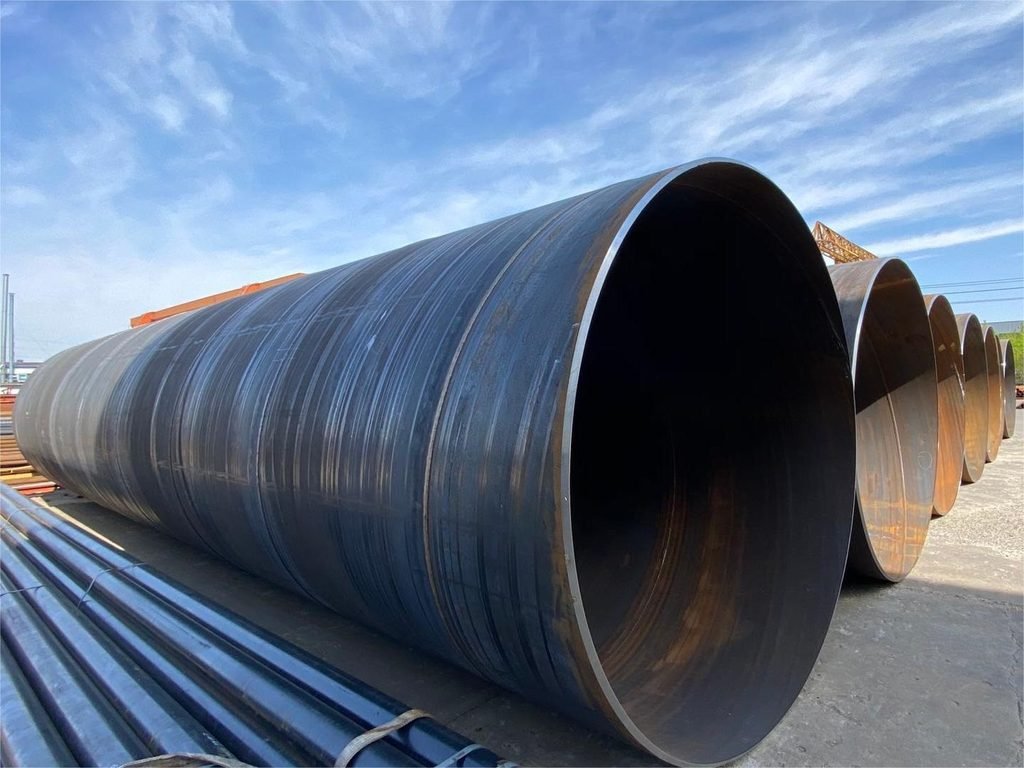
1. What Are Large Diameter and Small Diameter Steel Pipes?
Steel pipes are available in a wide range of outside diameters, wall thicknesses and lengths to meet different industrial and engineering requirements.
One common way to classify steel pipes is by their diameter.
Large diameter steel pipes are generally used for applications requiring high-volume fluid transportation, structural support and large-scale industrial infrastructure.
Small diameter steel pipes are commonly used in industrial piping networks, machinery, instrumentation, boilers, heat exchangers and structural components.
There is no single universal diameter boundary separating large diameter and small diameter steel pipes. The classification varies between manufacturers, industries and project specifications.
In pipeline engineering, terms such as large-bore and small-bore piping may also be used according to project-specific definitions.
Common manufacturing methods include:
Large diameter steel pipes:
- LSAW (Longitudinal Submerged Arc Welded).
- SSAW (Spiral Submerged Arc Welded).
- Large-diameter seamless manufacturing, where commercially and technically suitable.
Small diameter steel pipes:
- Seamless hot-finished pipes.
- Cold-drawn seamless pipes.
- ERW (Electric Resistance Welded) pipes.
- HFW (High-Frequency Welded) pipes.
The choice of manufacturing process depends on the required diameter, wall thickness, material grade, production capacity, pressure conditions and applicable standards.
2. Manufacturing Processes of Large Diameter Steel Pipes
Large diameter steel pipes are widely used in oil and gas transportation, water transmission, offshore engineering and structural construction.
Their manufacturing processes must accommodate large forming dimensions, substantial wall thicknesses and demanding welding requirements.
Three major manufacturing routes are commonly used.
2.1 LSAW Steel Pipe Manufacturing
LSAW stands for Longitudinal Submerged Arc Welded.
It is a manufacturing process in which a steel plate is formed into a cylindrical pipe and welded along its longitudinal seam using submerged arc welding.
Common forming methods include UOE and JCOE.
UOE Manufacturing Process
The UOE process involves three main forming stages:
- U-forming: The steel plate is pressed into a U-shaped section.
- O-forming: The U-shaped section is pressed into a cylindrical shape.
- Expanding: The pipe is mechanically expanded to improve dimensional accuracy and roundness.
The longitudinal seam is welded using submerged arc welding, commonly with internal and external weld passes.
JCOE Manufacturing Process
The JCOE process forms the steel plate through a series of incremental pressing operations.
The plate is progressively formed into a J-shape, then a C-shape and finally an O-shape.
After welding and mechanical expansion, the finished pipe undergoes the specified inspection and testing.
Advantages of LSAW Pipes
- Suitable for large outside diameters.
- Capable of producing relatively thick-walled pipes.
- Good dimensional control through forming and expansion.
- Suitable for demanding pipeline and structural applications.
- Longitudinal welds can be inspected using specified NDT methods.
Typical Applications
- Oil and natural gas trunk pipelines.
- Offshore pipelines.
- High-pressure transmission projects.
- Structural piling.
- Marine engineering.
- Large industrial infrastructure.
2.2 SSAW Steel Pipe Manufacturing
SSAW stands for Spiral Submerged Arc Welded.
It is also known as HSAW (Helical Submerged Arc Welded).
Unlike LSAW, which uses steel plates to form a longitudinal seam, SSAW pipes are manufactured by forming a continuous steel strip or coil into a spiral shape.
The edges are joined using submerged arc welding.
Typical SSAW Manufacturing Process
- Steel coil inspection and preparation.
- Uncoiling and strip edge preparation.
- Strip forming at a specified spiral angle.
- Internal and external submerged arc welding.
- Pipe cutting to the required length.
- Dimensional inspection.
- NDT and hydrostatic testing, where required.
- Final inspection and coating.
Advantages of SSAW Pipes
- Suitable for manufacturing large outside diameters.
- Flexible production through adjustment of the forming angle.
- Efficient use of steel coils.
- Continuous forming and welding process.
- Suitable for large-scale water transmission and infrastructure projects.
Typical Applications
- Water supply pipelines.
- Drainage and sewage systems.
- Irrigation projects.
- Structural piling.
- Dredging pipelines.
- Selected oil and gas transmission projects.
The suitability of SSAW pipe for a particular pressure service must be verified against the applicable product standard, weld inspection requirements and project design.
2.3 Large Diameter Seamless Steel Pipes
Large diameter seamless steel pipes are manufactured without a longitudinal or spiral weld seam.
The process generally begins with a solid round steel billet.
The billet is heated and pierced to form a hollow shell, which is then elongated, rolled and sized to the required dimensions.
Common production equipment includes:
- Rotary piercing mills.
- Mandrel mills.
- Plug mills.
- Pilger mills.
- Sizing and reducing mills.
The availability of large diameter seamless pipes depends on the manufacturer’s equipment, material grade, wall thickness and production capabilities.
Compared with welded pipe production, seamless manufacturing may become less economical as the required diameter and dimensions increase.
Typical Applications
- High-pressure industrial piping.
- Power generation.
- Boiler systems.
- Refinery equipment.
- Specialised mechanical applications.
3. Manufacturing Processes of Small Diameter Steel Pipes
Small diameter steel pipes are widely used in industrial systems where compact dimensions, dimensional accuracy and specific mechanical properties are important.
Two major manufacturing categories are seamless and welded pipes.
3.1 Small Diameter Seamless Steel Pipes
Small diameter seamless steel pipes are produced from solid steel billets without a welded seam.
The manufacturing process generally includes:
- Billet heating.
- Rotary piercing.
- Hollow shell formation.
- Elongation and rolling.
- Sizing or reducing.
- Heat treatment, where required.
- Straightening.
- Cutting and finishing.
- Inspection and testing.
Small diameter seamless pipes can also undergo cold drawing to achieve tighter dimensional tolerances and improved surface finish.
Advantages
- No longitudinal weld seam.
- Suitable for a wide range of pressure-bearing applications.
- Available in different carbon and alloy steel grades.
- Can be produced with relatively precise dimensions through cold finishing.
Typical Applications
- Boiler tubes.
- Heat exchanger tubes.
- Hydraulic systems.
- Mechanical engineering.
- Automotive components.
- Instrumentation and industrial piping.
3.2 Small Diameter ERW Steel Pipes
ERW stands for Electric Resistance Welded.
The manufacturing process uses steel strip or coil as the starting material.
The strip is continuously formed into a cylindrical shape through a series of forming rolls.
The longitudinal edges are heated using electrical resistance and joined under pressure.
Modern high-frequency ERW production uses controlled electrical heating and pressure to produce a continuous longitudinal weld.
Typical Manufacturing Process
- Steel coil preparation.
- Strip uncoiling and levelling.
- Edge preparation.
- Roll forming.
- High-frequency welding.
- Weld seam treatment and inspection.
- Sizing and straightening.
- Cutting.
- NDT and final inspection.
Advantages of ERW Pipes
- High production efficiency.
- Good dimensional consistency.
- Suitable for continuous manufacturing.
- Cost-effective for many small- and medium-diameter applications.
- Widely available in carbon steel grades.
Typical Applications
- Water and gas distribution.
- Fire protection systems.
- Structural tubing.
- Mechanical engineering.
- Industrial piping.
- General construction.
The suitability of ERW pipes for pressure service depends on the applicable standard, weld quality, manufacturing control and required inspection coverage.
4. Large Diameter vs Small Diameter Steel Pipes: Key Differences
Although both product categories are used for fluid transportation and industrial construction, their manufacturing processes, equipment requirements and applications can differ significantly.
| Comparison | Large Diameter Steel Pipes | Small Diameter Steel Pipes |
|---|---|---|
| Typical Manufacturing | LSAW, SSAW, selected seamless | Seamless, ERW, HFW |
| Raw Material | Steel plate or coil, or billet for seamless | Steel billet or coil |
| Forming Process | Plate forming or spiral forming | Piercing, rolling or continuous roll forming |
| Welding | SAW for LSAW/SSAW | High-frequency resistance welding for ERW/HFW |
| Wall Thickness | Available in medium to heavy sections | Wide range depending on product |
| Production Equipment | Large forming presses and heavy welding systems | Piercing mills, drawing equipment and continuous forming lines |
| Transportation | Often requires specialised lifting and transport | Generally easier to bundle and transport |
| Common Applications | Trunk pipelines, water transmission, piling | Industrial piping, boilers, machinery |
| Inspection | Weld NDT, dimensional and pressure testing as specified | Dimensional, material, weld or other specified testing |
| Project Requirements | Often project-specific | Often standardised product dimensions |
These are general manufacturing and application differences. They are not absolute rules: large and small diameter products can be manufactured using different processes depending on available equipment and product requirements.
5. Differences in Size, Wall Thickness and Pressure Capacity
Outside diameter alone does not determine the pressure capacity of a steel pipe.
Wall thickness, material strength, manufacturing quality, weld efficiency where applicable, corrosion allowance and design code all influence the pipe’s pressure performance.
5.1 Outside Diameter
Large diameter pipes are designed to transport larger volumes of fluid or to meet structural requirements.
Small diameter pipes are commonly used where compact routing, precise flow control or connection to smaller equipment is required.
5.2 Wall Thickness
Large diameter steel pipes may require substantial wall thickness to meet design pressure, external loading and handling requirements.
Small diameter pipes can also have thick walls, particularly in high-pressure hydraulic, mechanical and industrial applications.
The diameter-to-thickness ratio is an important parameter when evaluating pipe geometry.
5.3 Pressure Capacity
For a thin-walled cylindrical pipe, the approximate circumferential stress relationship is:
σh = P × D / (2t)
Where:
- σh = Circumferential or hoop stress.
- P = Internal pressure.
- D = Pipe outside diameter, used here as an approximation in the thin-wall relationship.
- t = Pipe wall thickness.
This simplified relationship helps explain why larger diameters generally require greater wall thickness for the same pressure and material strength.
However, actual pressure design must follow the applicable engineering code, including its definitions of diameter, design factors, weld factors, corrosion allowance and other requirements.
A large diameter pipe is not automatically a low-pressure pipe, and a small diameter pipe is not automatically a high-pressure pipe.
6. Applications of Large Diameter Steel Pipes
Large diameter steel pipes are essential for infrastructure projects involving large fluid volumes and substantial structural loads.
6.1 Oil and Gas Transmission
Large diameter line pipes are used to transport oil and natural gas over long distances.
LSAW and SSAW pipes are commonly considered depending on project requirements, material grade, wall thickness and pipeline design.
API 5L is an important product specification for line pipe used in pipeline transportation systems.
6.2 Water Supply and Transmission
Large diameter steel pipes are used in municipal water supply, water transfer and irrigation systems.
They can transport large volumes of water between reservoirs, treatment plants and distribution networks.
Protective coatings and internal linings may be specified to control corrosion and protect water quality.
6.3 Offshore Engineering
Offshore projects use large diameter pipes for pipeline systems, structural components and marine infrastructure.
Material toughness, weld integrity, external corrosion protection and installation loads are important design considerations.
6.4 Structural Piling
Large diameter steel pipes are used as foundation piles in:
- Bridges.
- Ports.
- Offshore platforms.
- Marine structures.
- Industrial buildings.
- Coastal engineering.
The required pipe dimensions depend on axial load, bending, soil conditions and structural design.
6.5 Dredging and Slurry Transportation
Large diameter pipes are also used to transport water mixed with sand, sediment and other solid particles.
For these applications, wall thickness, abrasion resistance, internal lining and connection design require particular attention.
7. Applications of Small Diameter Steel Pipes
Small diameter steel pipes are used across a wide range of industrial and commercial sectors.
7.1 Boiler and Heat Exchanger Systems
Small diameter seamless tubes are commonly used in boilers and heat exchangers.
ASTM A192, ASTM A210 and ASTM A213 cover different categories of boiler, superheater and heat exchanger tubes.
The material selection depends on temperature, pressure, corrosion conditions and equipment design.
7.2 Mechanical Engineering
Small diameter precision steel tubes are used in machinery, automotive components, hydraulic cylinders and mechanical assemblies.
Dimensional accuracy and surface quality are particularly important in these applications.
7.3 Industrial Piping
Small diameter pipes are used for:
- Compressed air systems.
- Instrumentation lines.
- Hydraulic piping.
- Cooling water systems.
- Process connections.
- General industrial services.
7.4 Construction and Structural Applications
ERW steel pipes are widely used in:
- Scaffolding.
- Fencing.
- Building structures.
- Handrails.
- Furniture frames.
- Mechanical support systems.
The required material grade, dimensions and product standard depend on the intended structural function.
8. Which Manufacturing Process Should You Choose?
Selecting a suitable steel pipe manufacturing method requires more than comparing outside diameter.
The following considerations should be evaluated.
8.1 Choose LSAW Pipes When:
- Large outside diameters are required.
- Relatively thick walls are needed.
- The project requires longitudinal submerged arc welding.
- The specified application and standard permit LSAW products.
- Weld inspection and dimensional requirements can be met.
8.2 Choose SSAW Pipes When:
- Large diameter water transmission pipes are required.
- Continuous spiral forming offers manufacturing advantages.
- The project specification permits spiral-welded pipe.
- Wall thickness and pressure requirements are compatible with the manufacturing route.
8.3 Choose Seamless Pipes When:
- A product without a longitudinal or spiral weld seam is required.
- The specified standard calls for seamless manufacturing.
- The required dimensions are available from the manufacturer.
- High-pressure, boiler or mechanical applications require a suitable seamless product.
8.4 Choose ERW Pipes When:
- Small- or medium-diameter welded pipes are required.
- Good dimensional consistency is important.
- High-volume production and cost efficiency are priorities.
- The application and relevant standard permit ERW/HFW pipes.
The final selection should always be based on the design specification and the manufacturer’s verified production capability.
9. Common Standards for Large and Small Diameter Steel Pipes
Different steel pipe standards cover different manufacturing methods, material grades and applications.
The following are commonly encountered in industrial procurement.
| Standard | Product | Typical Application |
|---|---|---|
| API 5L | Line Pipe | Oil and gas transmission |
| ASTM A53/A53M | Welded and Seamless Steel Pipe | General pressure and structural applications |
| ASTM A106/A106M | Seamless Carbon Steel Pipe | High-temperature service |
| ASTM A335/A335M | Seamless Ferritic Alloy Steel Pipe | High-temperature service |
| ASTM A333/A333M | Low-Temperature Steel Pipe | Low-temperature service |
| ASTM A500/A500M | Cold-Formed Structural Tubing | Structural applications |
| ASTM A252 | Welded and Seamless Steel Pipe Piles | Foundation piling |
| AWWA C200 | Steel Water Pipe | Water transmission |
The product standard should be selected according to the intended service and project specification, not simply the pipe diameter.
10. Quality Inspection Requirements for Large and Small Diameter Steel Pipes
Quality inspection is necessary to verify that steel pipes meet the specified material, dimensional and performance requirements.
The inspection scope depends on the product standard, manufacturing method and purchase order.
10.1 Chemical Composition Testing
Chemical analysis verifies the material grade and specified alloying elements.
Common elements include carbon, manganese, silicon, sulphur, phosphorus, chromium and nickel.
10.2 Mechanical Testing
Depending on the product specification, mechanical testing may include:
- Tensile testing.
- Yield strength testing.
- Elongation testing.
- Impact testing.
- Hardness testing.
- Flattening or bend testing.
10.3 Dimensional Inspection
Typical checks include:
- Outside diameter.
- Wall thickness.
- Length.
- Ovality.
- Straightness.
- End preparation.
- Pipe weight, where required.
10.4 Non-Destructive Testing
The applicable NDT methods depend on the product and manufacturing route.
For welded pipes, weld seam inspection is particularly important.
Common methods include:
- Ultrasonic Testing (UT).
- Radiographic Testing (RT).
- Electromagnetic Testing (ET).
- Magnetic Particle Testing (MT).
- Liquid Penetrant Testing (PT).
10.5 Hydrostatic Testing
Hydrostatic testing is used to verify pressure integrity under specified conditions.
Test pressure, holding time and acceptance requirements must follow the applicable product specification.
10.6 Surface Treatment and Coating Inspection
For coated steel pipes, additional checks may include:
- Surface preparation.
- Coating thickness.
- Adhesion.
- Holiday testing.
- Internal lining.
- End protection.
Large diameter water and buried pipeline projects may require particular attention to external corrosion protection.
11. How to Select the Right Steel Pipe for Your Project
Before purchasing large or small diameter steel pipes, buyers should define the following requirements.
1. Outside Diameter
Specify the required OD in millimetres or inches.
2. Wall Thickness
Confirm the nominal wall thickness and applicable tolerance.
3. Material Grade
Identify the required carbon steel, alloy steel or stainless steel grade.
4. Manufacturing Method
Specify seamless, ERW, HFW, LSAW or SSAW as required.
5. Applicable Standard
Identify the relevant ASTM, API, ASME, EN or AWWA specification.
6. Operating Conditions
Define design pressure, temperature, fluid type and corrosion conditions.
7. Inspection Requirements
Specify NDT, hydrostatic testing, mechanical testing and third-party inspection requirements.
8. Surface Protection
Identify whether the pipe requires FBE, 3LPE, 3LPP, galvanising or internal lining.
9. Delivery Length and Quantity
Confirm the required pipe length, tolerances, quantity and packaging arrangements.
10. Material Documentation
Specify the required MTC, inspection reports and traceability documentation.
Providing these details helps manufacturers recommend a suitable production route and prepare a more accurate quotation.
12. Frequently Asked Questions About Large and Small Diameter Steel Pipes
What is considered a large diameter steel pipe?
There is no universal boundary. The definition varies by manufacturer and industry. In pipeline manufacturing, pipes around 16 inches (406.4 mm) and above are frequently discussed as large-diameter products, but this is a commercial convention rather than a universal technical definition.
What is the difference between large diameter and small diameter steel pipes?
The main differences relate to available manufacturing processes, dimensions, production equipment, transportation and typical applications. Large diameter pipes are widely used in transmission pipelines and infrastructure, while small diameter pipes are common in industrial piping, boilers and machinery.
Are large diameter steel pipes always welded?
No. Large diameter seamless pipes are also available. However, LSAW and SSAW manufacturing methods are widely used for large-diameter products because they offer practical production advantages.
Which is better, LSAW or SSAW steel pipe?
Neither is universally better. LSAW is often selected for large-diameter, relatively thick-wall and demanding pipeline applications. SSAW is frequently used for large-diameter water transmission, piling and other applications where spiral-welded pipe is permitted.
Are small diameter steel pipes always seamless?
No. Small diameter pipes can be manufactured through seamless, ERW and other suitable welding processes. The choice depends on the required material properties, application and product specification.
Do large diameter steel pipes have thicker walls?
Not necessarily. Wall thickness is determined by design pressure, material strength, external loading, corrosion allowance and other engineering factors. Both large and small diameter pipes can be manufactured with different wall thicknesses.
Which manufacturing method is more economical?
ERW is often economical for suitable smaller- and medium-diameter products due to continuous production. SSAW can be efficient for large diameters, while LSAW is often selected for specific heavy-wall and demanding applications. Actual cost depends on material, dimensions, production volume and inspection requirements.
Which standards are used for large diameter steel pipes?
API 5L is widely used for line pipes, while ASTM A252 covers steel pipe piles and AWWA C200 covers steel water pipe. The correct standard depends on the intended application.
Can large diameter steel pipes be used for high-pressure applications?
Yes. Properly designed and manufactured large diameter steel pipes can be used in high-pressure applications. Their suitability must be verified through the applicable design code, material grade, wall thickness and manufacturing quality requirements.
13. Conclusion
Large diameter and small diameter steel pipes serve different industrial requirements, but neither category is limited to a single manufacturing method or application.
Large diameter pipes are widely used in oil and gas transmission, water supply, offshore engineering and structural piling. LSAW and SSAW manufacturing processes provide practical solutions for producing large-diameter welded pipes.
Small diameter pipes are commonly manufactured through seamless and ERW processes and are widely used in boiler systems, machinery, industrial piping and construction.
The correct choice depends on more than outside diameter. Wall thickness, material grade, pressure requirements, operating temperature, manufacturing process and applicable standards must all be considered.
For buyers, clearly specifying pipe dimensions, manufacturing methods, material grades and inspection requirements is essential for obtaining products that meet project requirements.
Looking for Large or Small Diameter Steel Pipes?
Whether your project requires large diameter LSAW and SSAW pipes, small diameter seamless tubes or ERW steel pipes, provide your required outside diameter, wall thickness, material grade, standard, manufacturing method and quantity.
Request a quotation with technical specifications, material certificates and inspection requirements.