
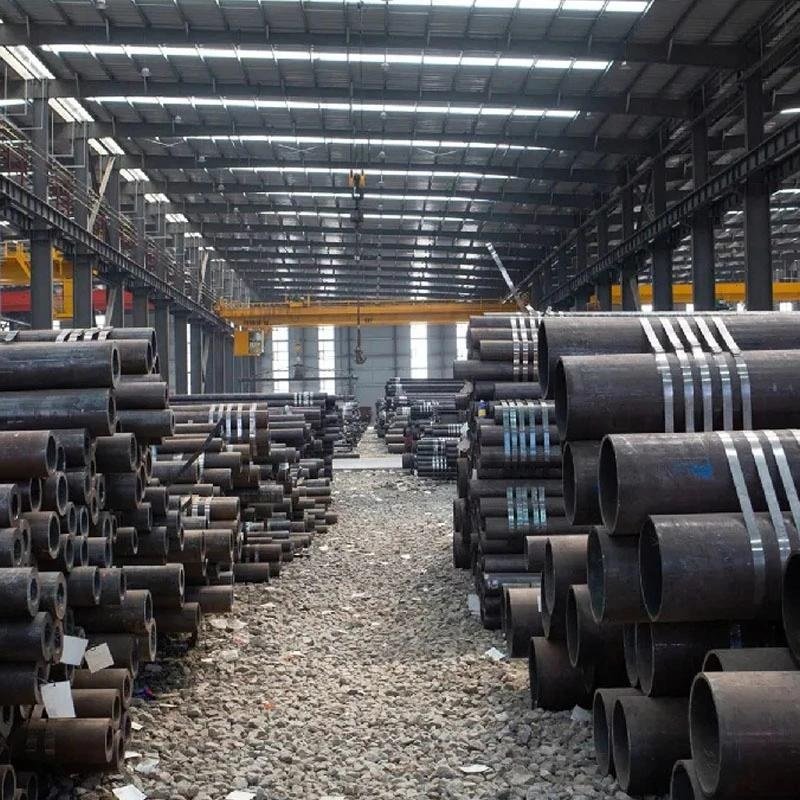
1. What Is Carbon Steel Pipe?
Carbon steel pipe is a tubular steel product primarily made from iron and carbon, with manganese and other elements controlled according to the applicable material specification.
It is widely used in industrial piping systems, oil and gas transportation, power generation, construction, water supply and mechanical engineering.
Carbon steel pipes are valued for their mechanical strength, availability, weldability, and relatively economical material cost. They can be manufactured in a wide range of outside diameters, wall thicknesses and steel grades to meet different operating requirements.
Depending on the manufacturing process, carbon steel pipes are generally classified into two main categories:
- Seamless carbon steel pipes
- Welded carbon steel pipes
The appropriate type depends on the required pressure rating, operating temperature, pipe dimensions, manufacturing specification and intended application.
Carbon steel pipes are commonly manufactured and supplied under standards such as ASTM A106, ASTM A53 and API 5L. Each specification covers different product requirements and service conditions.
2. Main Types of Carbon Steel Pipes
Carbon steel pipes can be classified according to their manufacturing processes, material grades and intended applications.
2.1 Seamless Carbon Steel Pipe
Seamless carbon steel pipe is manufactured without a longitudinal or spiral weld seam.
The production process generally begins with a solid steel billet, which is heated and pierced to form a hollow shell. The shell is then elongated, rolled, sized and finished to achieve the required dimensions.
Depending on the manufacturing route, seamless pipes can be produced through hot rolling, hot finishing, cold rolling or cold drawing.
Main characteristics:
- No longitudinal weld seam
- Suitable for a wide range of pressure and temperature applications when properly specified
- Available in different diameters and wall thicknesses
- Suitable for further machining and processing
- Can be supplied in different heat treatment and delivery conditions
Common applications:
- Oil and gas processing facilities
- Power plants
- Petrochemical piping
- High-temperature fluid transportation
- Mechanical engineering
- Boiler and pressure piping systems
ASTM A106 Grade B is a commonly specified seamless carbon steel pipe for high-temperature service.
2.2 ERW Carbon Steel Pipe
ERW stands for Electric Resistance Welded.
ERW carbon steel pipe is manufactured from steel strip or coil that is gradually formed into a cylindrical shape. The longitudinal edges are heated using electrical resistance and joined under pressure to create a weld seam.
Modern high-frequency ERW production lines provide controlled welding conditions and consistent manufacturing quality.
Main characteristics:
- Longitudinal welded construction
- Economical production for suitable size ranges
- Consistent wall thickness when properly controlled
- Good dimensional accuracy
- Suitable for many structural and fluid transportation applications
Common applications:
- Water supply systems
- Low- and medium-pressure piping
- Building construction
- Fire protection systems
- Mechanical structures
- General industrial applications
ASTM A53 Type E and API 5L specifications include applicable ERW pipe products.
2.3 LSAW Carbon Steel Pipe
LSAW stands for Longitudinal Submerged Arc Welded.
LSAW pipes are manufactured from steel plates that are formed into a cylindrical shape and welded along a longitudinal seam using the submerged arc welding process.
The UOE and JCOE processes are commonly used in LSAW pipe manufacturing.
LSAW pipes are particularly suitable for large-diameter and heavy-wall applications.
Main characteristics:
- Large outside diameters
- Heavy wall thickness capabilities
- Longitudinal welded seam
- Suitable for demanding pipeline projects
- Available in high-strength pipeline grades
Common applications:
- Long-distance oil and gas pipelines
- Offshore pipeline projects
- Water transmission systems
- Industrial infrastructure
- Large-diameter structural applications
2.4 SSAW Carbon Steel Pipe
SSAW stands for Spiral Submerged Arc Welded.
SSAW pipe is manufactured by forming steel coil into a spiral shape and welding the joining edges using submerged arc welding.
Unlike LSAW pipes, the weld seam follows a spiral path along the pipe body.
Main characteristics:
- Large-diameter production capability
- Efficient use of steel coil
- Suitable for long-distance fluid transportation
- Available in different diameters and wall thicknesses
Common applications:
- Water transmission pipelines
- Oil and gas transportation
- Municipal infrastructure
- Irrigation systems
- Large-diameter piling and structural projects
The suitability of SSAW pipe for a specific project depends on the applicable design code, manufacturing specification, weld quality and inspection requirements.
2.5 Comparison of Carbon Steel Pipe Manufacturing Types
| Pipe type | Manufacturing method | Main advantages | Typical applications |
|---|---|---|---|
| Seamless | Billet piercing and rolling | No pipe-body weld seam | High-temperature and pressure piping |
| ERW | Forming and resistance welding | Economical, consistent dimensions | General piping and structural applications |
| LSAW | Plate forming and submerged arc welding | Large diameter and heavy wall | Transmission pipelines |
| SSAW | Spiral forming and submerged arc welding | Efficient large-diameter production | Water and oil transportation |
No manufacturing method is automatically suitable for every application. Selection should be based on project specifications, operating conditions and applicable standards.
3. Common Carbon Steel Pipe Grades and Standards
Material standards define the chemical composition, mechanical properties, manufacturing requirements, inspection procedures and acceptance criteria for carbon steel pipes.
The following specifications are widely referenced in industrial projects.
3.1 ASTM A106 Carbon Steel Pipe
ASTM A106 covers seamless carbon steel pipe intended for high-temperature service.
It is commonly used in refineries, petrochemical plants, power stations and industrial steam piping systems.
The standard includes three grades:
- ASTM A106 Grade A
- ASTM A106 Grade B
- ASTM A106 Grade C
Grade B is widely used because it offers a practical combination of strength, availability and fabrication characteristics.
Typical applications:
- High-temperature process piping
- Steam transportation
- Oil refinery piping
- Power generation systems
- Petrochemical facilities
ASTM A106 pipe is seamless. Welded pipe should not be specified as ASTM A106.
3.2 ASTM A53 Carbon Steel Pipe
ASTM A53 covers seamless and welded carbon steel pipe for mechanical and pressure applications and other general uses.
It includes different manufacturing types:
- Type S: Seamless
- Type E: Electric Resistance Welded
- Type F: Furnace Butt Welded
Common grades include Grade A and Grade B.
Typical applications:
- Water and gas transportation
- General industrial piping
- Mechanical applications
- Building services
- Structural applications where permitted by the relevant specification
ASTM A53 is frequently selected for general-purpose piping systems.
3.3 API 5L Line Pipe
API 5L specifies seamless and welded steel line pipe used in pipeline transportation systems.
It is widely used in the oil and gas industry for transporting petroleum, natural gas and other fluids.
Common grades include:
- API 5L Grade B
- API 5L X42
- API 5L X52
- API 5L X60
- API 5L X65
- API 5L X70
The higher-grade designations generally correspond to higher specified minimum yield strengths.
API 5L also distinguishes between two product specification levels:
PSL1: Covers the basic product specification requirements.
PSL2: Includes additional requirements for chemical composition, mechanical properties, testing and traceability.
The required PSL level depends on the pipeline design, service conditions and project specification.
3.4 ASTM A333 Low-Temperature Carbon Steel Pipe
ASTM A333 covers seamless and welded carbon and alloy steel pipe intended for low-temperature service.
ASTM A333 Grade 6 is a commonly used grade for low-temperature applications.
Its requirements include impact testing at specified temperatures to verify toughness under low-temperature conditions.
Typical applications:
- Low-temperature process piping
- LNG-related facilities, where the specified design conditions permit
- Refrigeration systems
- Petrochemical plants
- Cold-region industrial facilities
3.5 Common Carbon Steel Pipe Standards Comparison
| Standard | Product type | Main application |
|---|---|---|
| ASTM A106 | Seamless carbon steel pipe | High-temperature service |
| ASTM A53 | Seamless and welded pipe | General mechanical and pressure applications |
| API 5L | Seamless and welded line pipe | Oil and gas transmission |
| ASTM A333 | Seamless and welded pipe | Low-temperature service |
| ASTM A500 | Structural tubing | Building and structural applications |
| ASTM A252 | Welded and seamless piling pipe | Foundation and piling applications |
These specifications are not interchangeable. A pipe should be supplied to the standard specified in the purchase order and engineering design.
4. Industrial Applications of Carbon Steel Pipes
Carbon steel pipes are used in many industries because of their strength, availability, fabrication characteristics and broad range of specifications.
4.1 Oil and Gas Industry
Carbon steel pipes play an important role in upstream, midstream and downstream oil and gas operations.
Typical applications include:
- Oil and natural gas transmission pipelines
- Gathering and distribution lines
- Refinery process piping
- Gas transportation systems
- Water injection lines
- Industrial utility pipelines
API 5L is widely used for pipeline transportation projects, while ASTM A106 is commonly specified for high-temperature process piping in refineries and petrochemical plants.
For corrosive service, material selection must consider carbon dioxide, hydrogen sulfide, chlorides, water content and operating temperature.
Additional corrosion protection or specialised materials may be required.
4.2 Power Generation and Boiler Systems
Carbon steel pipes are widely used in conventional power plants and industrial boiler systems.
Typical applications include:
- Steam piping
- Feedwater lines
- Boiler-related piping
- Condensate systems
- High-temperature process lines
ASTM A106 is commonly used for high-temperature pressure piping.
It is important to distinguish ordinary carbon steel piping from dedicated boiler and heat exchanger tubes. Products such as ASTM A192 and ASTM A210 have their own product-specific requirements.
4.3 Petrochemical and Chemical Processing
Petrochemical facilities use carbon steel pipes to transport various process fluids, gases and utilities.
Applications include:
- Process piping
- Utility lines
- Compressed air systems
- Steam lines
- Hydrocarbon transportation
- Plant infrastructure
The selection of carbon steel depends on fluid composition, pressure, temperature and corrosion allowance.
For highly corrosive media, stainless steel, alloy steel or internally lined piping may be more appropriate.
4.4 Water Supply and Infrastructure
Carbon steel pipes are also used in water transmission and industrial water distribution systems.
Typical applications include:
- Municipal water transmission
- Industrial water pipelines
- Irrigation systems
- Pumping stations
- Large-diameter transmission networks
External coatings, internal linings and cathodic protection may be required to control corrosion, depending on the installation environment and water chemistry.
4.5 Construction and Structural Engineering
Structural carbon steel pipes and hollow sections are used in construction because they provide good load-bearing characteristics and can be fabricated into different structural configurations.
Typical applications include:
- Building columns
- Steel frameworks
- Bridge structures
- Industrial supports
- Scaffolding-related systems
- Foundation piling
ASTM A500 and other applicable structural product specifications are commonly used for structural tubing.
5. Advantages and Limitations of Carbon Steel Pipes
5.1 Advantages
High mechanical strength
Carbon steel pipes are available in different grades and wall thicknesses to meet a wide range of mechanical and pressure requirements.
Good weldability
Many low-carbon steel pipe grades offer good weldability when appropriate welding procedures are followed.
Wide availability
Carbon steel pipes are produced in a broad range of dimensions, grades and manufacturing types.
Cost-effectiveness
Carbon steel generally has a lower initial material cost than stainless steel and many high-alloy alternatives.
Flexible manufacturing options
Carbon steel pipes can be manufactured through seamless, ERW, LSAW and SSAW processes.
5.2 Limitations
Susceptibility to corrosion
Carbon steel can rust when exposed to moisture and oxygen. Coatings, linings or other corrosion protection measures may be necessary.
Maintenance requirements
Protective coatings and corrosion control systems may require inspection and maintenance during service.
Limited performance in certain aggressive environments
Standard carbon steel may not be suitable for highly corrosive fluids, seawater or sour service without additional material assessment and protection.
Temperature limitations
High-temperature and low-temperature applications require specific grades and appropriate mechanical property verification.
6. How to Choose the Right Carbon Steel Pipe
Selecting the correct carbon steel pipe requires more than choosing a grade based on price or availability.
The following factors should be considered before procurement.
6.1 Operating Pressure and Temperature
Pressure and temperature determine the required pipe wall thickness, allowable stress and material specification.
For example, ASTM A106 is commonly used for high-temperature service, while ASTM A333 is designed for specified low-temperature applications.
6.2 Manufacturing Method
Choose between seamless and welded pipe based on the project requirements.
Consider:
- Outside diameter
- Wall thickness
- Operating pressure
- Weld inspection requirements
- Available manufacturing capacity
- Project specifications
6.3 Material Grade and Standard
Confirm the applicable specification and grade.
For example:
- ASTM A106 Grade B for seamless high-temperature piping.
- ASTM A53 Grade B for general-purpose piping.
- API 5L Grade B or X52 for specified line pipe applications.
- ASTM A333 Grade 6 for specified low-temperature service.
6.4 Corrosion Protection
Evaluate the operating medium and external environment.
Depending on the application, protection may include:
- Epoxy coatings
- 3LPE coatings
- Fusion-bonded epoxy
- Internal cement mortar lining
- Galvanising
- Cathodic protection
The coating system should be selected according to the project specification and exposure conditions.
6.5 Dimensions and Delivery Requirements
Before ordering, confirm:
- Outside diameter (OD)
- Wall thickness (WT)
- Pipe schedule
- Length
- End finish
- Manufacturing method
- Heat treatment condition, where applicable
- Inspection and testing requirements
These details help ensure the supplied product is compatible with the intended piping system.
7. Carbon Steel Pipe Inspection and Quality Control
Quality control is essential to ensure that carbon steel pipes comply with the specified material and dimensional requirements.
Typical inspection activities include:
Chemical Composition Analysis
Chemical analysis verifies that the material meets the chemical composition limits of the specified grade.
Tensile Testing
Tensile testing determines yield strength, tensile strength and elongation.
Hydrostatic Testing
Hydrostatic testing is used to verify pressure integrity according to the applicable product specification.
Non-Destructive Testing
Depending on the product type and specification, inspection methods may include:
- Ultrasonic Testing (UT)
- Radiographic Testing (RT)
- Eddy Current Testing (ET)
- Magnetic Particle Testing (MT)
Dimensional Inspection
Dimensional checks generally include outside diameter, wall thickness, length, ovality and straightness.
Material Traceability
Material Test Certificates, heat numbers and inspection records help establish traceability between the finished pipe and its manufacturing batch.
The required tests and acceptance criteria must follow the applicable standard and purchase specification.
8. Frequently Asked Questions About Carbon Steel Pipes
What are the main types of carbon steel pipes?
The main manufacturing types are seamless, ERW, LSAW and SSAW carbon steel pipes. They differ in production method, dimensions, weld configuration and typical applications.
What is the most commonly used carbon steel pipe grade?
ASTM A106 Grade B, ASTM A53 Grade B and API 5L Grade B are widely specified carbon steel pipe grades. Their applications differ according to the product specification and service conditions.
What is the difference between ASTM A106 and ASTM A53?
ASTM A106 covers seamless carbon steel pipe for high-temperature service. ASTM A53 covers seamless and welded pipe for general mechanical and pressure applications.
They should not be treated as interchangeable simply because some grades have similar mechanical properties.
Is carbon steel pipe suitable for high-pressure applications?
Yes. Properly specified carbon steel pipes are used in high-pressure industrial piping and pipeline systems. Suitability depends on material grade, wall thickness, design temperature, pressure, corrosion allowance and applicable design codes.
Does carbon steel pipe rust?
Yes. Carbon steel is susceptible to corrosion in the presence of moisture and oxygen. Protective coatings, linings and cathodic protection can help control corrosion.
What is the difference between seamless and welded carbon steel pipes?
Seamless pipes are manufactured from solid billets through piercing and rolling without a pipe-body weld seam. Welded pipes are produced by forming steel strip or plate and joining the edges through a welding process.
Which carbon steel pipe is suitable for oil and gas pipelines?
API 5L line pipe is widely used in oil and natural gas transportation systems. The appropriate grade and PSL level depend on pipeline design, pressure, fluid composition, temperature and project requirements.
9. Conclusion
Carbon steel pipes are widely used in industrial piping, oil and gas transportation, power generation, water supply and structural engineering.
Seamless, ERW, LSAW and SSAW pipes provide different manufacturing options for different dimensions and service conditions. Standards such as ASTM A106, ASTM A53, API 5L and ASTM A333 define important material and product requirements.
Selecting the correct carbon steel pipe requires consideration of operating pressure, temperature, fluid composition, manufacturing method, dimensions and corrosion protection.
A properly specified pipe helps ensure reliable operation, compliance with project requirements and effective lifecycle cost management.
Looking for carbon steel pipes for your project?
Specify the required standard, grade, manufacturing method, outside diameter, wall thickness and application conditions to identify the appropriate carbon steel pipe for your project.