
1. What Are DN, OD and WT in Steel Pipes?
When selecting or purchasing steel pipes, three dimensional terms frequently appear in technical drawings, product specifications and purchase orders: DN, OD and WT.
Although these terms are closely related, they describe different aspects of a pipe.
- DN (Nominal Diameter): A standardised nominal size designation used to identify a pipe size. It is not the actual measured diameter.
- OD (Outside Diameter): The actual outside diameter of the pipe, measured across its external surface.
- WT (Wall Thickness): The thickness of the pipe wall, measured from the outside surface to the inside surface.
These dimensions are essential for determining pipe compatibility, internal flow capacity, mechanical performance and installation requirements.
A common example is DN50 steel pipe. Its standard outside diameter is approximately 60.3 mm, not 50 mm. The actual wall thickness depends on the specified pipe schedule or dimensional specification.
Understanding the relationship between DN, OD and WT helps prevent ordering errors and ensures that the selected steel pipe meets the requirements of the piping system.
2. What Is DN (Nominal Diameter)?
DN stands for Diamètre Nominal, also known as Nominal Diameter.
It is a metric designation used to identify the nominal size of pipes and related components, including fittings, valves and flanges.
DN is a dimensionless reference number. It does not represent the actual outside diameter or inside diameter of a pipe in millimetres.
For example:
- DN15 corresponds to a nominal pipe size of approximately 1/2 inch.
- DN50 corresponds to a nominal pipe size of approximately 2 inches.
- DN100 corresponds to a nominal pipe size of approximately 4 inches.
- DN200 corresponds to a nominal pipe size of approximately 8 inches.
The DN designation provides a standardised way to identify pipe sizes across different manufacturers and piping systems.
2.1 DN vs NPS
DN is commonly used in metric-based standards, while NPS (Nominal Pipe Size) is widely used in North American piping specifications.
The two systems have corresponding nominal size designations.
| DN | Corresponding NPS | Standard OD (mm) |
|---|---|---|
| DN15 | 1/2″ | 21.3 |
| DN20 | 3/4″ | 26.7 |
| DN25 | 1″ | 33.4 |
| DN32 | 1-1/4″ | 42.2 |
| DN40 | 1-1/2″ | 48.3 |
| DN50 | 2″ | 60.3 |
| DN65 | 2-1/2″ | 73.0 |
| DN80 | 3″ | 88.9 |
| DN100 | 4″ | 114.3 |
| DN125 | 5″ | 141.3 |
| DN150 | 6″ | 168.3 |
| DN200 | 8″ | 219.1 |
| DN250 | 10″ | 273.1 |
| DN300 | 12″ | 323.9 |
Note: These are commonly used corresponding pipe size designations and nominal outside diameters. Values should be verified against the applicable dimensional standard.
An important point is that DN and NPS are nominal designations, not direct mathematical conversions of the actual pipe diameter.
For example, DN50 does not mean that the pipe has an outside diameter of exactly 50 mm. Its standard OD is approximately 60.3 mm.
3. What Is OD (Outside Diameter)?
OD stands for Outside Diameter.
It refers to the distance across the outer surface of a pipe, measured through its centre.
Unlike DN, OD is an actual dimensional measurement and is commonly expressed in millimetres or inches.
OD is important because it determines the physical compatibility of a pipe with fittings, flanges, clamps and other connecting components.
3.1 Why Is Outside Diameter Important?
Outside diameter affects several aspects of pipe manufacturing and installation.
Pipe and fitting compatibility
Pipes and fittings must have compatible connection dimensions. An incorrect OD can result in installation difficulties or unsuitable connections.
Wall thickness and inside diameter
For a given OD, increasing wall thickness reduces the available internal diameter.
Dimensional inspection
OD is measured during manufacturing and final inspection to confirm that the pipe complies with the dimensional requirements of the applicable standard.
Pipe manufacturing
Different manufacturing processes, including seamless rolling, ERW welding, LSAW welding and cold drawing, have different dimensional control requirements.
3.2 How to Measure Pipe OD
Outside diameter can be measured using:
- Vernier calipers
- Digital calipers
- Outside micrometers
- Diameter tapes for larger pipes
For accurate inspection, measurements should be taken at suitable positions and directions according to the relevant product specification.
On larger pipes, measurements at multiple positions may be necessary to evaluate ovality and dimensional consistency.
4. What Is WT (Wall Thickness)?
WT stands for Wall Thickness.
It refers to the distance between the outside and inside surfaces of a pipe wall.
Wall thickness is commonly expressed in millimetres or inches.
Unlike DN, wall thickness directly affects the pipe’s internal diameter and is an important factor in pressure design, structural performance and material consumption.
4.1 Why Is Wall Thickness Important?
Pressure resistance
Wall thickness is one of the key parameters used in pressure design calculations. For a given material, outside diameter and design condition, a greater required wall thickness may be necessary to withstand higher internal pressure.
Mechanical strength
Wall thickness affects the pipe’s resistance to external loads, bending and mechanical damage.
Internal flow capacity
Increasing wall thickness reduces the inside diameter, which changes the available flow area.
Pipe weight
A thicker wall means more steel is used, increasing the weight per unit length and usually increasing material cost.
4.2 How to Calculate Pipe Wall Thickness
If the outside diameter and inside diameter are known, the nominal geometric wall thickness can be calculated using:
WT = (OD − ID) / 2
Where:
- WT = Wall Thickness
- OD = Outside Diameter
- ID = Inside Diameter
For example:
If a pipe has an OD of 60.3 mm and an ID of 52.5 mm:
WT = (60.3 − 52.5) / 2
WT = 3.9 mm
This calculation provides the wall thickness based on the measured diameters. Actual manufacturing acceptance must also account for dimensional tolerances.
5. What Is the Relationship Between DN, OD and WT?
DN, OD and WT work together to define the dimensions of a steel pipe.
DN identifies the nominal pipe size, OD defines its standard external dimension, and WT determines the thickness of the pipe wall.
The inside diameter can be calculated from OD and WT:
ID = OD − (2 × WT)
This relationship explains why two pipes with the same DN can have different internal diameters.
For example, consider DN50 (NPS 2) carbon steel pipe.
Both Schedule 40 and Schedule 80 pipes have the same nominal outside diameter of 60.3 mm, but their wall thicknesses are different.
| Parameter | DN50 Schedule 40 | DN50 Schedule 80 |
|---|---|---|
| DN | 50 | 50 |
| NPS | 2″ | 2″ |
| OD | 60.3 mm | 60.3 mm |
| WT | 3.91 mm | 5.54 mm |
| Calculated ID | 52.48 mm | 49.22 mm |
The comparison demonstrates three important points:
- DN remains unchanged.
- OD remains unchanged.
- Increasing wall thickness reduces the inside diameter.
This is why pipe size should never be identified by nominal diameter alone when a complete product specification is required.
6. What Is Pipe Schedule (SCH)?
Pipe Schedule, commonly abbreviated as SCH, is a standardised designation used to identify a series of nominal pipe wall thicknesses.
Common schedules include:
- SCH 5
- SCH 10
- SCH 20
- SCH 30
- SCH 40
- SCH 60
- SCH 80
- SCH 100
- SCH 120
- SCH 160
The higher schedule generally indicates a thicker wall for the same nominal pipe size.
However, Schedule 40 does not represent one fixed wall thickness for every pipe diameter. The actual specified wall thickness varies with NPS.
6.1 SCH 40 vs SCH 80
SCH 40 and SCH 80 are two commonly specified pipe wall thickness series.
For the same nominal pipe size, SCH 80 generally has a thicker wall than SCH 40.
| Parameter | SCH 40 | SCH 80 |
|---|---|---|
| Wall thickness | Generally thinner | Generally thicker |
| Inside diameter | Generally larger | Generally smaller |
| Pipe weight | Generally lower | Generally higher |
| Material consumption | Lower | Higher |
| Typical selection | General piping applications | Applications requiring a greater specified wall thickness |
A thicker pipe wall does not automatically mean that the pipe is suitable for every higher-pressure application.
Pressure design must also consider material strength, design temperature, corrosion allowance, manufacturing tolerances and the applicable piping code.
6.2 Does Pipe Schedule Affect Outside Diameter?
No. For a given NPS, the standard OD remains the same across different schedules.
For example, NPS 2 carbon steel pipe has an OD of 60.3 mm under both SCH 40 and SCH 80.
The difference is in wall thickness and inside diameter.
This dimensional system allows pipes of the same nominal size to maintain compatible outside dimensions for standard fittings and connections.
7. Steel Pipe Dimension Standards: ASME B36.10M and ASME B36.19M
Steel pipe dimensions are standardised to ensure compatibility between pipes, fittings and other piping components.
Two commonly referenced dimensional standards are ASME B36.10M and ASME B36.19M.
7.1 ASME B36.10M
ASME B36.10M covers the standardisation of dimensions for welded and seamless wrought steel pipe.
It is commonly referenced for:
- Carbon steel pipes
- Alloy steel pipes
- Welded steel pipes
- Seamless steel pipes
The standard provides nominal pipe sizes, outside diameters and wall thickness series.
7.2 ASME B36.19M
ASME B36.19M covers the dimensions of welded and seamless wrought stainless steel pipe.
It includes wall thickness schedules designated with the suffix S, such as:
- SCH 5S
- SCH 10S
- SCH 40S
- SCH 80S
The S designation distinguishes the stainless steel schedule series from the corresponding schedules in ASME B36.10M.
Some schedule thicknesses differ between the two standards, so they should not be treated as interchangeable.
7.3 Which Standard Should Be Used?
| Pipe material | Common dimensional standard |
|---|---|
| Carbon steel pipe | ASME B36.10M |
| Alloy steel pipe | ASME B36.10M |
| Stainless steel pipe | ASME B36.19M |
| Stainless steel pipe with other applicable schedules | ASME B36.19M and, where specified, B36.10M |
The applicable product specification must also be considered. A dimensional standard does not replace the material, manufacturing, testing or acceptance requirements of the pipe product specification.
8. How to Measure Steel Pipe Dimensions Correctly
Accurate dimensional inspection is important during steel pipe manufacturing, procurement and installation.
The main measurements include outside diameter, wall thickness, inside diameter and pipe length.
8.1 Measuring Outside Diameter
A vernier caliper or digital caliper can be used to measure OD on suitable pipe sizes.
For larger pipes, a diameter tape or other approved measuring equipment may be used.
Measurements should be taken across the pipe at appropriate positions to identify dimensional variation and ovality.
8.2 Measuring Wall Thickness
Wall thickness can be measured using:
- Mechanical wall thickness gauges
- Micrometers at accessible pipe ends
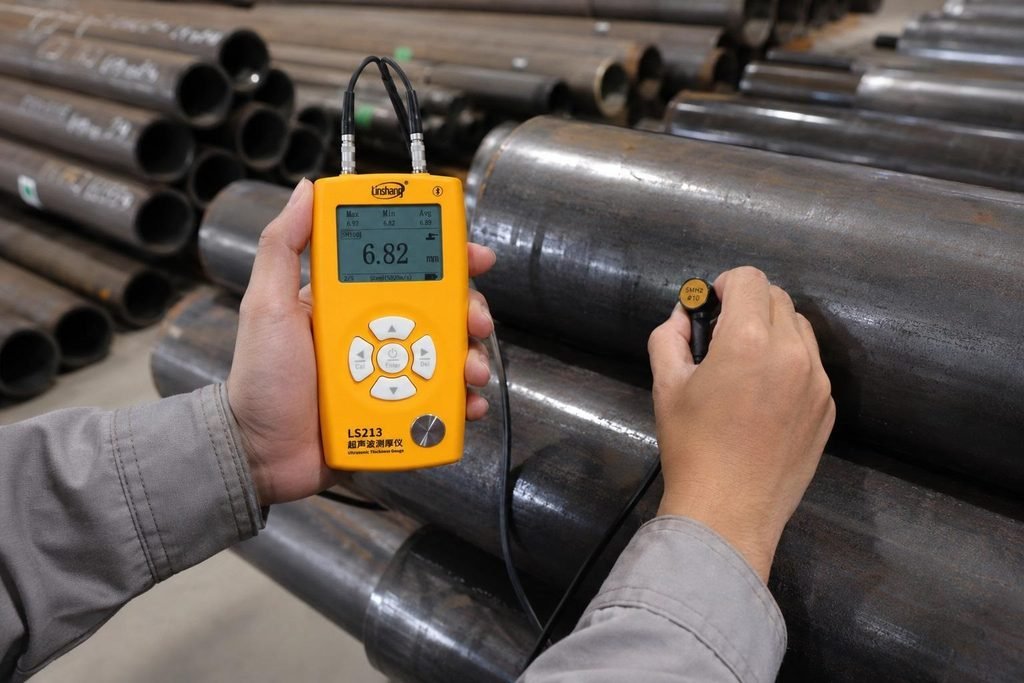
- Ultrasonic thickness gauges
Ultrasonic thickness measurement is particularly useful for inspecting installed pipes or pipe sections where direct access to the internal surface is not possible.
For accurate ultrasonic measurement, the instrument should be calibrated for the material and measurement conditions.
8.3 Measuring Inside Diameter
The inside diameter can be measured using internal calipers, bore gauges or suitable dimensional inspection equipment.
Alternatively, it can be calculated from the measured OD and wall thickness:
ID = OD − 2WT
8.4 Why Are Dimensional Tolerances Important?
The nominal OD and WT listed in a dimensional chart are standard values. The actual manufactured pipe dimensions may vary within the permitted tolerances.
These tolerances depend on:
- Pipe manufacturing method
- Material specification
- Outside diameter
- Wall thickness
- Product standard
- Delivery condition
For example, seamless and welded pipes may have different dimensional tolerance requirements under their respective product specifications.
Therefore, a dimensional inspection report should be evaluated against the applicable product standard rather than against nominal dimensions alone.
9. Common Mistakes When Ordering Steel Pipes
Incorrect interpretation of pipe dimensions can lead to purchasing errors, connection problems and additional fabrication costs.
The following mistakes are particularly common.
Mistake 1: Treating DN as the actual outside diameter
DN50 does not mean that the pipe has an OD of 50 mm. Its standard OD is approximately 60.3 mm.
Mistake 2: Assuming all pipes with the same DN have the same inside diameter
Different wall thicknesses produce different inside diameters even when DN and OD remain unchanged.
Mistake 3: Assuming SCH 40 means the same wall thickness for every pipe size
Schedule is a wall thickness series, not a fixed thickness in millimetres.
Mistake 4: Ignoring manufacturing tolerances
The actual measured dimensions must comply with the relevant product specification and its tolerance limits.
Mistake 5: Ordering pipes without specifying the applicable standard
A complete purchase specification should identify the material grade, dimensional standard, manufacturing method, dimensions and delivery requirements.
10. How to Specify Steel Pipe Dimensions When Purchasing
When ordering steel pipes, providing only the DN designation is generally insufficient for a complete technical specification.
A clear purchase description should include:
- Nominal size (DN or NPS).
- Outside diameter (OD).
- Wall thickness (WT) or Schedule.
- Material grade.
- Applicable product standard.
- Manufacturing method.
- Pipe length.
- End preparation.
- Inspection and testing requirements.
For example:
NPS 2 / DN50, OD 60.3 mm × WT 3.91 mm, ASTM A106 Grade B, Seamless, SCH 40.
This description identifies the nominal size, outside diameter, wall thickness, material grade, manufacturing method and schedule.
For project procurement, the relevant dimensional and product standards should always be stated in the purchase order.
11. Frequently Asked Questions
Is DN the same as OD?
No. DN is a nominal size designation, while OD is the actual outside diameter. For example, DN50 steel pipe has a standard OD of approximately 60.3 mm.
What does DN50 mean in steel pipe?
DN50 is a metric nominal size designation corresponding to NPS 2. Its standard outside diameter is approximately 60.3 mm.
What is the difference between DN and NPS?
DN is a metric nominal size designation, while NPS is the nominal pipe size designation used primarily in North American standards. They have corresponding size designations but are not direct numerical conversions of actual diameters.
What does OD mean in pipe dimensions?
OD means Outside Diameter. It is the distance measured across the external surface of a pipe through its centre.
What does WT mean in steel pipes?
WT means Wall Thickness. It is the distance between the outside and inside surfaces of the pipe wall.
Does a higher Schedule mean a larger pipe diameter?
No. For a given NPS, the standard outside diameter remains the same. A higher Schedule generally means a thicker wall and a smaller inside diameter.
What is the difference between SCH 40 and SCH 80?
SCH 80 generally has a thicker wall than SCH 40 for the same nominal pipe size. This results in a smaller internal diameter and higher pipe weight.
How do you calculate the inside diameter of a steel pipe?
Use the following formula:
ID = OD − (2 × WT)
For example, if the OD is 60.3 mm and WT is 3.91 mm, the calculated ID is 52.48 mm.
Which standards define steel pipe dimensions?
ASME B36.10M is commonly used for welded and seamless wrought steel pipes, including carbon and alloy steel. ASME B36.19M covers welded and seamless wrought stainless steel pipes.
12. Conclusion
DN, OD and WT are three fundamental parameters used to identify and specify steel pipe dimensions.
DN represents the nominal pipe size, OD defines the standard outside diameter, and WT determines the thickness of the pipe wall. Together with the applicable pipe schedule and product standard, these dimensions help ensure compatibility, dimensional accuracy and suitability for the intended application.
For steel pipe procurement, it is important to specify the nominal size, actual outside diameter, wall thickness, material grade and applicable standard. Relying on DN alone can result in incorrect product selection or installation problems.
Looking for steel pipes with specific dimensions and wall thicknesses?
Provide your required DN, OD, WT, material grade and applicable standard to identify the appropriate seamless or welded steel pipe for your project.