
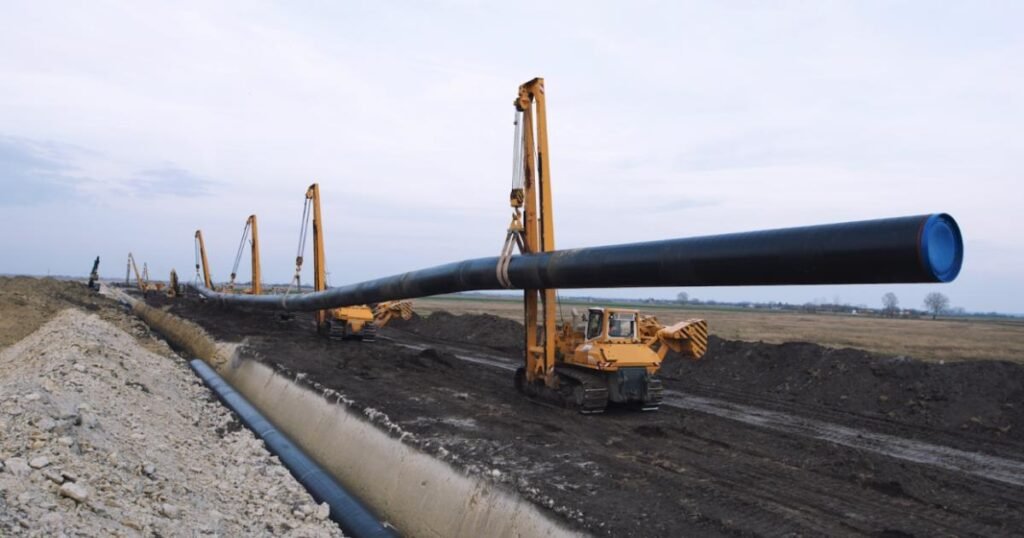
Choosing the right steel pipe is one of the most important decisions in an oil and gas pipeline project. The pipe must withstand internal pressure, temperature changes, transportation loads, corrosion, external forces, and long-term operating conditions. A pipe that looks suitable based only on diameter and wall thickness may still be unsuitable for the actual service environment.
For oil and gas pipeline projects, steel pipe selection should be based on the complete operating condition rather than a single specification. Material grade, pipe manufacturing method, diameter, wall thickness, PSL level, corrosion environment, coating system, testing requirements, and project standards all need to be considered together.
For most pipeline applications, API 5L line pipe is one of the main standards used for transporting oil, natural gas, and other hydrocarbon products. However, the correct API 5L grade and pipe type depend on the specific project.
What Type of Steel Pipe Is Used for Oil and Gas Pipelines?
Oil and gas pipeline systems can use different types of steel pipe depending on the pipeline’s diameter, pressure, application, and operating environment.
Common choices include:
- Seamless steel pipe
- ERW steel pipe
- HFW steel pipe
- LSAW steel pipe
- SSAW steel pipe
For large-diameter transmission pipelines, welded line pipe is commonly used because it can efficiently produce large diameters and heavy wall thicknesses.
Seamless steel pipe is more common in smaller-diameter and high-pressure applications where its manufacturing characteristics are advantageous.
The choice between seamless and welded pipe should therefore be based on project requirements rather than assuming that seamless pipe is always the better option.
Start With the Pipeline Service Conditions
Before selecting a steel pipe, the first step is to understand what the pipeline will actually carry and where it will operate.
Important parameters include:
- Transported medium
- Design pressure
- Operating pressure
- Design temperature
- Operating temperature
- Pipeline diameter
- Pipeline length
- Installation method
- Internal corrosion conditions
- External corrosion conditions
- Offshore or onshore installation
- Sour or non-sour service
- Expected service life
For example, a natural gas transmission pipeline operating at high pressure may require a high-strength line pipe, while a low-pressure water or utility pipeline may have very different material requirements.
The same steel grade should not automatically be used for every pipeline.
API 5L: A Key Standard for Oil and Gas Line Pipe
API 5L is one of the most widely recognized specifications for line pipe used in pipeline transportation systems.
It covers seamless and welded steel pipe for pipeline transportation systems in the petroleum and natural gas industries.
Common API 5L grades include:
- Grade B
- X42
- X52
- X60
- X65
- X70
The number in an X-grade designation is related to the specified minimum yield strength in ksi. For example, X52 has a specified minimum yield strength of approximately 52 ksi.
Higher-strength grades can allow engineers to achieve the required pressure capacity with a lower wall thickness in some applications. However, choosing a higher grade is not automatically better because weldability, fracture toughness, sour-service requirements, manufacturing capability, and project specifications also need to be considered.
How to Choose the Right API 5L Grade
The correct grade depends primarily on the mechanical and environmental requirements of the pipeline.
API 5L Grade B
Grade B is commonly used for general pipeline applications where the strength requirements are moderate.
It may be considered for:
- General oil pipelines
- Gas pipelines
- Utility pipelines
- Lower-stress pipeline systems
Its relatively straightforward material characteristics can make it economical for suitable applications.
API 5L X42
X42 provides higher strength than Grade B and can be used in a wider range of pipeline applications.
It is often considered where additional mechanical strength is required without moving to higher-strength grades.
API 5L X52
X52 is a widely used pipeline steel grade.
It provides a useful balance between:
- Strength
- Weldability
- Availability
- Cost
For many conventional oil and gas pipeline projects, X52 can be a practical material choice when the project specification permits it.
API 5L X60 and X65
Higher-strength grades such as X60 and X65 are used when pipeline design requires greater strength.
Potential advantages include:
- Higher yield strength
- Reduced wall thickness in suitable designs
- Lower pipe weight
- Improved transportation efficiency
However, higher-strength steel can place greater demands on welding procedures, forming, heat treatment, and quality control.
API 5L X70
X70 is a high-strength pipeline grade used in demanding transmission pipeline applications.
Its high strength can allow engineers to optimize pipeline wall thickness and reduce steel consumption in appropriately designed systems.
However, X70 requires careful control of:
- Chemical composition
- Welding
- Toughness
- Heat affected zone properties
- Manufacturing process
- Field installation
Higher grade does not mean better in every project. The selected grade must match the complete engineering design.
PSL1 or PSL2: Which Should You Choose?
API 5L line pipe can be supplied according to different product specification levels.
The two commonly encountered levels are:
- PSL1
- PSL2
PSL2 generally has more stringent requirements than PSL1 for areas such as chemical composition, mechanical properties, testing, traceability, and manufacturing control.
For critical oil and gas pipeline projects, PSL2 is frequently specified when tighter control over product quality and performance is required.
However, buyers should not select PSL2 simply because it sounds more advanced. The correct level should be determined by the project specification and engineering requirements.
Why Is PSL Important?
PSL affects more than the inspection report.
It can influence:
- Chemical composition limits
- Mechanical testing
- Toughness requirements
- NDT requirements
- Traceability
- Manufacturing controls
- Acceptance criteria
When requesting a quotation, it is therefore important to state the required PSL rather than simply writing “API 5L.”
How to Choose the Correct Pipe Diameter
Pipe diameter has a direct effect on the pipeline’s transportation capacity.
A larger diameter can transport a greater volume of fluid at a given flow velocity, but it also increases material consumption, construction requirements, and project cost.
The diameter should be determined according to factors such as:
- Required flow rate
- Fluid properties
- Operating pressure
- Pressure drop
- Pipeline length
- Future capacity requirements
- Pumping or compression requirements
Common large-diameter pipeline sizes can range from several hundred millimeters to more than one meter depending on the project.
The correct diameter should come from hydraulic and engineering calculations rather than simply choosing the largest available pipe.
How to Select the Correct Wall Thickness
Wall thickness is one of the most important parameters when selecting steel pipe for an oil and gas pipeline.
The pipe wall must withstand the internal pressure while also allowing for:
- Corrosion allowance
- External loads
- Installation stresses
- Transportation loads
- Temperature effects
- Manufacturing tolerances
A basic pressure design relationship can provide an initial indication of required wall thickness, but final design should follow the applicable pipeline design code and project specification.
For example, transmission pipelines may be designed according to standards such as ASME B31.4 or ASME B31.8, depending on the service.
Increasing wall thickness generally improves pressure and mechanical capacity, but it also increases:
- Pipe weight
- Material cost
- Welding volume
- Transportation cost
- Installation requirements
The goal is not to select the thickest pipe possible. The goal is to select a wall thickness that safely meets the design requirements.
Sour Service Requires Special Attention
Oil and gas pipelines carrying fluids containing hydrogen sulfide require additional consideration.
H₂S can create serious material problems, including risks associated with:
- Sulfide stress cracking
- Hydrogen-induced cracking
- Hydrogen-related damage
A standard API 5L grade should not automatically be considered suitable for sour service.
Sour-service material selection may require additional requirements based on applicable standards and project specifications, including requirements associated with NACE MR0175 / ISO 15156 for relevant oil and gas production environments.
Depending on the project, additional controls may involve:
- Chemical composition
- Hardness
- Heat treatment
- Sulfur and phosphorus limits
- Toughness
- HIC testing
- SSC testing
This is an area where the project specification should always take priority over a general material recommendation.
Consider Corrosion Protection
Selecting the correct steel grade is only part of pipeline corrosion control.
External corrosion can occur when steel pipe is exposed to:
- Moisture
- Soil
- Salt water
- Marine environments
- Chemicals
- Damaged coating systems
Common external pipeline coating systems include:
- Fusion Bonded Epoxy (FBE)
- 3LPE
- 3LPP
The coating system should be selected according to:
- Soil conditions
- Operating temperature
- Installation method
- Mechanical damage risk
- Pipeline location
- Required service life
For buried pipelines, external coating is commonly combined with cathodic protection as part of the overall corrosion-control system.
Internal Corrosion Also Matters
External coating cannot protect the inside of the pipe.
Internal corrosion depends on the transported fluid and its composition.
Potential causes include:
- Water
- CO₂
- H₂S
- Chlorides
- Oxygen
- Other corrosive contaminants
Possible control methods include:
- Corrosion inhibitors
- Dehydration
- Internal coating
- Chemical treatment
- Material upgrading
- Corrosion monitoring
The pipe material and corrosion-control strategy should therefore be considered together.
Seamless vs Welded Steel Pipe for Oil and Gas Pipelines
One of the most common questions from buyers is whether seamless pipe or welded pipe is better for oil and gas pipelines.
The answer depends on the application.
Seamless Steel Pipe
Advantages include:
- No longitudinal weld seam
- Good pressure resistance
- Suitable for many high-pressure applications
- Available in a wide range of grades and dimensions
Seamless pipe can be attractive for smaller-diameter high-pressure systems and certain specialized applications.
However, large-diameter seamless pipe becomes less practical from a manufacturing and economic perspective.
LSAW Steel Pipe
Longitudinal Submerged Arc Welded pipe is widely used for large-diameter and heavy-wall pipeline applications.
Advantages include:
- Large outside diameter capability
- Heavy wall thickness capability
- Good dimensional control
- Efficient production of large-diameter line pipe
LSAW is commonly considered for major oil and gas transmission projects.
SSAW Steel Pipe
Spiral Submerged Arc Welded pipe is manufactured by forming the steel plate or coil helically and welding along the spiral seam.
It can offer:
- Large diameter capability
- Efficient production
- Competitive cost
Its suitability depends on the applicable project specification and service requirements.
ERW and HFW Pipe
Electric Resistance Welded and High-Frequency Welded pipes are commonly used for certain smaller and medium-diameter applications.
They can provide:
- Good dimensional accuracy
- Efficient production
- Competitive manufacturing cost
The appropriate manufacturing method should be selected according to pipe size, grade, wall thickness, service condition, and applicable standard.
Pipe Manufacturing Method Should Match the Project
A practical selection approach is:
| Project Requirement | Potential Pipe Choice |
|---|---|
| Small-diameter high-pressure service | Seamless |
| Large-diameter transmission pipeline | LSAW |
| Large-diameter economical applications | SSAW where permitted |
| Small/medium diameter pipeline | ERW/HFW where permitted |
| High-temperature alloy service | Seamless alloy pipe or specified welded pipe |
| Critical sour service | Project-specific API 5L / sour-service requirements |
This table is only a general starting point. The actual project specification determines which manufacturing method is acceptable.
Check Toughness, Not Just Strength
Strength is only one part of pipeline performance.
Pipeline steel may also need sufficient toughness to resist brittle fracture, particularly at low temperatures or under demanding operating conditions.
Important properties may include:
- Yield strength
- Tensile strength
- Elongation
- Impact toughness
- Hardness
For critical pipeline projects, Charpy impact testing and other toughness requirements may be specified.
This is particularly important for pipelines operating in:
- Cold regions
- Offshore environments
- Low-temperature conditions
- High-pressure service
A steel pipe with high strength but inadequate toughness may not be suitable for the actual application.
Consider Weldability
Pipeline construction involves extensive welding.
This means steel grade selection must consider not only the pipe’s strength but also its weldability.
Factors that influence weldability include:
- Carbon content
- Carbon equivalent
- Alloying elements
- Pipe wall thickness
- Welding process
- Preheating requirements
- Heat input
- Post-weld heat treatment requirements
Higher-strength pipeline steels may require more carefully controlled welding procedures.
For large pipeline projects, welding performance can have a major effect on construction speed and overall project cost.
Quality Inspection for Oil and Gas Steel Pipe
Oil and gas pipeline projects normally have strict inspection and documentation requirements.
Depending on the applicable specification, inspection may include:
- Chemical analysis
- Tensile testing
- Impact testing
- Hardness testing
- Hydrostatic testing
- Ultrasonic testing
- Magnetic particle testing
- Dimensional inspection
- Visual inspection
For welded pipe, additional inspection of the weld seam may be required.
Check the Mill Test Certificate
The Mill Test Certificate should be carefully checked against the physical pipe.
Important information includes:
- Pipe standard
- Grade
- PSL
- Heat number
- Chemical composition
- Mechanical test results
- Heat treatment condition
- Hydrostatic test information
- NDT results
The heat number on the certificate should match the marking on the pipe.
Traceability is especially important for critical oil and gas projects.
Pipe Coating and Transportation Should Be Considered Together
Steel pipe can be damaged before it reaches the construction site.
Common transportation risks include:
- Impact damage
- Coating scratches
- Pipe-end deformation
- Corrosion
- Improper stacking
Proper loading, support, separation and handling procedures can reduce these risks.
For coated pipe, lifting equipment and handling methods should be selected to avoid damaging the coating.
Pipe ends may also require suitable protection during transportation and storage.
How to Select Steel Pipes for Different Oil and Gas Applications
Crude Oil Transmission Pipelines
Important considerations include:
- Pipeline pressure
- Flow rate
- Corrosion
- Wax or deposit formation
- Operating temperature
- Pipeline length
API 5L carbon steel line pipe is commonly considered for these systems, with the specific grade determined by engineering requirements.
Natural Gas Transmission Pipelines
Gas transmission systems often operate at relatively high pressures.
Key factors include:
- High-strength steel selection
- Fracture control
- Toughness
- Weldability
- Pressure design
- External corrosion protection
Grades such as X52, X60, X65 and X70 may be considered depending on project requirements.
Sour Gas Pipelines
Sour gas requires additional attention because of H₂S.
Material selection may need to include:
- Sour-service requirements
- Hardness control
- HIC resistance
- SSC resistance
- Chemical composition limits
The project specification and applicable sour-service standards should be followed carefully.
Offshore Pipelines
Offshore pipelines face additional challenges, including:
- Seawater corrosion
- External pressure
- Waves and currents
- Installation stresses
- Low-temperature conditions
- Difficult maintenance access
Pipe material, wall thickness, coating, cathodic protection and installation method must be considered together.
A Practical Steel Pipe Selection Checklist
Before placing an order, buyers should confirm the following information:
1. Application
What will the pipeline transport?
2. Design pressure
What pressure must the pipe withstand?
3. Design temperature
What are the minimum and maximum operating temperatures?
4. Diameter
What internal flow capacity is required?
5. Wall thickness
What wall thickness is required by the design?
6. Material grade
Is Grade B, X42, X52, X60, X65, X70 or another grade specified?
7. PSL
Is PSL1 or PSL2 required?
8. Sour service
Does the pipeline contain H₂S or require special sour-service testing?
9. Manufacturing method
Is seamless, LSAW, SSAW, ERW or another manufacturing method specified?
10. Coating
Is FBE, 3LPE, 3LPP or another coating required?
11. Inspection
What testing and inspection documents must be supplied?
12. Applicable standards
Which API, ASME, ISO, NACE or project-specific requirements apply?
Common Mistakes When Buying Pipeline Steel Pipe
Choosing the Grade Only by Strength
Higher strength does not automatically mean better performance.
The selected grade must also satisfy toughness, weldability, corrosion, sour-service and manufacturing requirements.
Ignoring PSL Requirements
Simply specifying “API 5L” may not provide enough information for a critical project.
The required PSL should be clearly stated.
Selecting Pipe by Diameter Alone
A correct diameter does not guarantee that the wall thickness, grade or pressure rating is suitable.
Treating Sour Service as a Normal Application
H₂S-containing service can require additional material and testing requirements.
Focusing Only on Pipe Price
The cheapest pipe may not be the lowest-cost option after considering:
- Coating
- Transportation
- Welding
- Inspection
- Installation
- Maintenance
- Service life
Total project cost is more important than the initial pipe price alone.
How to Make the Right Steel Pipe Choice
A good steel pipe selection process should follow the actual engineering requirements:
Service Conditions → Design Pressure → Diameter → Wall Thickness → Material Grade → PSL → Manufacturing Method → Corrosion Protection → Inspection → Documentation
This approach helps buyers avoid selecting pipe based on only one parameter.
For example, a high-pressure natural gas transmission pipeline may require API 5L PSL2 X65 LSAW pipe with a specified wall thickness, impact toughness, NDT requirements, external coating and project-specific acceptance criteria.
Another project may require a completely different combination.
Conclusion
Selecting steel pipes for an oil and gas pipeline project is not simply a matter of choosing the correct diameter and steel grade.
The right pipe must match the pipeline’s pressure, temperature, transported medium, corrosion environment, installation conditions and expected service life.
For many oil and gas transmission projects, API 5L line pipe provides the basic material framework, while the final selection may involve considerations such as Grade B, X42, X52, X60, X65 or X70; PSL1 or PSL2; seamless or welded pipe; wall thickness; sour-service requirements; coating; and non-destructive testing.
The most suitable steel pipe is therefore the one that meets the complete project specification while providing the required safety, reliability and economic performance.
For buyers, engineers and contractors, clearly defining these requirements before requesting quotations is the best way to avoid material mismatches, unnecessary costs and problems during pipeline construction.