
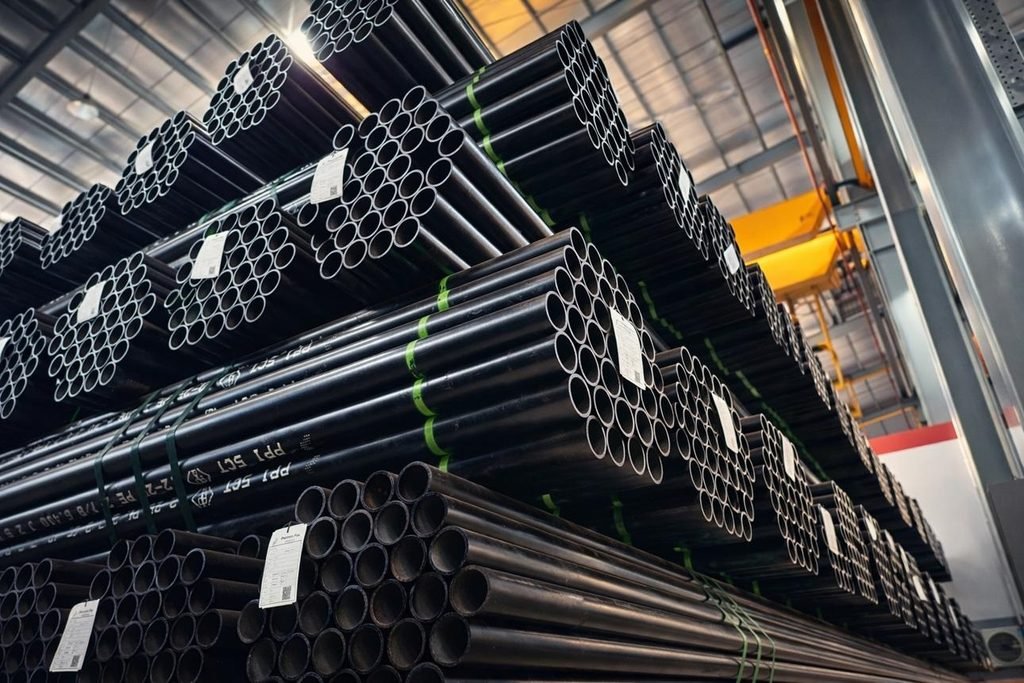
1. What Is the Difference Between Seamless Steel Pipe and Seamless Steel Tube?
Seamless steel pipes and seamless steel tubes are both manufactured without a welded seam. They are widely used in oil and gas, construction, machinery, automotive manufacturing, power generation and industrial processing.
Although the terms “pipe” and “tube” are sometimes used interchangeably, they generally refer to products designed for different purposes.
The main difference is not the manufacturing process. It is how the products are specified, dimensioned, manufactured and used.
In general:
- Seamless steel pipe is primarily specified for fluid and gas transportation, pressure service and industrial piping systems.
- Seamless steel tube is commonly used for mechanical components, precision equipment, heat exchangers and applications requiring specific dimensional accuracy.
- Seamless mechanical tubing may be supplied in round, square, rectangular or special shapes, depending on the applicable specification.
- Precision seamless tubing is often cold-finished to achieve tighter dimensional tolerances and improved surface quality.
However, these are general industry conventions rather than absolute definitions. Some round tubes are used in pressure applications, and some pipes are manufactured to demanding dimensional tolerances.
The applicable product standard and purchase specification ultimately determine the technical requirements.
2. What Is Seamless Steel Pipe?
Seamless steel pipe is a hollow steel product manufactured without a longitudinal weld seam.
It is commonly produced by heating a solid steel billet, piercing it to create a hollow shell, and then rolling or sizing the shell to obtain the required outside diameter and wall thickness.
Seamless steel pipes are widely used in applications where pressure containment, structural integrity and reliable fluid transportation are important.
Common Applications of Seamless Steel Pipe
- Oil and gas transportation.
- Oilfield drilling and production.
- Boiler and steam pipelines.
- Petrochemical processing.
- Power generation.
- Industrial fluid transportation.
- High-pressure piping systems.
Common Seamless Steel Pipe Standards
ASTM A106
ASTM A106 covers seamless carbon steel pipe intended for high-temperature service. It is commonly used in refineries, power plants and industrial piping systems.
ASTM A53
ASTM A53 covers black and hot-dipped galvanized welded and seamless steel pipe. It is used in mechanical and pressure applications, as well as other general-purpose piping services.
ASTM A335
ASTM A335 covers seamless ferritic alloy-steel pipe for high-temperature service. Common grades include P11, P22 and P91.
API 5L
API 5L specifies line pipe used in pipeline transportation systems for the petroleum and natural gas industries.
The required grade, manufacturing route, dimensions and inspection requirements should always be checked against the relevant standard and order.
3. What Is Seamless Steel Tube?
Seamless steel tube is a hollow steel product manufactured without a welded joint.
Unlike conventional piping products, steel tubing is frequently specified according to its exact outside diameter and wall thickness.
It is commonly used where dimensional accuracy, surface finish, mechanical properties or component fit are important.
Seamless tubes can be supplied as hot-finished or cold-finished products.
Cold drawing is particularly common in precision tube manufacturing because it can improve dimensional accuracy and surface finish.
Common Applications of Seamless Steel Tube
- Automotive components.
- Hydraulic and pneumatic cylinders.
- Mechanical shafts and machine components.
- Heat exchangers.
- Boiler and superheater systems.
- Precision instruments.
- Industrial equipment.
- Structural and fabrication applications.
Common Seamless Steel Tube Standards
ASTM A519
ASTM A519 covers several grades of seamless carbon and alloy steel mechanical tubing.
It includes hot-finished and cold-finished tubing, with round, square, rectangular and special shapes available as specified.
Common grades include 1020, 1026, 4130 and 4140.
ASTM A213
ASTM A213 covers seamless ferritic and austenitic alloy-steel boiler, superheater and heat-exchanger tubes.
It includes grades such as T5, T11, T22, TP304 and TP347H.
ASTM A269
ASTM A269 covers seamless and welded austenitic stainless steel tubing for general corrosion-resisting and low- or high-temperature service.
EN 10305
The EN 10305 series covers precision steel tubes for different applications and manufacturing conditions. EN 10305-1, for example, addresses seamless cold-drawn precision steel tubes.
These standards are not interchangeable. Buyers should select the specification according to the intended application rather than relying on the words “pipe” or “tube” alone.
4. Seamless Steel Pipe vs Seamless Steel Tube: Key Differences
Although both products can be manufactured using seamless technology, several important differences should be considered.
4.1 Dimensional Measurement
One of the most important differences is the way products are commonly specified.
Steel pipe is frequently ordered by Nominal Pipe Size (NPS), schedule and material specification.
Steel tubing is generally specified by its actual outside diameter (OD) and wall thickness (WT).
For example:
A pipe ordered as NPS 2 does not have an actual outside diameter of 2 inches. Its standardized outside diameter is 2.375 inches.
A tube specified as 2 inches OD has an actual outside diameter of 2 inches.
This distinction is important when selecting fittings, designing connections and calculating internal flow areas.
4.2 Dimensional Tolerances
Seamless steel pipes are manufactured to the dimensional tolerances specified by their relevant product standards.
Precision seamless tubes, particularly cold-drawn tubes, are often supplied with tighter OD, wall thickness and straightness tolerances.
This is important in applications involving:
- Hydraulic cylinder assemblies.
- Precision mechanical components.
- Sliding or moving parts.
- Instrumentation systems.
- Components requiring accurate machining allowances.
However, not every tube has tighter tolerances than every pipe. Actual tolerances must be compared using the applicable product standards and order requirements.
4.3 Wall Thickness and Pressure Requirements
Pipe specifications commonly use standardized wall thickness schedules, such as SCH 10, SCH 40, SCH 80 and SCH 160.
Tube products are generally ordered by an explicitly stated outside diameter and wall thickness.
For pressure applications, the required wall thickness must be calculated according to the applicable design code.
It depends on factors such as:
- Design pressure.
- Design temperature.
- Allowable material stress.
- Weld or quality factors, where applicable.
- Corrosion allowance.
- Manufacturing tolerance.
- Applicable piping code.
A thicker tube is not automatically suitable for pressure service, and a pipe schedule alone does not establish its allowable operating pressure.
4.4 Manufacturing Process
Both seamless steel pipes and tubes can be produced through hot working and subsequent cold finishing.
A typical seamless manufacturing route includes:
- Steel billet preparation.
- Billet heating.
- Rotary piercing.
- Hollow shell rolling.
- Diameter and wall thickness reduction.
- Heat treatment, where required.
- Straightening.
- Cutting and finishing.
- Inspection and testing.
For precision seamless tubes, additional cold drawing or cold finishing may be used.
This process can improve:
- Outside diameter accuracy.
- Wall thickness consistency.
- Surface finish.
- Straightness.
- Mechanical property control.
The manufacturing route should be selected according to the required product specification and dimensional requirements.
4.5 Surface Finish
Surface finish is another important consideration.
Hot-finished seamless pipes generally have a surface condition associated with hot working, descaling and subsequent finishing operations.
Cold-drawn seamless tubes often have a smoother and more uniform surface.
This makes precision tubing suitable for applications where surface quality and dimensional consistency affect component performance.
Nevertheless, surface finish requirements should be specified rather than assumed from the product name.
4.6 Application and Function
The intended application is often the clearest way to distinguish pipe from tube.
| Comparison | Seamless Steel Pipe | Seamless Steel Tube |
|---|---|---|
| Main Purpose | Fluid and gas transportation | Mechanical, precision and heat-transfer applications |
| Common Dimensions | NPS, OD and schedule | Actual OD and WT |
| Cross-Section | Generally circular | Round, square, rectangular or special |
| Dimensional Requirements | Product-standard tolerances | Often tighter in precision applications |
| Common Manufacturing | Hot finished or cold finished | Hot finished or cold drawn |
| Typical Applications | Oil and gas, pressure piping, steam systems | Hydraulics, machinery, heat exchangers and precision components |
| Typical Standards | ASTM A106, A53, A335, API 5L | ASTM A519, A213, A269, EN 10305 |
This comparison describes common industrial practice, not universal restrictions.
5. What Is the Difference Between Hot-Finished and Cold-Drawn Seamless Tubes?
The manufacturing process has a direct influence on the dimensional characteristics and surface condition of seamless tubes.
Hot-Finished Seamless Tubes
Hot-finished tubes are formed and sized at elevated temperatures.
Their main characteristics include:
- Suitable for a wide range of dimensions.
- Commonly used in general mechanical applications.
- Less additional finishing compared with precision cold-drawn products.
- Surface finish associated with hot working.
- Dimensional tolerances determined by the relevant standard.
Cold-Drawn Seamless Tubes
Cold drawing involves pulling a hollow steel product through a die, often over a mandrel, to reduce its diameter and wall thickness.
This process is used to obtain more precise dimensions and improved surface quality.
Common characteristics include:
- Tighter dimensional tolerances.
- Better surface finish.
- Improved dimensional consistency.
- Greater suitability for precision machining.
- Potential increase in strength and hardness due to work hardening.
Cold drawing does not automatically improve every mechanical property. The final condition depends on material grade, reduction ratio and subsequent heat treatment.
Comparison
| Parameter | Hot-Finished Tube | Cold-Drawn Tube |
|---|---|---|
| Manufacturing Temperature | Elevated temperature | Room-temperature drawing after initial tube production |
| Dimensional Accuracy | Standard manufacturing tolerances | Often tighter tolerances |
| Surface Finish | Generally less refined | Generally smoother |
| Strength | Depends on grade and heat treatment | May increase through work hardening |
| Machining Suitability | General applications | Precision applications |
| Typical Use | Mechanical and industrial tubing | Hydraulic cylinders and precision components |
6. Which Standards Should You Choose for Seamless Steel Pipe and Tube?
The correct standard depends on the intended service and product requirements.
The following examples are useful when preparing a purchase specification.
For Pressure and Fluid Transportation
Consider the relevant pipe specifications:
- ASTM A106 for seamless carbon steel pipe in high-temperature service.
- ASTM A53 for specified seamless and welded carbon steel pipe applications.
- ASTM A335 for seamless ferritic alloy-steel pipe in high-temperature service.
- API 5L for line pipe used in petroleum and natural gas transportation.
For Mechanical and Precision Applications
Consider:
- ASTM A519 for seamless carbon and alloy steel mechanical tubing.
- EN 10305-1 for seamless cold-drawn precision steel tubes.
- Other applicable EN 10305 parts for the required manufacturing route and product type.
For Heat Exchangers and Boilers
Consider:
- ASTM A213 for seamless ferritic and austenitic alloy-steel boiler, superheater and heat-exchanger tubes.
- ASTM A192 for seamless carbon steel boiler tubes, where applicable.
- ASTM A210 for seamless medium-carbon steel boiler and superheater tubes.
For Stainless Steel Tubing
Consider:
- ASTM A269 for general-service austenitic stainless steel tubing.
- ASTM A213 for specified stainless steel boiler, superheater and heat-exchanger tubes.
- ASTM A511/A511M for seamless stainless steel mechanical tubing.
The purchaser should confirm the current edition, grade, dimensions, heat treatment, testing and supplementary requirements before placing an order.
7. How to Choose Between Seamless Steel Pipe and Seamless Steel Tube?
The right product depends on how it will be used.
Choose Seamless Steel Pipe When:
- You need to transport liquids or gases.
- The application involves pressure piping.
- The project specifies NPS and schedule dimensions.
- Standard pipe fittings and connections are required.
- The governing design code specifies a pipe product standard.
Typical products include ASTM A106 Grade B, ASTM A53 Grade B and ASTM A335 P11/P22/P91.
Choose Seamless Steel Tube When:
- The application requires precise OD and wall thickness.
- The product will be machined into mechanical components.
- Dimensional accuracy is important for assembly.
- A smooth internal or external surface is required.
- The application involves hydraulic cylinders or heat exchangers.
- The specification requires mechanical tubing or precision tubing.
Typical products include ASTM A519 Grade 1020, ASTM A519 Grade 4130 and EN 10305-1 precision tubes.
Questions to Ask Before Purchasing
Before requesting a quotation, confirm:
- Is the product intended for pressure service, fluid transportation or mechanical use?
- What material grade is required?
- Is the required size based on NPS or actual OD?
- What wall thickness is needed?
- Are hot-finished or cold-drawn products acceptable?
- What dimensional tolerances are required?
- What heat treatment condition is specified?
- What inspection and certification documents are required?
Providing this information helps avoid incorrect product selection and unnecessary specification changes.
8. Common Mistakes When Buying Seamless Steel Pipes and Tubes
Mistake 1: Assuming Pipe and Tube Are Different Manufacturing Processes
Both products can be manufactured without welding. Their differences are mainly related to product specification, dimensions and application.
Mistake 2: Ordering by Nominal Size Without Confirming Actual OD
NPS is a nominal designation. It does not necessarily equal the actual outside diameter.
This can cause fitting and connection problems.
Mistake 3: Assuming Every Tube Has Tighter Tolerances
Precision tubes often have tighter tolerances, but this must be confirmed against the relevant standard and purchase specification.
Mistake 4: Choosing Mechanical Tubing for Pressure Service Without Verification
ASTM A519 mechanical tubing should not automatically be treated as equivalent to ASTM A106 pressure pipe.
The product must satisfy the relevant design code and pressure-service requirements.
Mistake 5: Ignoring Surface Finish Requirements
For hydraulic and precision mechanical applications, internal surface quality can be important.
The required surface condition should be clearly stated in the purchase order.
Mistake 6: Comparing Products Without Checking Standards
Two products with identical outside diameters and wall thicknesses may have different chemical composition, heat treatment and testing requirements.
Dimensional similarity does not establish technical equivalence.
9. Frequently Asked Questions
Is seamless steel pipe the same as seamless steel tube?
No. Both are hollow products manufactured without a welded seam, but they are commonly specified and used differently. Pipe is generally associated with fluid transportation and pressure service, while tubing is frequently associated with mechanical, precision and heat-transfer applications.
Is seamless steel tube stronger than seamless steel pipe?
Not necessarily. Strength depends on material grade, dimensions, manufacturing process and heat treatment. Neither product category is inherently stronger than the other.
What is the main dimensional difference between pipe and tube?
Pipe is commonly specified by NPS and schedule, while tube is generally specified by its actual outside diameter and wall thickness.
Why is cold-drawn seamless tubing more expensive?
Cold drawing requires additional processing, tooling, dimensional control and sometimes intermediate heat treatment. These steps can increase manufacturing costs but provide improved dimensional accuracy and surface quality.
Can seamless steel tubes be used for high-pressure applications?
Yes, provided the specific tube product, material, dimensions and manufacturing quality meet the applicable design and pressure-service requirements.
What is ASTM A519 steel tubing used for?
ASTM A519 covers seamless carbon and alloy steel mechanical tubing. It is commonly used in machinery, automotive components, hydraulic systems and other mechanical applications.
What is the difference between ASTM A106 and ASTM A519?
ASTM A106 specifies seamless carbon steel pipe for high-temperature service. ASTM A519 specifies seamless carbon and alloy steel mechanical tubing. They have different product scopes and should not be treated as interchangeable.
Are seamless tubes available in square and rectangular shapes?
Yes. ASTM A519 allows mechanical tubing in round, square, rectangular and special shapes, as specified by the purchaser.
Which is better for hydraulic cylinders: pipe or tube?
Precision seamless tubing is often preferred for hydraulic cylinder barrels because of its dimensional accuracy and surface finish. The required pressure rating, bore finish and material properties must still be verified.
Does seamless mean the product has no defects?
No. Seamless means the product has no longitudinal welded seam. It does not mean that internal or external defects are impossible. Inspection and testing are still necessary.
10. Conclusion
Seamless steel pipe and seamless steel tube are both manufactured without a welded seam, but they are designed and specified for different industrial requirements.
Seamless steel pipe is commonly used for fluid transportation, pressure piping and high-temperature industrial systems. Seamless steel tube is frequently selected for mechanical components, precision equipment, hydraulic systems and heat exchangers.
The main differences involve dimensional designation, manufacturing tolerances, surface finish, product standards and intended applications.
ASTM A106, ASTM A335 and API 5L are commonly associated with pipe products, while ASTM A519 and EN 10305-1 are important specifications for mechanical and precision tubing. ASTM A213 and ASTM A269 cover specific tube applications.
Before purchasing, confirm the actual outside diameter, wall thickness, material grade, manufacturing condition and applicable inspection requirements.
Looking for Seamless Steel Pipes or Precision Steel Tubes?
Whether your project requires ASTM A106 seamless carbon steel pipe, ASTM A335 alloy steel pipe, ASTM A519 mechanical tubing or EN 10305 precision seamless tubes, provide your required dimensions, material grade, application and inspection requirements.
A clearly defined technical specification helps ensure that the supplied product meets the actual requirements of your project.