
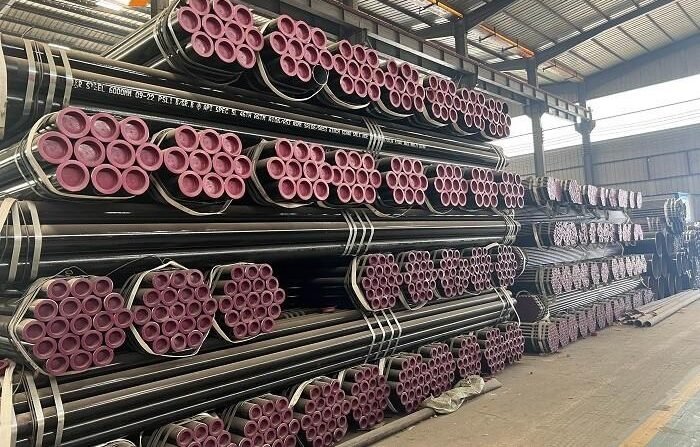
1. What Do SCH 40, SCH 80 and SCH 160 Mean?
When selecting steel pipes for industrial piping systems, SCH 40, SCH 80 and SCH 160 are three commonly specified wall thickness designations.
The term “SCH” stands for Schedule. It identifies a standardised wall thickness series for a given nominal pipe size (NPS).
The schedule number is used together with the nominal pipe size to determine the pipe’s specified outside diameter and nominal wall thickness.
For the same NPS:
- SCH 40 has a thinner wall than SCH 80.
- SCH 80 has a thinner wall than SCH 160.
- A higher schedule generally means a thicker pipe wall and a smaller internal diameter.
- The standard outside diameter generally remains unchanged across these schedules for the same NPS.
For example, a 4-inch NPS carbon steel pipe has an outside diameter of 114.3 mm regardless of whether it is SCH 40, SCH 80 or SCH 160. However, the wall thickness and inside diameter differ.
Pipe schedule designations are primarily associated with ASME B36.10M for carbon and alloy steel pipes. Stainless steel pipe dimensions are covered by ASME B36.19M.
It is important to understand that SCH 40, SCH 80 and SCH 160 are wall thickness designations, not direct pressure ratings. The actual allowable pressure depends on material grade, design temperature, pipe dimensions, applicable design code, corrosion allowance and other engineering factors.
2. SCH 40 vs SCH 80 vs SCH 160: Main Differences
The main difference between these three pipe schedules is their wall thickness.
For a given NPS, increasing the schedule generally increases wall thickness and decreases the internal diameter.
| Comparison | SCH 40 | SCH 80 | SCH 160 |
|---|---|---|---|
| Wall Thickness | Standard / Medium | Thick | Extra Thick |
| Outside Diameter | Standard | Standard | Standard |
| Inside Diameter | Larger | Smaller | Smallest |
| Pipe Weight | Lower | Higher | Highest |
| Material Consumption | Lower | Higher | Highest |
| Flow Area | Larger | Smaller | Smallest |
| Pressure Design Potential | Depends on design | Depends on design | Depends on design |
| Typical Application | General industrial piping | Higher design pressure or demanding service | Heavy-wall and specialised applications |
2.1 SCH 40 Steel Pipe
SCH 40 is one of the most widely used steel pipe schedules in industrial and commercial piping systems.
It provides a balance between wall thickness, material consumption, weight and cost.
Common applications include:
- General industrial fluid transportation.
- Water supply systems.
- HVAC piping.
- Building services.
- Low- and moderate-pressure process piping.
- General mechanical piping.
SCH 40 is often selected when the calculated minimum wall thickness, including applicable allowances and tolerances, is satisfied.
2.2 SCH 80 Steel Pipe
SCH 80 has a thicker wall than SCH 40 for the same NPS.
Its thicker cross-section provides a greater nominal wall thickness and can increase pressure containment capacity when other design conditions are the same.
Common applications include:
- Chemical processing plants.
- Industrial steam systems.
- Higher-pressure fluid transportation.
- Mechanical equipment connections.
- Industrial process piping.
- Applications requiring additional wall thickness.
SCH 80 also has a smaller internal diameter than SCH 40 at the same NPS, which may affect flow velocity and pressure drop.
2.3 SCH 160 Steel Pipe
SCH 160 is a heavy-wall pipe schedule used in applications requiring substantial wall thickness.
Its larger wall thickness can provide increased resistance to internal pressure and mechanical damage, subject to the relevant design calculations.
Typical applications include:
- High-pressure industrial piping.
- Specialised process systems.
- Heavy-duty mechanical installations.
- High-pressure fluid and gas connections.
- Applications with demanding wall thickness requirements.
SCH 160 pipes are heavier and generally more expensive than SCH 40 and SCH 80 pipes of the same nominal size.
Their smaller internal diameter also needs to be considered during hydraulic design.
3. SCH 40, SCH 80 and SCH 160 Wall Thickness Chart
The following table provides selected nominal dimensions for carbon and alloy steel pipes based on the ASME B36.10M dimensional system.
Selected Steel Pipe Dimensions
| NPS | DN | OD (mm) | SCH 40 WT (mm) | SCH 80 WT (mm) | SCH 160 WT (mm) |
|---|---|---|---|---|---|
| 1/2″ | 15 | 21.3 | 2.77 | 3.73 | 4.78 |
| 3/4″ | 20 | 26.7 | 2.87 | 3.91 | 5.56 |
| 1″ | 25 | 33.4 | 3.38 | 4.55 | 6.35 |
| 1-1/2″ | 40 | 48.3 | 3.68 | 5.08 | 7.14 |
| 2″ | 50 | 60.3 | 3.91 | 5.54 | 8.74 |
| 3″ | 80 | 88.9 | 5.49 | 7.62 | 11.13 |
| 4″ | 100 | 114.3 | 6.02 | 8.56 | 13.49 |
| 6″ | 150 | 168.3 | 7.11 | 10.97 | 18.26 |
| 8″ | 200 | 219.1 | 8.18 | 12.70 | 23.01 |
| 10″ | 250 | 273.1 | 9.27 | 15.09 | 25.40 |
| 12″ | 300 | 323.9 | 10.31 | 17.48 | 33.32 |
Notes:
- NPS means Nominal Pipe Size.
- DN means Nominal Diameter.
- OD means Outside Diameter.
- WT means Wall Thickness.
- Values are nominal dimensions in millimetres.
- A dash or unavailable value in a full dimensional table should not be interpreted as a permitted substitute.
- The table is a selected reference, not a complete manufacturing or purchasing specification.
- Always verify the required dimensions against the applicable edition of ASME B36.10M and the actual purchase specification.
3.1 Example: Comparing a 4-Inch Steel Pipe
For a 4-inch NPS carbon steel pipe:
- Outside diameter: 114.3 mm.
- SCH 40 wall thickness: 6.02 mm.
- SCH 80 wall thickness: 8.56 mm.
- SCH 160 wall thickness: 13.49 mm.
The approximate inside diameter can be calculated using:
ID = OD – 2 × WT
Therefore:
| Schedule | OD (mm) | WT (mm) | Approx. ID (mm) |
|---|---|---|---|
| SCH 40 | 114.3 | 6.02 | 102.26 |
| SCH 80 | 114.3 | 8.56 | 97.18 |
| SCH 160 | 114.3 | 13.49 | 87.32 |
This example demonstrates that a higher schedule reduces the internal diameter even though the nominal pipe size and outside diameter remain the same.
4. How Does Pipe Schedule Affect Pressure Capacity?
One of the most common misunderstandings in steel pipe selection is assuming that SCH 40, SCH 80 and SCH 160 correspond to fixed working pressure ratings.
This is incorrect.
Pipe schedule defines the nominal wall thickness for a particular pipe size. The allowable internal pressure must be determined using the applicable piping design code.
For example, ASME B31.3 provides design rules for process piping.
4.1 Factors Affecting Allowable Pressure
The pressure capacity of a steel pipe depends on several factors:
1. Wall Thickness
A thicker pipe wall generally increases resistance to internal pressure when the other design parameters remain unchanged.
2. Material Grade
Different steel grades have different allowable stress values.
For example, ASTM A106 Grade B and higher-strength alloy steel grades cannot automatically be assigned the same pressure capacity.
3. Design Temperature
The allowable stress of a material may decrease as design temperature increases.
High-temperature applications therefore require appropriate material stress values and temperature corrections.
4. Corrosion Allowance
If the pipe is exposed to corrosive fluids, additional wall thickness may be required to account for expected metal loss during the design life.
5. Manufacturing Tolerance
The specified nominal wall thickness is not necessarily the minimum actual wall thickness at every point.
Applicable manufacturing tolerances must be considered during design.
6. Design Code and Joint Factors
The relevant design code may require consideration of weld quality factors, material coefficients and other design parameters.
4.2 Why SCH 160 Does Not Always Mean a Higher Pressure Rating
A SCH 160 pipe generally has a thicker wall than a SCH 80 pipe of the same NPS.
However, the allowable operating pressure cannot be determined from the schedule number alone.
For example, a lower-strength material with a thicker wall may not necessarily have the same pressure capacity as a higher-strength material with a thinner wall.
Pressure calculations must consider the complete design conditions.
5. How to Choose Between SCH 40, SCH 80 and SCH 160
The correct schedule should be selected based on engineering requirements rather than choosing the thickest available option.
5.1 When to Choose SCH 40
SCH 40 is suitable for many general-purpose industrial piping applications.
It may be selected when:
- The calculated wall thickness is satisfied.
- The design pressure and temperature are within the material’s allowable limits.
- The corrosion allowance is adequately considered.
- The required mechanical and dimensional properties are met.
- The pipe meets the applicable product specification.
Its lower material consumption can also reduce purchasing and installation costs.
5.2 When to Choose SCH 80
SCH 80 may be appropriate when additional wall thickness is required.
Typical considerations include:
- Higher design pressure.
- Additional corrosion allowance.
- Greater mechanical protection.
- More demanding industrial operating conditions.
- Project-specific dimensional requirements.
However, the reduced internal diameter must be evaluated to avoid unnecessary flow restrictions.
5.3 When to Choose SCH 160
SCH 160 is generally considered for applications requiring heavy-wall pipe dimensions.
It may be appropriate when:
- Engineering calculations require a substantial wall thickness.
- High-pressure design conditions demand additional section thickness.
- The project specifies a heavy-wall pipe.
- Additional machining or structural requirements apply.
Its higher material weight, cost, handling requirements and smaller bore should be considered before selection.
6. SCH 40 vs SCH 80 vs SCH 160: Effect on Flow and Pipe Weight
Wall thickness affects more than pressure containment. It also changes the pipe’s internal diameter, flow area and weight.
6.1 Effect on Internal Diameter
For the same NPS, increasing wall thickness reduces the internal diameter.
A smaller internal diameter means a smaller cross-sectional flow area.
This can result in:
- Higher fluid velocity at the same volumetric flow rate.
- Increased frictional pressure loss.
- Different pump requirements.
- Reduced flow capacity under certain operating conditions.
Hydraulic calculations should therefore be performed using the actual internal diameter rather than the nominal pipe size.
6.2 Effect on Pipe Weight
Thicker pipe walls require more steel material.
As a result, SCH 80 and SCH 160 pipes are generally heavier than SCH 40 pipes of the same NPS and material grade.
The theoretical weight per metre can be estimated using:
W = 0.02466 × (OD – WT) × WT
Where:
- W = theoretical weight (kg/m).
- OD = outside diameter (mm).
- WT = wall thickness (mm).
This simplified formula assumes a steel density of approximately 7,850 kg/m³.
For actual procurement, weight calculations should also account for material density, manufacturing tolerances, coating and other product-specific factors.
7. SCH 40, SCH 80 and SCH 160 for Different Steel Pipe Materials
Pipe schedule designations are used with different steel pipe materials, but the applicable dimensional standard must be checked.
7.1 Carbon Steel Pipes
Carbon steel pipes are widely used in industrial piping, water transportation, oil and gas systems and power generation.
Common product specifications include:
- ASTM A106 Grade B.
- ASTM A53 Grade B.
- API 5L X42.
- API 5L X52.
- API 5L X65.
ASME B36.10M is commonly used for carbon and alloy steel pipe dimensions.
7.2 Alloy Steel Pipes
Alloy steel pipes are used in applications requiring specific strength, temperature resistance or other mechanical properties.
Examples include ASTM A335 P11 and P22.
These materials are often used in power plants, refineries and high-temperature process piping.
The pipe schedule and material grade should be specified separately.
7.3 Stainless Steel Pipes
Stainless steel pipes are widely used in chemical processing, food production, pharmaceutical systems, marine environments and other corrosion-sensitive applications.
Their dimensions are commonly specified using ASME B36.19M.
Stainless steel schedules may include:
- SCH 5S.
- SCH 10S.
- SCH 40S.
- SCH 80S.
The S suffix is important because stainless steel pipe dimensional designations should not automatically be treated as identical to the carbon steel schedules in ASME B36.10M.
For stainless steel pipe purchasing, always verify the material grade, applicable dimensional standard and specified wall thickness.
8. Difference Between SCH 40, SCH 80, SCH 160, STD and XS
Buyers sometimes confuse schedule designations with traditional pipe weight classifications.
The following terms are related but are not universally interchangeable.
| Designation | Meaning |
|---|---|
| SCH 40 | Schedule 40 wall thickness |
| SCH 80 | Schedule 80 wall thickness |
| SCH 160 | Schedule 160 wall thickness |
| STD | Standard Weight |
| XS | Extra Strong |
| XXS | Double Extra Strong |
There are historical dimensional relationships between these designations.
For example:
- SCH 40 and STD have the same nominal wall thickness through NPS 10.
- SCH 80 and XS have the same nominal wall thickness through NPS 8.
- Above these sizes, they are not necessarily interchangeable.
Therefore, purchasing documents should specify the actual NPS, outside diameter, wall thickness and applicable dimensional standard instead of relying only on traditional weight classifications.
9. Common Standards for SCH 40, SCH 80 and SCH 160 Steel Pipes
The following standards are commonly referenced when specifying steel pipes.
| Standard | Description | Application |
|---|---|---|
| ASME B36.10M | Welded and Seamless Wrought Steel Pipe | Carbon and alloy steel pipe dimensions |
| ASME B36.19M | Stainless Steel Pipe | Stainless steel pipe dimensions |
| ASME B31.3 | Process Piping | Process piping design |
| ASTM A106 | Seamless Carbon Steel Pipe for High-Temperature Service | High-temperature applications |
| ASTM A53 | Pipe, Steel, Black and Hot-Dipped, Zinc-Coated, Welded and Seamless | General piping applications |
| ASTM A312 | Seamless, Welded and Heavily Cold Worked Austenitic Stainless Steel Pipes | Corrosion-resistant piping |
| ASTM A335 | Seamless Ferritic Alloy-Steel Pipe for High-Temperature Service | High-temperature alloy steel piping |
| API 5L | Line Pipe | Oil and gas pipeline transportation |
These standards serve different purposes.
ASME B36.10M and B36.19M define pipe dimensions, while ASTM and API product specifications define material, manufacturing, testing and delivery requirements.
ASME B31.3 provides design requirements for process piping and should not be confused with a pipe dimensional standard.
10. Frequently Asked Questions About SCH 40, SCH 80 and SCH 160
What is the main difference between SCH 40 and SCH 80?
The main difference is wall thickness. SCH 80 has a thicker wall than SCH 40 for the same NPS, resulting in a smaller internal diameter and greater material weight.
Is SCH 160 stronger than SCH 80?
SCH 160 has a greater nominal wall thickness than SCH 80 for the same NPS. However, actual strength and allowable pressure depend on the steel grade, design temperature, dimensions and applicable design code.
Does SCH 80 have the same outside diameter as SCH 40?
Yes. For the same NPS under the applicable standard, SCH 40 and SCH 80 generally have the same outside diameter. Their wall thicknesses and inside diameters are different.
What is the difference between SCH 40 and SCH 40S?
SCH 40 is commonly used in the carbon and alloy steel pipe dimensional system, while SCH 40S is a stainless steel pipe schedule designation associated with ASME B36.19M. Their nominal wall thicknesses should not automatically be assumed identical at every size.
Which is better for high-pressure applications, SCH 80 or SCH 160?
Neither can be selected based on schedule alone. The required wall thickness must be calculated using the applicable design code and the actual material and operating conditions.
Does a thicker pipe wall reduce flow capacity?
Yes, if the outside diameter remains the same, a thicker wall reduces the inside diameter and flow area. This may increase fluid velocity and pressure drop.
Is SCH 160 available in every pipe size?
No. Schedule availability varies by nominal pipe size, material, manufacturing process and supplier. Buyers should confirm availability against the applicable dimensional standard and manufacturer’s production range.
Are SCH 40 and STD the same?
They have the same nominal wall thickness through NPS 10 under the traditional carbon steel pipe dimensional system, but they are not interchangeable at every size.
How do I calculate the inside diameter of a steel pipe?
Use the following formula:
ID = OD – 2 × WT
For example, a 4-inch NPS SCH 80 carbon steel pipe has an OD of 114.3 mm and a nominal wall thickness of 8.56 mm.
Its calculated nominal inside diameter is:
114.3 – (2 × 8.56) = 97.18 mm.
Which standard should I use for stainless steel pipe schedules?
ASME B36.19M is commonly used for stainless steel pipe dimensions. The applicable material product specification, such as ASTM A312, should also be confirmed.
11. Conclusion
SCH 40, SCH 80 and SCH 160 represent different steel pipe wall thickness schedules.
For the same nominal pipe size, the outside diameter generally remains the same, while the wall thickness increases and the inside diameter decreases as the schedule becomes heavier.
SCH 40 is widely used for general industrial piping, SCH 80 is commonly considered where additional wall thickness is required, and SCH 160 is used for selected heavy-wall applications.
However, choosing the correct schedule requires more than comparing thickness values.
Design pressure, operating temperature, material grade, corrosion allowance, hydraulic requirements, manufacturing tolerances and applicable piping codes must all be considered.
For buyers, the most reliable way to specify a steel pipe is to confirm the NPS, outside diameter, wall thickness, material grade, applicable standard and required inspection documentation.
Looking for SCH 40, SCH 80 or SCH 160 seamless and welded steel pipes?
Provide your required NPS, material grade, wall thickness, length and applicable standard to identify the appropriate steel pipe for your project.