
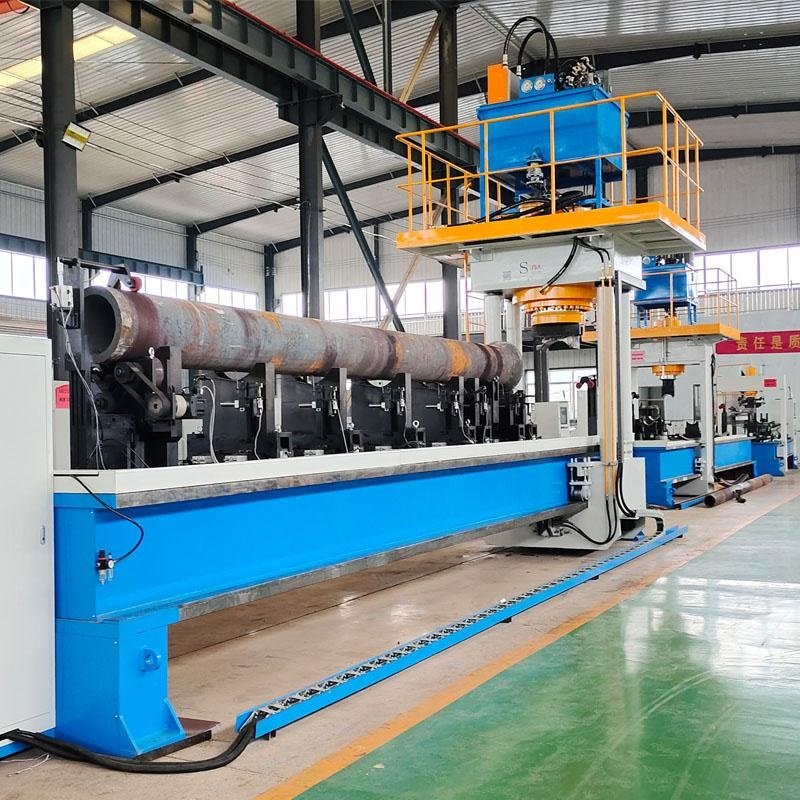
1. What Is the Steel Pipe Straightening Process?
Steel pipe straightening is an important finishing operation in steel pipe manufacturing. It is used to correct bending and dimensional deviations that may occur during forming, welding, rolling, cooling, heat treatment, cutting and transportation.
Steel pipes may develop longitudinal curvature, local bending or other geometric deviations during production. These defects can affect dimensional accuracy, assembly, machining and installation.
The straightening process applies controlled mechanical deformation to the pipe so that its residual curvature is reduced after unloading.
Depending on the pipe dimensions, material properties and production requirements, manufacturers may use press straightening, two-roll straightening or multi-roll rotary straightening machines.
Straightening is commonly performed on seamless steel pipes, ERW welded pipes, LSAW pipes, precision steel tubes and other tubular products.
The main objectives are to:
- Improve longitudinal straightness.
- Reduce local bending and curvature.
- Improve dimensional consistency.
- Support subsequent cutting, machining and welding operations.
- Meet the straightness tolerances specified by the relevant product standard.
- Reduce rejection caused by excessive bending.
The final straightness depends not only on the straightening machine but also on the initial pipe condition, material properties, roller configuration and process settings.
2. Why Do Steel Pipes Need Straightening?
Steel pipes can become bent or distorted at different stages of manufacturing.
Understanding the causes of deformation is important for selecting an appropriate straightening method.
2.1 Deformation During Rolling and Forming
During seamless pipe manufacturing, the billet undergoes heating, piercing, elongation and rolling.
Non-uniform deformation, temperature differences and variations in rolling conditions may introduce initial curvature or geometric deviations.
For welded pipes, forming rolls and welding operations can also produce longitudinal bending, residual stresses and cross-sectional distortion.
2.2 Uneven Cooling
Uneven cooling can generate temperature gradients and non-uniform thermal contraction across the pipe section.
This may cause residual stresses and dimensional distortion, particularly in large-diameter pipes and products with non-uniform wall thickness.
2.3 Heat Treatment
Heat treatment changes the microstructure and mechanical properties of steel.
During heating and cooling, differences in temperature distribution, support conditions and residual stress release may result in dimensional changes or bending.
The risk depends on the steel grade, pipe geometry and thermal treatment process.
2.4 Residual Stress
Residual stresses may remain after rolling, welding, sizing, cold working and heat treatment.
When these stresses are redistributed during subsequent processing, the pipe may develop additional curvature or dimensional changes.
2.5 Cutting, Handling and Transportation
Steel pipes can also become bent during lifting, stacking, loading and transportation.
Improper support, excessive local loading and impact may cause permanent deformation.
This is particularly important for long pipes and thin-wall products.
3. Main Steel Pipe Straightening Methods
Different straightening methods are used depending on the pipe diameter, wall thickness, material strength, initial curvature and required straightness.
3.1 Press Straightening
Press straightening uses a hydraulic or mechanical press to apply a controlled force at selected positions along the pipe.
The pipe is supported at appropriate points, and the press applies a counter-bending force to correct the original deformation.
The process generally involves:
- Measuring the initial pipe curvature.
- Positioning the pipe on supporting points.
- Applying a controlled pressing force.
- Allowing elastic recovery after unloading.
- Rechecking the residual curvature.
- Repeating the operation if necessary.
Advantages:
- Suitable for correcting local bending.
- Flexible for different pipe lengths and diameters.
- Relatively straightforward equipment configuration.
- Useful for large pipes and individual workpieces.
Limitations:
- Often requires repeated positioning and measurement.
- Productivity may be lower than continuous roller straightening.
- Localised loading may produce surface indentation or cross-sectional deformation if improperly controlled.
Press straightening is commonly used for large steel pipes, structural tubes and repair operations.
3.2 Two-Roll Straightening
Two-roll straightening uses a pair of inclined or skewed rollers to rotate and advance the pipe while applying bending deformation.
As the pipe passes through the rollers, it experiences repeated bending and rotation.
The combination of axial movement and rotary bending helps reduce curvature in different directions.
Advantages:
- Continuous processing.
- Suitable for certain bar and tube products.
- Relatively simple equipment arrangement.
- Effective for correcting bending when properly configured.
Limitations:
- Straightening performance depends strongly on roller geometry and alignment.
- Improper adjustment may cause surface marks or cross-sectional deformation.
- The process window can be limited for pipes with widely varying dimensions.
3.3 Multi-Roller Rotary Straightening
Multi-roller rotary straightening is widely used in steel tube manufacturing.
The equipment consists of several upper and lower rollers arranged in a staggered or inclined configuration.
As the pipe passes through the machine, the rollers apply a sequence of controlled bending actions in different directions.
The pipe undergoes repeated elastic-plastic deformation, which gradually reduces its initial curvature.
A typical multi-roller straightening system includes:
- Upper and lower straightening rollers.
- Roller adjustment mechanisms.
- Drive motors and transmission systems.
- Pipe feeding and conveying equipment.
- Hydraulic or mechanical adjustment systems.
- Monitoring and control systems.
Advantages:
- Suitable for continuous production.
- Can correct curvature in multiple directions.
- High production efficiency.
- Suitable for a wide range of tube dimensions with appropriate machine configuration.
Limitations:
- Requires careful adjustment of roller positions and angles.
- Incorrect reduction may cause over-straightening or additional deformation.
- Different materials and wall thicknesses require different process settings.
3.4 Three-Roller Continuous Straightening
Three-roller continuous straightening is used in certain large-diameter welded pipe manufacturing processes, including LSAW pipe production.
The system applies controlled bending through three coordinated rollers.
The process can be designed to correct longitudinal straightness and, in suitable configurations, improve cross-sectional roundness at the same time.
Roller profile, contact geometry, pipe positioning and deformation control are important factors affecting the final result.
This method is particularly relevant to large-diameter pipes where straightness and ovality need to be controlled together.
4. How Does a Multi-Roller Straightening Machine Work?
Multi-roller straightening is based on controlled bending and elastic recovery.
The process does not simply force the pipe into a straight line. Instead, the rollers impose a series of bending deformations that compensate for the original curvature.
A typical process includes the following stages.
Step 1: Pipe Feeding
The pipe is transferred to the straightening machine using a feeding or conveying system.
Before processing, its dimensions, material grade and initial bending condition should be identified.
Step 2: Roller Positioning
The upper and lower rollers are adjusted according to the pipe diameter, wall thickness and material properties.
The roller angle, spacing and reduction position determine how the pipe contacts the rollers.
Step 3: Controlled Bending
As the pipe passes through the roller system, it experiences alternating bending.
The deformation must be sufficient to correct the original curvature while avoiding excessive plastic deformation.
Step 4: Elastic Recovery
After the pipe leaves the rollers, the applied load is removed.
The pipe partially recovers elastically. This phenomenon is known as springback.
The straightening process must account for springback because the final unloaded curvature is different from the curvature under the rollers.
Step 5: Straightness Inspection
After straightening, the pipe is inspected to determine whether the remaining deviation meets the specified tolerance.
If necessary, the roller settings are adjusted and the process is repeated.
5. Key Factors Affecting Steel Pipe Straightness
Final straightness is influenced by material properties, initial deformation, machine design and process parameters.
The following factors are particularly important.
5.1 Material Yield Strength
Yield strength determines the stress at which steel begins to undergo permanent plastic deformation.
Higher-strength steel generally requires greater bending force to achieve a comparable plastic deformation.
Different steel grades therefore require different straightening settings.
For example, carbon steel, low-alloy steel and high-strength pipeline steel should not automatically use identical roller reductions.
If the applied deformation is insufficient, the pipe may recover much of its original curvature after unloading.
If the deformation is excessive, it may introduce unwanted residual stress, surface damage or cross-sectional distortion.
5.2 Pipe Outside Diameter and Wall Thickness
Outside diameter and wall thickness influence pipe stiffness and bending behaviour.
For pipes with the same material and outside diameter, increasing wall thickness generally increases bending stiffness.
Thin-wall pipes are more sensitive to local deformation and ovality during straightening.
Thick-wall pipes generally require greater forces to achieve comparable bending deformation.
The straightening machine must therefore be configured according to the actual pipe dimensions.
5.3 Initial Curvature
The initial curvature and its direction affect the required straightening strategy.
A pipe with a relatively uniform longitudinal bend may require different roller settings from one with localised bending or multiple curvature variations.
Accurate initial measurement helps determine the required counter-bending deformation.
5.4 Roller Diameter and Arrangement
Roller diameter, spacing, inclination angle and contact profile directly influence the bending conditions.
Important parameters include:
- Number of straightening rollers.
- Roller diameter.
- Distance between rollers.
- Roller inclination angle.
- Upper and lower roller positions.
- Contact geometry.
An unsuitable roller arrangement may lead to insufficient straightening, surface marking or excessive local deformation.
5.5 Roller Reduction and Bending Amount
Roller reduction refers to the adjustment of roller positions that determines the deformation imposed on the pipe.
The amount of bending must be sufficient to compensate for the original curvature and springback.
Excessive reduction may produce unwanted plastic deformation, residual stresses or ovality.
Insufficient reduction may leave unacceptable residual bending.
The correct setting should be established through process trials, engineering calculations and inspection feedback.
5.6 Springback
Springback is the elastic recovery that occurs after the pipe is unloaded.
Its magnitude depends on material properties, geometry and the amount of plastic deformation.
Higher-strength materials may exhibit different springback behaviour from lower-strength materials.
Straightening parameters must account for this recovery to achieve the required final straightness.
5.7 Residual Stress Distribution
Residual stresses from rolling, welding, sizing and heat treatment can influence the pipe’s response during straightening.
Uneven residual stress distribution may result in non-uniform springback or additional deformation after processing.
A suitable manufacturing sequence and controlled straightening process help reduce the risk of dimensional instability.
5.8 Temperature and Processing Conditions
Temperature affects the mechanical properties and deformation behaviour of steel.
Straightening may be carried out at different stages of production, depending on the manufacturing route.
For conventional cold straightening, material temperature and processing consistency should be controlled.
The timing of straightening relative to heat treatment, cooling and cutting can also affect dimensional stability.
6. How to Improve Steel Pipe Straightness
Achieving consistent straightness requires coordinated control of manufacturing conditions and straightening parameters.
The following practices can help improve product quality.
6.1 Select the Appropriate Straightening Machine
The equipment should match the pipe diameter, wall thickness, material strength and required production capacity.
For example:
- Multi-roller machines are suitable for continuous tube straightening.
- Press straightening can be used for localised correction and large individual pipes.
- Specialised three-roller systems can be used for certain large-diameter welded pipes.
6.2 Optimise Roller Settings
Roller angle, spacing and reduction should be adjusted according to the pipe specifications.
Process parameters should not be transferred directly between different pipe sizes or steel grades without verification.
6.3 Control the Upstream Manufacturing Process
Straightening should not be used to compensate for every upstream manufacturing problem.
Important upstream controls include:
- Uniform billet heating.
- Stable rolling conditions.
- Consistent welding and forming.
- Controlled cooling.
- Proper heat treatment.
- Appropriate handling and storage.
Reducing the initial deformation can improve straightening efficiency and product consistency.
6.4 Maintain Straightening Rollers
Roller wear, surface damage and misalignment can affect contact conditions and straightening accuracy.
Regular inspection should include roller surface condition, alignment, bearings, transmission systems and adjustment mechanisms.
6.5 Use Measurement Feedback
Straightness measurement should be integrated into the production process.
The measured results can be used to adjust roller positions, bending amounts and process settings.
Automatic measurement and control systems can improve consistency in high-volume production.
7. Steel Pipe Straightness Inspection and Measurement
Straightness inspection is essential for determining whether finished steel pipes meet the requirements of the relevant product specification.
There are two important concepts:
- Overall straightness: The deviation of the entire pipe from a specified straight reference line.
- Local straightness: The deviation measured over a defined shorter length of the pipe.
Both measurements may be required because a pipe can have acceptable overall straightness but still contain local bending.
7.1 Straightedge and Feeler Gauge Measurement
A straightedge can be placed along the pipe surface to establish a reference line.
The maximum gap between the straightedge and the pipe is measured using a feeler gauge.
This method is suitable for basic inspection and certain local straightness checks.
7.2 Laser Straightness Measurement
Laser-based measurement systems can evaluate pipe alignment and detect deviations along the pipe length.
They are useful for automated production lines and precision inspection.
7.3 Dial Indicator Measurement
A dial indicator can be used to measure radial displacement as the pipe is rotated or moved along a reference setup.
This method is useful for identifying local bending and dimensional variation.
7.4 Straightness Tolerances
Straightness requirements vary according to product type, pipe dimensions, manufacturing standard and intended application.
For example, structural hollow sections, seamless mechanical tubes and API line pipes may have different straightness acceptance requirements.
The following factors should be checked:
- Total deviation over the full pipe length.
- Local deviation over a specified measurement length.
- Pipe end straightness.
- Measurement reference and procedure.
- Applicable product standard and edition.
For API 5L products, straightness requirements should be checked against the applicable edition and pipe category. A single tolerance value should not be assumed to apply to every diameter and product condition.
8. Steel Pipe Straightening in Different Manufacturing Processes
Straightening is used in both seamless and welded steel pipe production, but the causes of deformation and process requirements can differ.
8.1 Seamless Steel Pipe Straightening
Seamless steel pipes may undergo straightening after rolling, sizing, cooling or heat treatment.
The process helps correct bending caused by non-uniform deformation and thermal effects.
Typical production stages include:
Billet Heating → Piercing → Rolling → Sizing → Cooling → Straightening → Cutting → Inspection.
For cold drawn precision tubes, straightening may also be required after cold working and final heat treatment.
8.2 ERW Steel Pipe Straightening
ERW pipes are formed from steel strip or coil and joined by longitudinal resistance welding.
Forming, welding, sizing and cooling may introduce residual stresses and dimensional deviations.
Straightening equipment is commonly integrated into the downstream finishing section of ERW production lines.
It helps correct longitudinal bending and improve dimensional consistency before cutting and inspection.
8.3 LSAW Steel Pipe Straightening
LSAW pipes are manufactured from steel plate formed into a cylindrical shape and joined by longitudinal submerged arc welding.
Forming and welding may produce residual stresses, local deformation and geometric deviations.
Large-diameter LSAW pipes may use specialised multi-roller or three-roller straightening systems.
In some processes, straightness and roundness are controlled together to improve the overall dimensional quality.
9. Common Straightening Defects and Their Causes
Incorrect straightening parameters or unsuitable equipment may create additional quality problems.
| Defect | Possible Cause | Recommended Control |
|---|---|---|
| Residual bending | Insufficient roller reduction | Recheck bending amount and roller positions |
| Over-straightening | Excessive deformation | Optimise roller settings |
| Ovality | Excessive or uneven roller pressure | Control roller contact and support |
| Surface indentation | Damaged rollers or excessive contact pressure | Inspect and maintain roller surfaces |
| Uneven straightness | Misaligned rollers or inconsistent feeding | Check roller alignment and material positioning |
| Re-bending after straightening | Residual stress redistribution or excessive deformation | Review upstream processes and straightening parameters |
The cause of a defect should be identified before changing the straightening settings. Repeatedly increasing roller pressure may worsen the problem rather than correct it.
10. Frequently Asked Questions About Steel Pipe Straightening
What is the purpose of steel pipe straightening?
The purpose is to correct bending and reduce geometric deviations so that the finished pipe meets the required straightness tolerance.
Which machine is commonly used for steel pipe straightening?
Multi-roller rotary straightening machines are widely used in continuous steel tube manufacturing. Press straighteners and specialised three-roller systems are also used for particular pipe dimensions and production requirements.
What factors affect steel pipe straightness?
The main factors include material yield strength, pipe diameter, wall thickness, initial curvature, roller diameter, roller spacing, roller angle, reduction amount and springback.
Can thick wall and thin wall steel pipes use the same straightening settings?
Not necessarily. Their bending stiffness and deformation behaviour are different. Straightening settings should be adjusted according to the pipe dimensions and material properties.
Does straightening eliminate residual stress?
No. Straightening changes the stress and deformation state of the pipe, but it does not necessarily eliminate residual stress. In some cases, straightening can redistribute or introduce residual stresses.
How is steel pipe straightness measured?
Common methods include straightedge and feeler gauge measurements, dial indicators and laser-based measurement systems. The method depends on the required accuracy and applicable product specification.
What is the difference between overall and local straightness?
Overall straightness evaluates the deviation along the entire pipe length. Local straightness evaluates bending over a specified shorter section.
Is straightening required for all steel pipes?
Not every pipe requires the same straightening operation. The need for straightening depends on the manufacturing process, initial geometry, product requirements and applicable dimensional tolerances.
11. Conclusion
Steel pipe straightening is an important finishing process that directly affects the dimensional accuracy and quality of finished steel pipes.
Press straightening, two-roll straightening, multi-roller rotary straightening and three-roller continuous straightening are used for different pipe dimensions and manufacturing requirements.
The final straightness depends on material properties, initial curvature, pipe geometry, roller configuration, deformation amount and springback.
For manufacturers, consistent straightening requires more than selecting suitable equipment. It also requires control of upstream production conditions, regular machine maintenance and reliable straightness inspection.
For buyers, straightness should be specified and inspected according to the applicable product standard, rather than judged only by visual appearance.
Looking for seamless steel pipes or welded steel pipes with controlled straightness and dimensional accuracy?
Provide your required pipe dimensions, material grade, manufacturing method and applicable standard to determine the appropriate product and inspection requirements.