
1. Introduction
Heat treatment and cold drawing are two important processes in steel tube manufacturing. Although both influence the final properties of steel tubes, they work through different mechanisms and serve different manufacturing purposes.
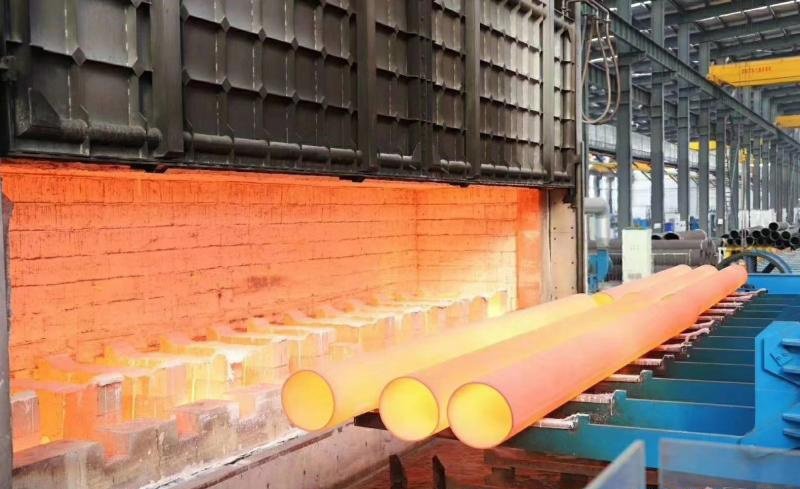
Heat treatment uses controlled heating, holding and cooling to modify the microstructure and mechanical properties of steel. Cold drawing is a metal forming process in which a steel tube is pulled through a drawing die, often over a mandrel, to reduce its outside diameter and wall thickness or improve dimensional accuracy.
These processes are frequently combined in the production of cold drawn seamless steel tubes and precision steel tubes. Cold drawing improves dimensional control and surface finish, while subsequent heat treatment can restore ductility, reduce residual stresses or achieve the mechanical properties required by the product specification.
Understanding how these processes work, and when they are used together, is important when selecting steel tubes for precision machinery, hydraulic systems, automotive components and industrial equipment.
2. What Is Heat Treatment in Steel Tube Manufacturing?
Heat treatment is a controlled thermal process used to change the microstructure and mechanical properties of steel without intentionally changing its overall dimensions.
The process generally consists of three stages:
- Heating the steel to a specified temperature.
- Holding it at that temperature for a defined period.
- Cooling it under controlled conditions.
The temperature, holding time and cooling rate depend on the steel grade, chemical composition, wall thickness and required delivery condition.
2.1 Common Heat Treatment Methods
Annealing
Annealing involves heating steel to an appropriate temperature, holding it and cooling it under controlled conditions.
It is commonly used to reduce hardness, improve ductility, relieve residual stresses and improve machinability.
For cold drawn steel tubes, annealing can help reduce the effects of work hardening and prepare the material for further drawing or forming operations.
Normalizing
Normalizing involves heating steel into the appropriate austenitizing temperature range, followed by air cooling under suitable conditions.
It is used to refine the microstructure and improve structural uniformity.
Normalizing is commonly applied to carbon steel and low-alloy steel products where a more uniform microstructure and specified mechanical properties are required.
Quenching and Tempering
Quenching involves rapidly cooling heated steel to develop a hardened microstructure. Tempering is then performed to adjust hardness, strength and toughness.
This combined process is commonly used for alloy steel tubes and components requiring higher strength and adequate toughness.
Stress-Relief Annealing
Stress-relief annealing is used to reduce residual stresses introduced by cold working, welding or other manufacturing operations.
It is particularly relevant to precision steel tubes where dimensional stability and subsequent machining performance are important.
2.2 Why Is Heat Treatment Important for Steel Tubes?
Heat treatment helps manufacturers achieve the mechanical and metallurgical requirements specified for the finished product.
Its main benefits include:
- Adjusting tensile strength and yield strength.
- Controlling hardness.
- Improving ductility and toughness.
- Reducing residual stresses from cold working.
- Producing a more uniform microstructure.
- Improving suitability for subsequent machining, bending and forming.
The required heat treatment condition depends on the product specification. Not every steel tube requires the same treatment.
3. What Is Cold Drawing in Steel Tube Manufacturing?
Cold drawing is a metal forming process in which a steel tube is pulled through a drawing die, usually with an internal mandrel or plug, to reduce its dimensions and obtain the required geometry.
Unlike hot rolling, cold drawing is generally carried out at or near room temperature.
The starting material is commonly a hot-finished seamless tube or a previously manufactured tube suitable for cold working.
During drawing, the tube undergoes plastic deformation as it passes through the die. This changes its outside diameter, wall thickness and mechanical properties.
3.1 Cold Drawing Process
A typical cold drawn seamless steel tube manufacturing process includes the following stages.
Step 1: Preparation of the Mother Tube
A hot-finished seamless tube is selected as the starting material. Its dimensions, surface condition and material quality are inspected before further processing.
Step 2: Pickling and Surface Cleaning
The tube surface is cleaned to remove scale, oxides and other contaminants that may affect the drawing operation.
Step 3: Lubrication
A suitable lubricant or drawing coating is applied to reduce friction between the tube, die and mandrel.
Proper lubrication helps reduce drawing force, surface damage and tool wear.
Step 4: Pointing
The end of the tube is reduced in diameter to allow it to pass through the drawing die and be gripped by the drawing equipment.
Step 5: Cold Drawing
The tube is pulled through the die, with the mandrel or plug controlling the internal diameter and wall thickness where applicable.
The reduction in cross-sectional area determines the amount of deformation during each drawing pass.
Multiple drawing passes may be required to achieve the final dimensions.
Step 6: Intermediate Heat Treatment
Depending on the material and reduction ratio, intermediate annealing or another suitable thermal treatment may be required between drawing passes.
This helps reduce work hardening and restore ductility for subsequent deformation.
Step 7: Final Heat Treatment
After the final drawing operation, the tube may undergo annealing, normalizing or stress-relief treatment, depending on the specified delivery condition.
Step 8: Straightening and Cutting
The tubes are straightened and cut to the required length.
Step 9: Inspection and Testing
Finished tubes undergo dimensional inspection, surface examination and the mechanical or non-destructive tests required by the applicable product specification.
3.2 Main Advantages of Cold Drawing
Cold drawing is widely used for manufacturing precision steel tubes because it provides several important advantages.
Improved dimensional accuracy
Cold drawing allows closer control of outside diameter and wall thickness compared with many conventional hot-finished products.
Better surface finish
The drawing process can produce smoother internal and external surfaces, depending on tooling, lubrication and process conditions.
Increased strength through work hardening
Cold deformation generally increases yield strength and tensile strength while reducing ductility.
Improved dimensional consistency
Controlled die geometry and drawing conditions help manufacturers achieve more consistent tube dimensions.
Suitable for precision applications
Cold drawn tubes are commonly used where accurate dimensions, good surface quality and consistent mechanical properties are required.
4. Heat Treatment vs. Cold Drawing: What Are the Differences?
Heat treatment and cold drawing are fundamentally different manufacturing processes.
Heat treatment changes the microstructure and mechanical properties through thermal cycles. Cold drawing changes the tube geometry through plastic deformation.
| Comparison | Heat Treatment | Cold Drawing |
|---|---|---|
| Process type | Thermal treatment | Plastic deformation |
| Main mechanism | Heating and controlled cooling | Pulling through a die |
| Main purpose | Modify microstructure and mechanical properties | Reduce dimensions and improve dimensional accuracy |
| Dimensional effect | May cause minor dimensional changes or distortion | Intentionally changes diameter and wall thickness |
| Strength | Depends on treatment and material | Generally increases through work hardening |
| Ductility | Can be restored or adjusted through suitable treatment | Generally decreases with increasing cold deformation |
| Surface finish | Depends on atmosphere and surface condition | Generally improves with suitable tooling and lubrication |
| Typical equipment | Heat treatment furnace | Drawing bench, die and mandrel |
| Common applications | Mechanical property control | Precision tube manufacturing |
Neither process is universally better. They address different production requirements and are often used together.
5. Why Are Heat Treatment and Cold Drawing Used Together?
In many steel tube manufacturing operations, cold drawing and heat treatment are complementary processes.
Cold drawing introduces plastic deformation into the steel. As deformation increases, dislocation density rises and the material undergoes work hardening.
This generally results in increased strength and hardness, accompanied by reduced ductility.
If the material undergoes excessive deformation, it may become unsuitable for further drawing or forming without an intermediate thermal treatment.
Heat treatment helps control these changes.
A typical manufacturing route is:
Hot-finished seamless tube → Pickling → Lubrication → Cold Drawing → Intermediate Annealing, if required → Further Cold Drawing → Final Heat Treatment → Straightening → Inspection → Cutting and Packing.
The exact sequence depends on the material grade, drawing reduction, tube dimensions and final mechanical property requirements.
5.1 Intermediate Annealing During Cold Drawing
Intermediate annealing is particularly important when several drawing passes are required.
Its main purposes are to:
- Reduce work hardening.
- Restore ductility.
- Improve the ability of the tube to undergo further deformation.
- Reduce the risk of cracking during subsequent drawing.
The annealing temperature and holding time must be selected according to the steel composition and required metallurgical condition.
5.2 Final Heat Treatment After Cold Drawing
Final heat treatment is used to achieve the specified delivery condition.
For example, some precision tubes are supplied in an annealed condition to improve machinability and formability, while others are supplied in a stress-relieved or normalized condition.
The final condition should be clearly defined in the purchase specification.
6. Common Delivery Conditions for Cold Drawn Steel Tubes
Cold drawn precision steel tubes are supplied in different delivery conditions depending on the applicable standard and customer requirements.
Common designations under EN 10305-1 include:
| Delivery condition | Designation | Description |
|---|---|---|
| Cold drawn / hard | +C | No subsequent heat treatment after final cold drawing |
| Cold drawn / soft | +LC | Final cold drawing followed by a light finishing reduction |
| Stress relieved | +SR | Heat treated after final cold drawing to reduce residual stresses |
| Annealed | +A | Annealed after final cold drawing |
| Normalized | +N | Normalized after final cold drawing |
These conditions are particularly relevant to precision seamless steel tubes.
They influence mechanical properties, formability, machinability and suitability for subsequent manufacturing operations.
Buyers should confirm the required delivery condition rather than specifying only the tube dimensions.
7. Which Steel Tubes Are Suitable for Cold Drawing?
Cold drawing can be applied to various steel grades, provided that their chemical composition, initial condition and processing characteristics are suitable.
Common product categories include:
Carbon Steel Tubes
Carbon steel tubes are widely used in mechanical engineering, automotive components and general industrial applications.
Common grades depend on the relevant product standard and application.
Low-Alloy Steel Tubes
Low-alloy steel tubes may be cold drawn to achieve closer dimensional tolerances and improved surface quality.
Their drawing and heat treatment conditions must account for alloy composition and hardenability.
Stainless Steel Tubes
Stainless steel tubes are also manufactured through cold drawing or cold pilgering.
Cold working can improve dimensional precision and strength, but intermediate or final annealing may be necessary to obtain the specified mechanical properties.
Precision Seamless Steel Tubes
Precision seamless tubes are widely produced through cold drawing because of their requirements for dimensional accuracy, surface quality and consistent mechanical properties.
8. Applications of Heat-Treated and Cold-Drawn Steel Tubes
The combination of cold drawing and suitable heat treatment is used in many industrial sectors.
| Industry | Typical applications | Important requirements |
|---|---|---|
| Automotive | Fuel injection components, shafts and structural components | Dimensional accuracy and mechanical strength |
| Hydraulic systems | Hydraulic cylinders and precision tubing | Surface quality and dimensional control |
| Mechanical engineering | Machine components and precision parts | Machinability and dimensional consistency |
| Construction machinery | Hydraulic and structural components | Strength and wear resistance |
| Power generation | Precision and alloy steel tubes | Mechanical properties and service conditions |
| General manufacturing | Machined components and industrial equipment | Tolerances and surface finish |
The appropriate tube condition depends on the component design, manufacturing process and operating environment.
9. Quality Control of Heat-Treated and Cold-Drawn Steel Tubes
Both processes require appropriate quality control to ensure that the finished product meets its technical requirements.
9.1 Dimensional Inspection
Dimensional inspection typically includes:
- Outside diameter.
- Inside diameter, where specified.
- Wall thickness.
- Ovality.
- Straightness.
- Length.
These measurements are particularly important for precision cold drawn tubes.
9.2 Mechanical Testing
Mechanical testing may include:
- Tensile testing.
- Yield strength measurement.
- Elongation testing.
- Hardness testing.
- Impact testing, where required.
These tests help confirm that the finished product meets the specified mechanical properties.
9.3 Surface Inspection
Surface inspection is used to identify defects such as scratches, cracks, laps and other discontinuities that may affect product performance.
9.4 Non-Destructive Testing
Depending on the product specification and application, non-destructive testing may include ultrasonic testing, eddy current testing or other approved methods.
9.5 Heat Treatment Records
For products requiring specified heat treatment conditions, production records should demonstrate that the required temperature, holding time and cooling conditions were achieved.
Material traceability and inspection documentation are also important for industrial procurement.
10. How to Choose Between Hot-Finished and Cold-Drawn Steel Tubes
Cold drawing is not necessary for every steel tube application.
Hot-finished seamless tubes are often suitable when larger dimensions, general structural performance and production efficiency are the main considerations.
Cold drawn tubes are more appropriate when closer dimensional tolerances, better surface finish and more consistent dimensions are required.
| Selection factor | Hot-finished seamless tube | Cold-drawn seamless tube |
|---|---|---|
| Manufacturing temperature | Hot working | Cold working |
| Dimensional accuracy | Generally wider tolerances | Generally closer tolerances |
| Surface finish | Typically rougher | Typically smoother |
| Strength | Depends on grade and delivery condition | Can be increased by work hardening |
| Production cost | Often more economical for larger sizes | Additional processing increases cost |
| Typical applications | General industrial and structural uses | Precision machinery and hydraulic systems |
The final choice should consider tube dimensions, wall thickness, material grade, required delivery condition and application requirements.
11. Frequently Asked Questions
What is the difference between heat treatment and cold drawing?
Heat treatment modifies the microstructure and mechanical properties of steel through controlled heating and cooling. Cold drawing changes the dimensions and shape of a steel tube through plastic deformation using a die and mandrel.
Does cold drawing increase steel strength?
Yes. Cold drawing generally increases yield strength and tensile strength through work hardening. However, ductility usually decreases as the amount of cold deformation increases.
Why is annealing required after cold drawing?
Annealing can reduce work hardening, restore ductility and improve the material’s ability to undergo further deformation. It may also be used as a final treatment to achieve the required delivery condition.
Are cold drawn seamless tubes stronger than hot-finished seamless tubes?
Cold drawn tubes can have higher strength because of work hardening. However, the actual mechanical properties depend on the steel grade, reduction ratio and final heat treatment condition. A cold drawn tube is not automatically stronger in every delivery condition.
What is the difference between cold drawn and cold rolled steel tubes?
Both are cold-working processes. Cold drawing pulls a tube through a die, usually with a mandrel or plug. Cold pilgering or cold rolling reduces the tube dimensions through rotating rolls. Both methods can improve dimensional accuracy and surface quality.
Which heat treatment is commonly used for cold drawn steel tubes?
Annealing and stress-relief treatment are common options. Normalizing may also be used for specific steel grades and delivery requirements. The appropriate process depends on the material and applicable standard.
What information should buyers provide when ordering cold drawn steel tubes?
Buyers should specify the steel grade, outside diameter, wall thickness, length, applicable standard, delivery condition, mechanical property requirements, surface condition and inspection requirements.
12. Conclusion
Heat treatment and cold drawing perform different but complementary functions in steel tube manufacturing.
Cold drawing is primarily used to achieve accurate dimensions, improved surface finish and increased strength through work hardening. Heat treatment is used to control the microstructure, adjust mechanical properties, reduce residual stresses and restore ductility where required.
For precision seamless steel tubes, the combination of controlled cold drawing and appropriate heat treatment is essential to achieving consistent product quality.
When selecting steel tubes for industrial applications, buyers should consider not only the manufacturing process but also the final delivery condition, dimensional tolerances, mechanical properties and applicable product standards.
Looking for cold drawn seamless steel tubes or precision steel tubes?
Provide your required steel grade, dimensions, delivery condition and applicable standard to determine the most suitable manufacturing and heat treatment route for your application.