
Casing and tubing are both essential components of an oil and gas well, but they serve very different purposes. Choosing the wrong product specification can lead to installation problems, unnecessary costs, or serious well-integrity risks.
Casing is installed to support the wellbore and isolate underground formations. Tubing is installed inside the completed well to provide a controlled path for producing hydrocarbons or injecting fluids.
Although both are steel tubular products, they differ in their functions, installation methods, load requirements, dimensions, connections, and operating conditions.
So, what is the difference between casing and tubing? Can one replace the other? And what should you consider when purchasing these products for a drilling or production project?
This guide explains the main differences between oilfield casing and tubing, their applications, material grades, connections, and selection criteria to help you choose the right product for your well.
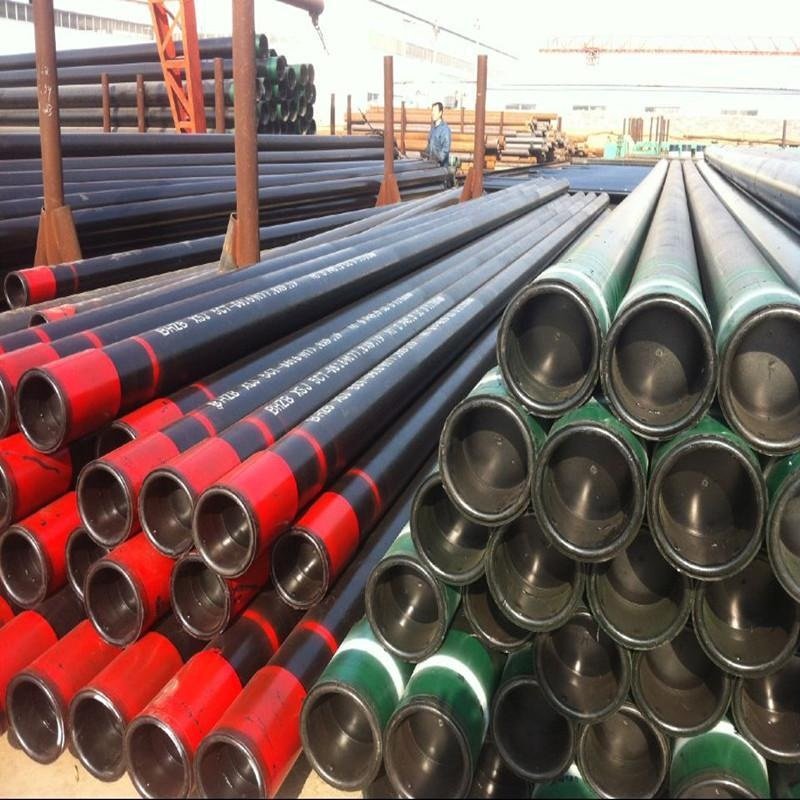
1. What Is Oilfield Casing?
Oilfield casing is a steel pipe installed in a drilled well to stabilize the wellbore, isolate geological formations, and support well integrity.
During drilling and completion, different casing strings may be installed at different depths. Depending on the well design, casing helps prevent the wellbore from collapsing, limits unwanted fluid movement between formations, and provides a structural and pressure-containment barrier.
After a casing string is run into the well, cement is commonly placed in the annular space between the casing and the surrounding formation to provide zonal isolation and support. The exact cementing arrangement depends on the casing design and completion method.
Main Functions of Casing
- Wellbore support: Helps maintain the integrity of the drilled hole.
- Formation isolation: Helps prevent unwanted communication between geological layers.
- Well control and pressure containment: Forms part of the engineered well-barrier system.
- Support for subsequent operations: Provides a stable foundation for further drilling and completion activities.
- Long-term well integrity: Helps protect the well throughout its intended service life.
Common Types of Oilfield Casing
Casing strings are selected according to the well design and the formations being drilled.
- Conductor casing: Supports the shallow wellbore and helps manage near-surface conditions.
- Surface casing: Helps protect shallow formations, including groundwater where applicable, and supports well-control requirements.
- Intermediate casing: Isolates formations that could complicate further drilling, such as unstable or abnormal-pressure intervals.
- Production casing: Provides the casing structure across the production interval, depending on the well architecture.
- Liner: A casing string that does not extend all the way to the surface but is supported or suspended within a previous casing string.
Not every well uses all these strings. The number, depth, and dimensions of casing sections depend on the geological conditions, well trajectory, pressure profile, and regulatory requirements.
2. What Is Oilfield Tubing?
Oilfield tubing is the pipe installed inside the casing as part of the well’s production or injection system.
During production, hydrocarbons typically flow from the reservoir through the completion and into the tubing before reaching the surface. In injection wells, tubing may carry water, gas, or other fluids downhole.
Unlike conventional casing strings, which are commonly cemented in place, tubing is generally designed as part of the completion string and may be retrieved or replaced during workover operations, depending on the completion design.
Main Functions of Tubing
- Fluid transportation: Carries produced oil, natural gas, or other fluids to the surface.
- Injection: Provides a flow path for water, gas, or other injection fluids.
- Pressure management: Forms part of the designed flow and pressure-containment system.
- Completion flexibility: Can often be removed, inspected, or replaced during appropriate intervention operations.
- Production optimization: Its dimensions and internal flow characteristics affect pressure losses and overall well performance.
Tubing is directly exposed to the fluids passing through it. As a result, fluid chemistry, corrosion, erosion, temperature, pressure, and flow conditions are important considerations when selecting the material and wall thickness.
3. Casing vs. Tubing: Key Differences at a Glance
The most important distinction is their function in the well: casing supports and isolates the wellbore, while tubing provides the intended production or injection flow path.
| Comparison factor | Oilfield casing | Oilfield tubing |
|---|---|---|
| Primary function | Supports the wellbore and helps isolate formations | Carries produced or injected fluids |
| Typical position | Installed along the wellbore; may be cemented in place | Installed inside the casing as part of the completion |
| Main design considerations | Collapse, burst, axial loads, formation conditions, cementing, and well integrity | Internal and external pressure, axial loads, corrosion, erosion, flow performance, and connections |
| Typical installation | Run into the well during drilling or completion; often cemented | Installed as part of the production or injection completion |
| Accessibility | Often difficult to retrieve once cemented | Generally more accessible for workover or replacement |
| Connection requirements | Must suit casing loads, installation, and sealing requirements | Must suit tubing loads, pressure containment, and sealing requirements |
| Corrosion exposure | Internal and external surfaces, depending on the well environment | Internal and external surfaces, depending on the completion and annular environment |
| Common standard | API Specification 5CT, where specified | API Specification 5CT, where specified |
Both products may use overlapping steel grades and may have similar outside diameters in some configurations. That does not make them interchangeable.
A casing string and a tubing string are designed for different load cases, installation procedures, connections, and service requirements.
4. Why Are Casing and Tubing Designed Differently?
The difference becomes clearer when you consider what each pipe must withstand downhole.
Casing: Structural Support and Well Integrity
Casing may experience external formation pressure, internal pressure, axial tension, compression, bending, and loads associated with cementing and changes in temperature.
For this reason, casing design must consider several failure modes, including:
- Collapse: External pressure exceeds the pipe’s resistance to collapse.
- Burst: Internal pressure exceeds the pipe’s resistance to rupture.
- Axial failure: Tensile or compressive loads exceed the allowable capacity.
- Connection failure: The threaded connection or seal does not meet the required load or pressure conditions.
- Corrosion-related degradation: Wall loss or material damage reduces the available structural capacity.
The relative importance of each load depends on the casing string’s position, installation conditions, pressure profile, and well design.
Tubing: Flow and Pressure Performance
Tubing must withstand the pressure and mechanical loads associated with production or injection while maintaining a reliable flow path.
Important considerations include:
- Internal pressure and burst resistance
- External pressure and collapse resistance
- Axial tension from the tubing’s own weight and operating loads
- Temperature changes and thermal expansion
- Corrosion and erosion from produced or injected fluids
- Connection sealing and pressure integrity
- Pressure loss and the required flow rate
Tubing may also experience changing loads during startup, shutdown, artificial-lift operations, or workover activities.
For buyers, the practical implication is simple: casing and tubing should be specified against their actual design conditions, not selected only by outside diameter or steel grade.
5. Casing vs. Tubing: Differences in Size, Wall Thickness, and Connections
Casing and tubing are available in a range of dimensions, but the required dimensions depend on the well design and the applicable product specification.
Outside Diameter and Wall Thickness
Casing dimensions are selected to provide the required wellbore clearance, structural capacity, and space for subsequent casing strings or completion equipment.
Tubing dimensions are selected according to the completion design, required flow rate, pressure conditions, available clearance, and compatibility with the other downhole components.
A larger outside diameter does not automatically mean a stronger pipe. Strength and pressure capacity depend on the material grade, wall thickness, dimensions, connection, manufacturing condition, and applicable design calculations.
Threaded Connections
Both casing and tubing commonly use threaded connections, but their connection designs and performance requirements may differ.
Common casing connection families include:
- Short round thread (STC)
- Long round thread (LTC)
- Buttress thread (BTC)
- Qualified proprietary connections
Common tubing connection options include:
- Non-upset tubing connections (NUE)
- External-upset tubing connections (EUE)
- Integral-joint or other qualified premium connections
These are examples rather than a complete list. Availability and suitability depend on the product specification, size, grade, and manufacturer.
The connection must meet the required load and sealing performance. For demanding wells, premium connections may be considered when the application requires specific gas-tight sealing, cyclic-load performance, or other enhanced characteristics.
Before ordering, confirm the connection designation, thread protection, coupling requirements, drift requirements, and any connection-specific testing.
6. Common Steel Grades for Casing and Tubing
Steel grade selection depends on the required mechanical properties and the well’s operating environment.
API Specification 5CT covers technical delivery requirements for specified casing, tubing, and related products, including dimensions, grades, and applicable end finishes.
Commonly encountered API 5CT grade designations include J55, K55, N80, L80, P110, and other grades intended for particular combinations of strength and service requirements.
The presence of a grade name on a quotation does not, by itself, establish that the product is suitable for a specific well.
How Should You Choose the Grade?
Consider the following factors:
- Required yield strength and tensile properties
- Collapse, burst, and axial-load calculations
- Operating temperature and impact-toughness requirements
- Corrosion risk, including CO₂ and H₂S where applicable
- Hardness and other sour-service requirements
- Connection performance
- Applicable product standard and supplementary requirements
For example, a higher-strength grade may be useful where mechanical loads demand it, but higher strength alone does not guarantee better corrosion resistance or suitability for sour service.
The selected grade must satisfy the complete design basis.
7. Casing vs. Tubing: Which Is More Corrosion-Resistant?
Neither casing nor tubing is inherently more corrosion-resistant simply because of its function. Corrosion performance depends primarily on the material, environment, surface condition, and protection measures.
However, the exposure conditions may differ.
Casing Corrosion
Casing can be exposed to corrosive fluids inside the pipe and to groundwater, formation fluids, or other environments outside it.
External corrosion may be difficult to assess directly after installation, particularly when the casing is cemented in place.
Cementing quality, material selection, external protection where applicable, and well-integrity monitoring all contribute to managing the risk.
Tubing Corrosion
Tubing is exposed to produced or injected fluids and may experience changes in water chemistry, gas composition, temperature, and flow conditions during the life of the well.
Depending on the service, potential concerns include CO₂ corrosion, H₂S-related damage, chloride-related corrosion, erosion-corrosion, and other mechanisms.
How Can Corrosion Risk Be Reduced?
Depending on the well conditions, measures may include:
- Selecting an appropriate steel grade or corrosion-resistant alloy
- Using compatible corrosion inhibitors
- Applying suitable coatings or linings where appropriate
- Controlling operating conditions where feasible
- Monitoring corrosion and wall loss
- Reviewing cementing and external corrosion risks for casing
Corrosion management should be based on the actual environment. A material that performs well in one well may not be suitable for another with different fluid chemistry or temperature.
8. How to Choose Between Casing and Tubing for Your Project
In most well designs, casing and tubing are not alternatives to one another. They serve complementary roles in the same well.
The real purchasing decision is to select the correct product specification for each role.
When Ordering Casing
Confirm:
- Casing string type and setting depth
- Outside diameter and wall thickness or specified mass per unit length
- Steel grade and applicable standard
- Required collapse, burst, and axial-load performance
- Thread and connection type
- Cementing and installation requirements
- Corrosion and sour-service conditions
- Inspection, testing, and traceability requirements
When Ordering Tubing
Confirm:
- Production or injection service
- Outside diameter and wall thickness or specified mass per unit length
- Steel grade and connection type
- Operating pressure and temperature
- Required flow rate and completion compatibility
- Corrosion, erosion, and sour-service conditions
- Connection sealing requirements
- Required inspection and testing documentation
The most effective way to avoid procurement errors is to provide the well design basis and the complete technical specification rather than requesting a product by name alone.
9. What Is API 5CT and Why Does It Matter?
API Specification 5CT is a key industry specification for casing and tubing used in oil and gas drilling and production operations.
It establishes product requirements covering relevant items such as dimensions, grades, manufacturing, inspection, testing, and end finishes. The exact requirements depend on the specified product and edition.
When purchasing casing or tubing, buyers should confirm:
- The required API 5CT edition and applicable addenda or errata.
- The exact steel grade and product dimensions.
- The specified connection and end finish.
- The required inspection and testing scope.
- Material identification and traceability.
- Any additional project or service-specific requirements.
API 5CT compliance does not replace the need for well-specific engineering. The operator or design team remains responsible for selecting the appropriate dimensions, connection, material properties, and design margins for the actual service conditions.
10. Frequently Asked Questions About Casing and Tubing
What is the main difference between casing and tubing?
Casing supports the wellbore and helps isolate underground formations. Tubing is installed inside the casing as the main flow path for producing or injecting fluids.
Is casing bigger than tubing?
Casing is often larger in outside diameter because tubing is commonly installed inside it. However, dimensions vary with the well design, and the actual clearance must be checked against the completion configuration.
Can tubing be used as casing?
Not simply because the dimensions or material grade appear similar. Casing and tubing serve different functions and are subject to different design and installation requirements. Any alternative use would require an engineering assessment and confirmation that the product meets the applicable specification and regulatory requirements.
Can casing be used as tubing?
A casing product should not automatically be substituted for tubing. The intended flow path, connection performance, dimensions, drift, pressure requirements, and applicable product specifications must all be evaluated before any substitution is considered.
Do casing and tubing use the same steel grades?
Some grades are available for both product categories under the applicable specification. However, a shared grade designation does not establish that the products have identical dimensions, connections, or suitability for a specific application.
Which is more expensive, casing or tubing?
There is no universal price ranking. Cost depends on dimensions, grade, connection, manufacturing method, order quantity, inspection requirements, and market conditions. Compare quotations based on the complete product specification.
What documents should I request from a supplier?
Depending on the order, request material test certificates, dimensional inspection records, applicable mechanical test results, connection and inspection records, and other documents required by the purchase specification. Confirm that the documentation is traceable to the delivered products.
Conclusion: Casing and Tubing Have Different Jobs in the Same Well
The difference between casing and tubing is primarily functional.
Casing provides structural support and helps isolate formations, while tubing carries produced or injected fluids through the completed well. Their dimensions, connections, material requirements, and design loads must therefore be selected according to different engineering considerations.
For buyers, the right approach is to define the well conditions, identify the required product role, and confirm the applicable standard, grade, dimensions, connection, and inspection requirements before placing an order.
Looking for Oilfield Casing or Tubing?
Whether you are sourcing casing for well construction or tubing for production and injection, the product specification should match the actual well design.
Share your required dimensions, steel grade, connection type, applicable standard, quantity, and operating conditions with our team.
Contact us to discuss your casing and tubing requirements and request a quotation.