When purchasing large-diameter steel pipes, the manufacturing process matters just as much as the material grade and dimensions. Poor forming accuracy, inconsistent welding, or inadequate inspection can lead to dimensional problems, rejected products, and costly delays on site.
Submerged arc welded (SAW) pipe is widely used in pipeline construction, water transmission, oil and gas transportation, and other industrial applications. However, not all SAW pipes are manufactured in the same way. Longitudinal submerged arc welded (LSAW) pipes are typically formed from steel plates, while spiral submerged arc welded (SSAW) pipes are produced from steel coils.
Understanding how these pipes are made helps buyers evaluate manufacturers, compare technical specifications, and identify the quality controls that matter before placing an order.
In this guide, we explain the submerged arc welded pipe manufacturing process, from raw material inspection and pipe forming to welding, testing, and final delivery.
1. What Is Submerged Arc Welding (SAW)?
Submerged arc welding is an automated welding process in which an electric arc forms between a continuously fed consumable electrode and the workpiece. The arc and molten weld pool are covered by a layer of granular flux.
This flux shields the welding area from atmospheric contamination and helps produce a stable welding process. Depending on the welding procedure, the flux also influences the chemical and metallurgical characteristics of the weld.
SAW is widely used in large-diameter steel pipe production because it can provide high deposition rates and consistent weld quality when the process is properly controlled.
For pipe manufacturing, SAW is commonly used in two configurations:
- LSAW (Longitudinal Submerged Arc Welded Pipe): The pipe is formed from a steel plate, with the main weld seam running lengthwise along the pipe.
- SSAW (Spiral Submerged Arc Welded Pipe): The pipe is formed from steel coil, with the weld seam following a spiral path around the pipe.
Both methods can use internal and external submerged arc welding. The actual production route, number of welding passes, forming method, and inspection requirements depend on the manufacturer, product specification, and intended application.
For buyers, the important point is that SAW describes the welding process, not a single pipe manufacturing method.
2. Overview of the SAW Pipe Manufacturing Process
Although LSAW and SSAW production lines differ in several stages, both follow a controlled sequence of material preparation, forming, welding, inspection, and finishing.
A typical manufacturing route includes:
- Raw material selection and inspection
- Steel plate preparation or coil preparation
- Pipe forming
- Edge alignment and tack welding, where applicable
- Internal and external submerged arc welding
- Weld inspection and any required repair
- Dimensional correction or sizing, where specified
- Hydrostatic testing and other required examinations
- Pipe-end preparation and surface finishing
- Final inspection, marking, documentation, and shipment
Not every factory uses exactly the same sequence. Some inspections are performed online during production, while others take place after welding or finishing. The applicable product standard and purchase specification determine which operations and tests are required.
3. Step 1: Raw Material Inspection
The quality of the finished pipe begins with the steel plate or coil used to manufacture it.
Before production starts, the manufacturer checks whether the incoming material meets the purchase specification. Depending on the product and applicable standard, this may include verifying:
- Steel grade and material identification
- Chemical composition and mechanical properties
- Plate or coil thickness, width, and dimensions
- Surface condition and visible defects
- Material test certificates and heat-number traceability
- Additional examination for internal imperfections, where required
For pressure-containing pipeline applications, material properties must be suitable for the specified design conditions. Requirements for strength, toughness, chemical composition, and weldability may differ between projects.
Traceability is equally important. The manufacturer should be able to link the incoming material to the finished pipe and its inspection records.
What should buyers check?
Ask whether the supplier can provide the required material test certificates and maintain heat-number traceability throughout production. If your project requires additional material testing or third-party verification, agree on the scope before manufacturing begins.
4. Step 2: Steel Plate or Coil Preparation
The next stage depends on whether the manufacturer is producing LSAW or SSAW pipe.
Steel Plate Preparation for LSAW Pipe
LSAW production typically starts with individual steel plates cut to the required dimensions.
The plate edges are prepared to provide the geometry needed for forming and welding. Edge milling, beveling, and other preparation operations help establish suitable joint alignment and welding conditions.
Plate dimensions and edge condition must be controlled carefully. Poor edge preparation can contribute to fit-up problems, inconsistent weld geometry, or additional corrective work.
Steel Coil Preparation for SSAW Pipe
SSAW production begins with steel coil. The coil is loaded onto a decoiler and fed into the production line.
Depending on the equipment and process, preparation may include levelling, trimming, edge preparation, and joining the ends of successive coils to maintain continuous production.
The coil width, thickness, and edge condition influence the forming process and the dimensions that can be achieved.
The main difference: LSAW production uses prepared steel plates, whereas SSAW production uses continuously fed steel coil. This distinction affects the forming equipment, production workflow, and range of available product dimensions.
5. Step 3: Pipe Forming
Forming converts flat steel into a cylindrical pipe shape. Accurate forming is essential because the pipe must meet the required outside diameter, roundness, straightness, and dimensional tolerances.
LSAW Pipe Forming: JCOE and UOE Processes
Two common LSAW forming methods are JCOE and UOE.
In the JCOE process, the steel plate is progressively pressed into a J-shaped, then C-shaped, and finally O-shaped configuration. After the edges are brought together and the pipe is welded, mechanical expansion may be used to improve dimensional accuracy.
In the UOE process, the plate is first pressed into a U shape and then an O shape. The edges are aligned before welding, and the pipe may subsequently undergo mechanical expansion.
The exact equipment and sequence vary by production line.
Both methods are used to manufacture large-diameter longitudinally welded pipes. The choice depends on equipment capability, product dimensions, production requirements, and the manufacturer’s qualified process.
SSAW Pipe Forming: Spiral Forming
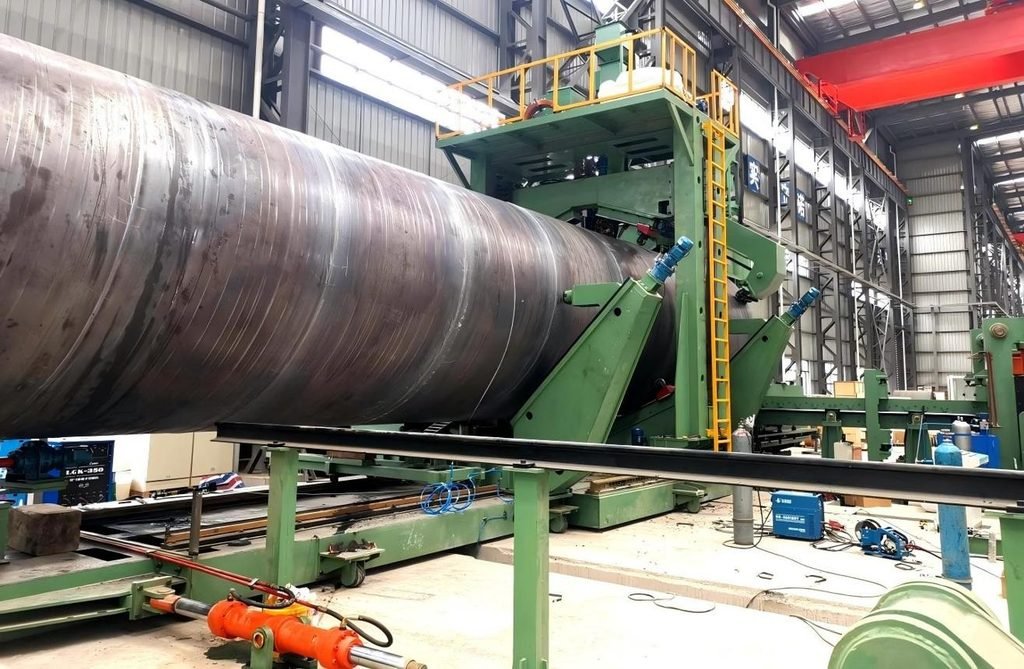
In SSAW production, the steel strip is fed into a spiral-forming machine at a controlled angle. As the strip is continuously shaped, its edges meet to create a cylindrical pipe with a helical seam.
The forming angle, coil width, and production settings influence the resulting pipe diameter.
This arrangement allows a manufacturer to produce different diameters within the capability of its equipment and available coil dimensions.
For buyers, forming quality matters because poor alignment or dimensional control can affect fit-up during installation and may require corrective work before the pipe can be accepted.
6. Step 4: Tack Welding and Submerged Arc Welding
Once the plate or strip has been formed, the adjoining edges must be held in the correct position before the final weld is completed.
Tack welding, where used, helps maintain alignment during subsequent welding operations.
The main seam is then welded using submerged arc welding according to the qualified welding procedure.
How Does Submerged Arc Welding Work?
A consumable welding wire is continuously fed toward the workpiece. An electric arc melts the wire and base material, while granular flux covers the welding zone.
As the weld progresses, molten metal solidifies to form the joint. The remaining flux and slag are removed during subsequent cleaning operations.
For many large-diameter SAW pipes, the seam is welded from both the inside and outside. The actual number of passes and welding sequence depend on the wall thickness, joint preparation, equipment, and approved welding procedure.
Why Welding Parameters Matter
Welding quality depends on more than the presence of an automated welding machine. Important process variables include:
- Welding current and voltage
- Travel speed
- Wire feed rate
- Electrode and flux selection
- Joint preparation and alignment
- Heat input and interpass conditions, where applicable
- Flux handling and contamination control
These parameters must be appropriate for the material grade, wall thickness, and required weld properties.
A qualified welding procedure and consistent process monitoring help reduce the risk of defects such as incomplete fusion, incomplete penetration, porosity, or cracking.
What should buyers ask?
For a project with strict quality requirements, ask the manufacturer how welding procedures are qualified, how welding parameters are controlled, and which inspection methods are required for the finished seam.
7. Step 5: Weld Cleaning and Inspection
After welding, the pipe seam is cleaned so that the weld surface can be examined. Visual inspection helps identify visible irregularities, but it cannot reveal every internal defect.
For this reason, SAW pipe manufacturing may include non-destructive testing (NDT) in accordance with the applicable product standard and purchase specification.
Ultrasonic Testing (UT)
Ultrasonic testing uses sound waves to detect and assess certain internal imperfections in the weld or pipe body.
The required inspection coverage depends on the specification and application. Some projects require full-length weld examination, while additional examinations may be required for the pipe body or specific regions.
Radiographic Testing (RT)
Radiographic testing uses X-rays or gamma rays to produce an image of internal features in the examined weld.
RT may be specified for particular weld regions, joints, or applications. It does not automatically replace other required inspection methods.
Visual and Dimensional Inspection
Visual inspection checks the external condition of the weld and pipe. Dimensional inspection verifies requirements such as outside diameter, wall thickness, length, roundness, straightness, and pipe-end geometry.
The purpose is to confirm that the pipe meets the specified acceptance criteria before it proceeds to the next production stage.
Inspection requirements should never be assumed to be identical for every SAW pipe. They must be defined by the governing standard and the purchase order.
8. Step 6: Dimensional Correction and Sizing
After forming and welding, a pipe may require dimensional correction to meet the specified tolerances.
For many JCOE and UOE LSAW production routes, mechanical expansion is used to improve dimensional consistency and roundness. Other sizing or correction methods may be used depending on the manufacturing process.
SSAW production lines may use different sizing and correction arrangements. The exact operations depend on the equipment, product dimensions, and requirements of the order.
Dimensional control is particularly important when pipes must be joined on site. Excessive ovality, inconsistent diameter, or poor end geometry can make field fit-up more difficult and increase installation time.
Buyers should therefore review the specified dimensional tolerances rather than relying only on nominal pipe dimensions.
9. Step 7: Hydrostatic Testing and Additional Quality Checks
Depending on the product specification, SAW pipes may undergo hydrostatic testing and other required examinations before final release.
During a hydrostatic test, the pipe is filled with water and pressurized under controlled conditions for the specified test period. The test checks the pipe’s ability to withstand the prescribed pressure without unacceptable leakage or other evidence of failure.
Hydrostatic testing is not a substitute for weld inspection. It serves a different purpose and is used alongside other applicable examinations.
Additional quality checks may include:
- Chemical composition and mechanical testing
- Impact testing, where specified
- Weld and pipe-body non-destructive examination
- Dimensional verification
- Visual examination of surfaces and pipe ends
- Additional project-specific tests
The required tests depend on the product type, material grade, service conditions, applicable standard, and purchase requirements.
For pipeline procurement, confirm which tests are included, the applicable acceptance criteria, and whether inspection records will be supplied with the shipment.
10. Step 8: Pipe-End Preparation and Surface Protection
Once the pipe has passed the required manufacturing and inspection stages, the ends are prepared for delivery and installation.
Pipe-end operations may include cutting, end facing, beveling, and removal of sharp edges or unwanted weld spatter. Bevel geometry must match the applicable specification and intended joining method.
Where corrosion protection is required, the pipe may receive an external coating, an internal lining, or both.
Common systems depend on the service environment and project requirements. They may include fusion-bonded epoxy, three-layer polyethylene, three-layer polypropylene, liquid coatings, or cement-mortar lining for appropriate applications.
Coating selection should consider the conveyed medium, soil or water exposure, operating temperature, installation method, and applicable project standards.
For coated pipe, relevant quality controls may include surface preparation checks, coating thickness measurement, visual examination, adhesion testing where required, and holiday testing to identify discontinuities in suitable coating systems.
The coating specification should be agreed before production because it affects surface preparation, inspection, handling, and delivery planning.
11. Step 9: Final Inspection, Marking, and Shipment
Before shipment, finished pipes undergo the final checks required by the purchase specification.
These checks may include verifying dimensions, surface condition, pipe-end preparation, coating condition, marking, and the completeness of inspection documentation.
Pipe marking and traceability are important because they connect the physical product to its material grade, manufacturing records, and inspection results.
Depending on the applicable standard and order, markings may identify the manufacturer, pipe dimensions, material grade, product specification, heat or traceability number, and other required information.
Before dispatch, the supplier should confirm that the required documentation is complete and that pipes are protected against damage during storage and transportation.
For international orders, packaging, lifting arrangements, corrosion protection, shipping marks, and loading plans should also be agreed in advance.
12. How Does the Manufacturing Process Affect Pipe Quality?
A well-controlled manufacturing process is not simply about completing every production step. Each stage contributes to the quality of the finished pipe.
| Manufacturing stage | Main quality concern | What buyers should verify |
|---|---|---|
| Raw material inspection | Incorrect grade or unsuitable material properties | Material certificates and traceability |
| Plate or coil preparation | Poor edge condition or dimensional variation | Material dimensions and preparation controls |
| Pipe forming | Out-of-roundness or dimensional deviations | Diameter, roundness, and straightness tolerances |
| SAW welding | Weld imperfections or inconsistent weld properties | Qualified welding procedures and process controls |
| Weld inspection | Defects not identified before release | Required NDT methods and inspection coverage |
| Hydrostatic testing | Failure to meet the specified test requirements | Test records and acceptance criteria |
| Coating and lining | Inadequate corrosion protection | Coating specification and inspection records |
| Final release | Missing documentation or incorrect marking | Traceability, certificates, and final inspection records |
The key point is that no single test proves every aspect of pipe quality. Material verification, welding control, dimensional inspection, and required testing work together to demonstrate conformity with the applicable specification.
13. Which Standards Apply to SAW Pipe Manufacturing?
The appropriate standard depends on the product and its intended application.
API Specification 5L is widely used for line pipe in the petroleum and natural gas industries. ISO 3183 is another important line-pipe standard. Other applications may require different standards, such as those for water transmission, structural piling, or general industrial piping.
The standard defines requirements relevant to the product, but project specifications may add further conditions for material properties, manufacturing controls, inspection, testing, documentation, and delivery.
When requesting a quotation, buyers should identify the exact standard and edition required by the project rather than simply asking for “SAW pipe.”
Also confirm whether the order specifies LSAW or SSAW, the steel grade, product specification level where applicable, outside diameter, wall thickness, length, coating, and inspection requirements.
The manufacturer should confirm that its production equipment and qualified processes can meet the full specification.
14. Frequently Asked Questions About SAW Pipe Manufacturing
What is the difference between LSAW and SSAW manufacturing?
LSAW pipe is typically manufactured from steel plate and has a longitudinal weld seam. SSAW pipe is manufactured from steel coil that is formed continuously into a spiral, producing a helical weld seam. Both can use submerged arc welding.
Why is submerged arc welding used for large-diameter steel pipes?
SAW can provide high deposition rates and consistent welding conditions, making it suitable for many large-diameter and thick-wall pipe applications. The finished quality still depends on material preparation, qualified procedures, process control, and inspection.
Are SAW pipes welded on both the inside and outside?
Many large-diameter SAW pipe manufacturing processes use internal and external welding. The actual welding sequence and number of passes depend on the production route, wall thickness, joint design, and applicable specification.
How is the quality of SAW pipes checked?
Quality control may include material verification, visual and dimensional inspection, ultrasonic testing, radiographic testing, hydrostatic testing, and mechanical or chemical testing where required. The exact scope depends on the governing standard and purchase order.
Is hydrostatic testing enough to guarantee pipe quality?
No. Hydrostatic testing evaluates performance under specified pressure-test conditions, but it does not replace material verification, dimensional checks, weld examination, or other required tests.
What should I provide when requesting a quotation for SAW pipe?
Provide the pipe type, outside diameter, wall thickness, steel grade, applicable standard, required length, quantity, coating or lining requirements, inspection scope, delivery destination, and requested schedule. Include operating conditions when they affect material selection or product suitability.
Conclusion: A Controlled Manufacturing Process Makes the Difference
The submerged arc welded pipe manufacturing process involves much more than shaping steel and welding the seam. Material selection, forming accuracy, welding control, inspection, dimensional correction, testing, and finishing all contribute to whether the finished pipe meets the project’s requirements.
For buyers, the most useful approach is to evaluate the manufacturing process alongside the product specification and inspection documentation.
Before placing an order, confirm that the manufacturer can produce the required pipe dimensions and grade, follow the applicable standard, carry out the specified tests, and provide traceable quality records.
Looking for a Reliable SAW Pipe Supplier?
Whether your project requires LSAW or SSAW steel pipe for oil and gas transportation, water transmission, infrastructure, or industrial applications, start with a clear technical specification.
Share your required pipe type, dimensions, material grade, applicable standard, quantity, coating requirements, and delivery schedule with our team.
We can review your requirements and help identify a suitable manufacturing solution for your project.
Contact us to discuss your requirements and request a quotation.