
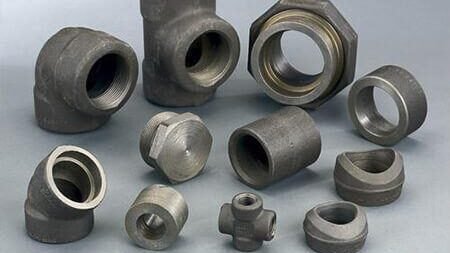
Forged fittings are widely used in small-bore industrial piping systems where pressure resistance, compact installation and reliable connections are important. In oil and gas facilities, refineries, chemical plants, power generation systems and other process industries, forged fittings are commonly specified for branch connections, changes in direction, reductions and equipment connections.
ASME B16.11 is one of the key standards governing forged socket-welding and threaded fittings. It covers requirements including dimensions, tolerances, ratings, marking and material requirements. Under the standard, threaded fittings are designated in Classes 2000, 3000 and 6000, while socket-weld fittings are available in Classes 3000, 6000 and 9000.
Understanding the difference between connection types, pressure classes and materials is essential when preparing a piping specification or purchasing forged fittings for a project.
What Are ASME B16.11 Forged Fittings?
Unlike many larger butt-weld fittings, forged fittings are produced from forged material and then machined to their final dimensions. This manufacturing route makes them particularly suitable for compact piping systems and demanding pressure service.
Typical ASME B16.11 forged fitting configurations include:
- 45° and 90° elbows
- Equal and reducing tees
- Crosses
- Full and half couplings
- Reducing couplings
- Unions
- Bushings
- Plugs
- Caps
- Reducer inserts
They are primarily divided into two connection categories: socket weld (SW) and threaded (THD) fittings.
Socket Weld Forged Fittings
With a socket-weld fitting, the pipe is inserted into a machined recess in the fitting and joined using an external fillet weld.
This creates a compact and permanent connection and is frequently selected for high-pressure process piping and small-bore lines where leakage control is important.
Common socket-weld products include:
- Socket weld elbows
- Socket weld tees
- Socket weld couplings
- Socket weld unions
- Socket weld crosses
- Socket weld reducers
ASME B16.11 socket-weld fittings are normally designated as Class 3000, Class 6000 and Class 9000.
Threaded Forged Fittings
Threaded fittings are mechanically connected to threaded pipe rather than welded.
They are useful when welding is undesirable or where dismantling and maintenance may be required. Threaded connections can therefore be practical for utility lines, auxiliary piping and selected instrumentation systems, provided that the project piping specification permits their use.
ASME B16.11 threaded forged fittings are designated in Class 2000, Class 3000 and Class 6000.
Socket Weld vs Threaded: What Is the Main Difference?
The fundamental difference is the connection.
| Feature | Socket Weld | Threaded |
|---|---|---|
| Connection | Fillet welded | Thread connection |
| Welding | Required | Not required |
| Removal | Requires cutting | Can normally be unscrewed |
| Typical use | Permanent process connection | Utility / removable connection |
| ASME B16.11 classes | 3000, 6000, 9000 | 2000, 3000, 6000 |
Neither connection should be selected simply because one fitting is cheaper. Pipe size, pressure, temperature, fluid service, vibration, maintenance requirements and the applicable project specification should all be considered.
Projectmaterials similarly identifies connection method as the key distinction: socket-weld fittings use a welded connection, while threaded fittings rely on tapered threads.
Understanding Class 3000, 6000 and 9000
One of the most common mistakes when purchasing forged fittings is treating the class number as a direct pressure value.
For example, Class 3000 should not simply be interpreted as “maximum pressure = 3000 psi.”
The suitability of a fitting depends on several factors, including:
- fitting class;
- material grade;
- connected pipe wall thickness;
- operating temperature;
- fluid service;
- applicable piping code;
- project specification.
For this reason, the correct fitting class should always be checked against the complete design conditions rather than selected from the class designation alone.
Common Materials for Forged Fittings
Several material specifications are frequently used depending on service conditions.
ASTM A105 Carbon Steel
ASTM A105 is one of the most commonly specified carbon steel forging materials for pressure piping components. The specification covers forged carbon steel components including fittings, flanges and similar piping parts for ambient and higher-temperature pressure service.
It is widely encountered in:
- oil and gas piping;
- refinery piping;
- petrochemical systems;
- power plant piping;
- general process piping.
ASTM A350 LF2
Where low-temperature toughness becomes an important design requirement, ASTM A350 LF2 may be specified depending on the applicable project requirements.
A105 and A350 LF2 should therefore not be treated as interchangeable solely because both are carbon-steel forging materials.
ASTM A182 Grades
For stainless and alloy steel forged fittings, ASTM A182 grades are frequently specified.
Common examples include:
- F304 / F304L
- F316 / F316L
- F11
- F22
- F91
The correct selection depends on corrosion requirements, operating temperature, mechanical requirements and the piping material specification.
How to Specify Forged Fittings in an RFQ
A vague request such as:
“Need forged fittings, please quote.”
usually creates unnecessary clarification work.
A more useful RFQ should include at least:
Product: 90° Elbow
Standard: ASME B16.11
Connection: Socket Weld
Size: 1″
Class: 3000
Material: ASTM A105
Quantity: 100 pcs
Certificate: EN 10204 3.1, if required
For threaded fittings, the thread standard should also be clearly stated.
Additional project requirements may include:
- NACE requirements;
- PMI;
- impact testing;
- hardness testing;
- surface coating;
- special marking;
- third-party inspection;
- packing requirements.
Giving these details at the RFQ stage helps suppliers quote the correct product from the beginning.
Choosing the Right ASME B16.11 Fitting
Selecting a forged fitting is not simply a matter of choosing a size and price.
Engineers and procurement teams should confirm:
- Applicable design code and project specification
- Connection type
- Nominal pipe size
- Pressure class
- Material specification
- Operating temperature
- Service medium
- Inspection and certification requirements
When these parameters are clearly defined, forged fittings can be sourced more accurately and technical deviations are easier to identify before production or shipment.
Need ASME B16.11 Forged Fittings?
Aspera Steel supplies forged piping components for industrial and project applications, including carbon steel, stainless steel and alloy steel options.
For a quotation, send us your:
size + connection + class + material + quantity + technical requirements
and our team can review the specification before quotation.