
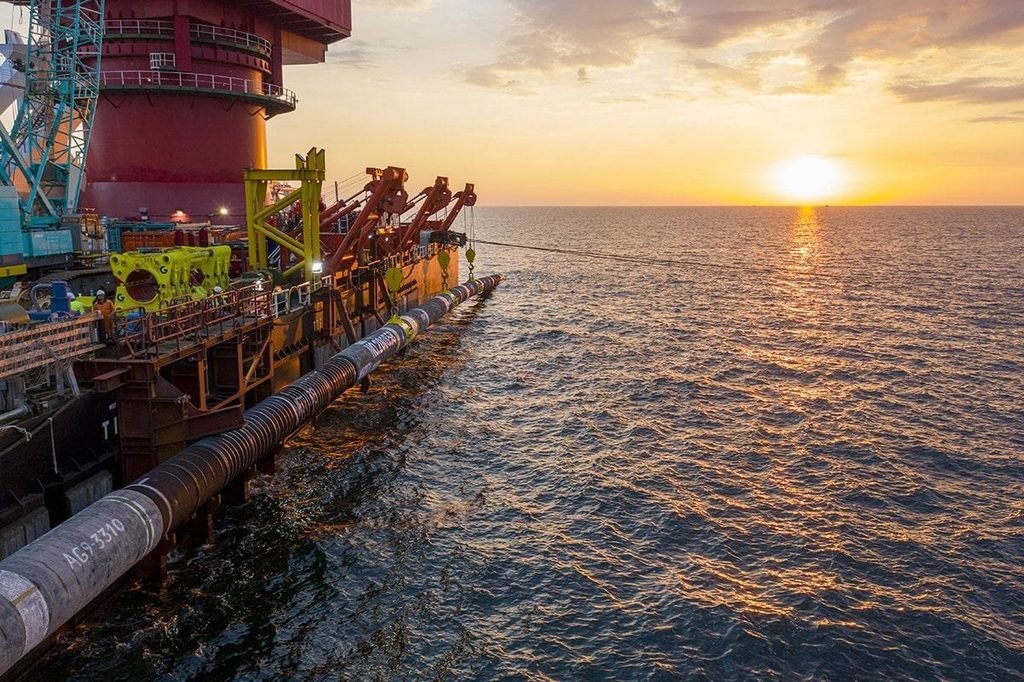
1. Why Do Subsea Pipelines Require Special Steel Pipes?
Subsea pipelines are essential components of offshore oil and gas transportation systems. They connect offshore production facilities, subsea wells, processing platforms and onshore terminals, often operating in environments where access for inspection and maintenance is difficult.
Unlike conventional onshore pipelines, subsea pipelines are exposed to external hydrostatic pressure, seawater corrosion, low-temperature conditions, seabed movement and complex installation loads.
In deepwater applications, increasing water depth results in higher external hydrostatic pressure. At the same time, internal operating pressure, transported fluid temperature, pipeline weight and seabed conditions create combined loading conditions that must be considered during design.
Steel pipes used in subsea pipeline systems must therefore satisfy more than basic tensile strength and dimensional requirements.
Their performance must be evaluated in relation to:
- Internal pressure containment.
- External pressure and collapse resistance.
- Fracture initiation and crack propagation resistance.
- Low-temperature toughness.
- Corrosion resistance.
- Weldability and heat-affected zone performance.
- Fatigue resistance.
- Dimensional accuracy and wall thickness consistency.
- Installation strain capacity.
- Long-term structural integrity.
Material selection should be based on the complete pipeline design, including operating conditions, water depth, installation method, transported fluid and design life.
2. High Strength and Mechanical Properties
High strength is one of the fundamental requirements for subsea pipeline steel pipes.
Pipelines must withstand internal operating pressure, external hydrostatic pressure, installation loads and other mechanical actions throughout their service life.
High-strength pipeline steels are commonly specified using API 5L grades such as X52, X60, X65 and X70, depending on project design requirements.
2.1 Yield Strength
Yield strength represents the stress at which steel begins to undergo permanent plastic deformation.
For subsea pipelines, yield strength is important when evaluating:
- Internal pressure capacity.
- External pressure and collapse behaviour.
- Installation bending loads.
- Axial tension and compression.
- Local and global buckling.
- Combined loading conditions.
Higher-strength steel can provide greater load-carrying capacity for a given pipe geometry.
However, selecting a higher grade does not automatically guarantee better overall performance.
Higher-strength materials may require more demanding controls over chemical composition, welding procedures, heat-affected zone toughness and fracture behaviour.
2.2 Tensile Strength and Elongation
Tensile strength represents the maximum stress a material can withstand during a tensile test before fracture.
Elongation provides information about the material’s ability to deform plastically.
Both properties are important for subsea pipeline applications.
A suitable balance between strength and ductility is required to withstand installation deformation, operational loads and potential local damage without premature failure.
2.3 Strength Consistency
Steel pipes supplied for the same pipeline project should exhibit consistent mechanical properties.
Excessive variation in yield strength, tensile strength or elongation can affect pipeline design assumptions, welding procedures and installation performance.
Manufacturers should control:
- Steelmaking and chemical composition.
- Rolling and forming conditions.
- Accelerated cooling where applicable.
- Heat treatment.
- Mechanical testing.
- Heat number and product traceability.
3. High Toughness and Fracture Resistance
Fracture resistance is one of the most important material requirements for subsea pipeline steel pipes.
A pipeline may contain local defects introduced during manufacturing, welding or installation. If the material has insufficient toughness, these defects may initiate or propagate into cracks under certain loading conditions.
Fracture control is particularly important for high-pressure gas pipelines and pipelines operating under low-temperature conditions.
3.1 Low-Temperature Impact Toughness
Subsea pipelines may operate in cold marine environments, particularly in deepwater and high-latitude regions.
Low temperatures can reduce the toughness of some ferritic steels and increase the risk of brittle fracture.
Charpy V-notch impact testing is commonly used to evaluate material impact toughness.
The test measures the energy absorbed by a specimen during fracture at a specified temperature.
For subsea pipeline projects, the required impact test temperature and absorbed energy should be established according to the project design and applicable specification.
The testing programme may include:
- Base metal impact testing.
- Weld metal impact testing.
- Heat-affected zone (HAZ) impact testing.
- Testing at specified low temperatures.
A pipe that meets tensile strength requirements may still be unsuitable if its fracture toughness is inadequate for the intended operating conditions.
3.2 Fracture Initiation Resistance
Fracture initiation resistance describes the material’s ability to resist the formation or extension of a crack under applied loading.
It is influenced by:
- Steel microstructure.
- Inclusion content.
- Grain size.
- Material strength.
- Temperature.
- Loading rate.
- Defect geometry.
For critical subsea applications, appropriate fracture mechanics testing and engineering assessment may be required.
3.3 Crack Arrest Capability
Crack arrest is particularly important for high-pressure gas pipelines.
When a running fracture develops, it may propagate rapidly along the pipeline if sufficient driving energy is available.
A suitable fracture control strategy should address both crack initiation and crack propagation.
Crack arrest properties may be assessed using appropriate full-scale or other specified fracture testing methods.
API 5L supplementary requirements and the applicable pipeline design standard should be reviewed to determine the necessary fracture control measures.
It is important to distinguish between high Charpy impact energy and demonstrated crack arrest performance. They are related material characteristics, but they are not interchangeable design criteria.
4. High Collapse Resistance Under External Hydrostatic Pressure
External pressure resistance is a particularly important requirement for deepwater subsea pipeline steel pipes.
As water depth increases, the surrounding seawater exerts greater hydrostatic pressure on the pipeline.
If the external pressure exceeds the pipe’s resistance to collapse, the pipe wall may undergo inward deformation, potentially resulting in local buckling or complete collapse.
4.1 What Causes Pipeline Collapse?
The collapse behaviour of a subsea pipeline depends on several factors:
- External hydrostatic pressure.
- Pipe outside diameter.
- Wall thickness.
- D/t ratio.
- Yield strength.
- Initial ovality.
- Wall thickness eccentricity.
- Residual stress.
- Geometric imperfections.
The D/t ratio is defined as:
D/t = Outside Diameter / Wall Thickness
For a given outside diameter, increasing wall thickness generally improves resistance to external pressure.
A lower D/t ratio generally indicates a more robust cross-section against collapse, although the actual collapse capacity must be calculated using the applicable design method.
4.2 Why Is Ovality Important?
Ovality is the difference between the maximum and minimum outside diameters of a pipe cross-section.
Initial ovality can significantly influence collapse behaviour.
Even when two pipes have identical nominal outside diameters and wall thicknesses, the pipe with greater initial ovality may have lower collapse resistance.
Therefore, dimensional inspection should include:
- Outside diameter.
- Wall thickness.
- Ovality.
- Wall thickness distribution.
- Pipe end geometry.
4.3 How to Improve Collapse Resistance
Manufacturers and designers can improve collapse performance through:
- Appropriate wall thickness selection.
- Higher and consistent material yield strength.
- Improved dimensional accuracy.
- Reduced initial ovality.
- Controlled manufacturing and forming processes.
- Suitable pipe geometry and design verification.
Collapse resistance should be assessed using the applicable design code, taking account of manufacturing tolerances and relevant imperfections.
5. Corrosion Resistance in Subsea Environments
Corrosion is a major concern for steel pipes operating in marine environments.
Subsea pipelines may be exposed to seawater, marine sediments, dissolved oxygen, chloride ions, microorganisms and transported fluids containing corrosive substances.
Corrosion protection must therefore consider both the external and internal surfaces.
5.1 External Seawater Corrosion
Carbon steel is susceptible to corrosion when exposed to seawater.
Long-term exposure can result in metal loss, localised corrosion and eventual reduction in wall thickness.
Common external corrosion protection methods include:
Three-Layer Polyethylene (3LPE)
3LPE coating systems typically combine an epoxy primer, an adhesive layer and an outer polyethylene layer.
They provide corrosion protection and mechanical resistance during transportation, installation and service.
Three-Layer Polypropylene (3LPP)
3LPP systems are similar in structure to 3LPE but use polypropylene as the outer layer.
They are suitable for applications requiring higher temperature resistance, subject to the coating system qualification.
Fusion-Bonded Epoxy (FBE)
FBE is an epoxy-based coating applied to the prepared steel surface.
It provides corrosion protection and is widely used in pipeline coating systems.
Cathodic Protection
Cathodic protection is commonly used together with external coatings to reduce the risk of external corrosion.
Sacrificial anodes or impressed current systems may be selected according to the pipeline design.
5.2 Internal Corrosion
Internal corrosion depends mainly on the transported fluid rather than the surrounding seawater.
Oil and gas pipelines may contain:
- Water.
- Carbon dioxide (CO2).
- Hydrogen sulfide (H2S).
- Chlorides.
- Organic acids.
- Other corrosive components.
For sour-service applications, the material must be assessed for hydrogen-induced cracking (HIC), sulfide stress cracking (SSC) and other relevant damage mechanisms.
Depending on the service conditions, suitable measures may include:
- Sour-service-qualified carbon steel.
- Corrosion-resistant alloy (CRA) pipes.
- Internal cladding or lining.
- Corrosion inhibitors.
- Fluid dehydration.
- Monitoring and inspection programmes.
5.3 CRA, Clad and Lined Steel Pipes
For highly corrosive subsea applications, carbon steel pipes with corrosion-resistant alloy layers may be considered.
Common configurations include:
- CRA clad pipes.
- CRA lined pipes.
- Solid corrosion-resistant alloy pipes.
Clad pipes typically have a metallurgically bonded corrosion-resistant layer, whereas lined pipes use a separate internal liner.
These products can combine the structural strength of carbon steel with the corrosion resistance of an appropriate alloy.
Material selection must consider bonding integrity, fabrication, welding, thermal expansion and compatibility with the transported fluid.
6. Excellent Weldability and Heat-Affected Zone Toughness
Subsea pipelines are commonly assembled offshore through circumferential girth welding.
The quality of these welds directly affects pipeline structural integrity.
Steel pipes must therefore provide suitable weldability while maintaining the required mechanical properties in the base metal, weld metal and heat-affected zone.
6.1 Chemical Composition and Carbon Equivalent
Carbon equivalent is commonly used as an indicator of steel weldability and hardenability.
One widely used carbon equivalent expression is:
CEIIW = C + Mn/6 + (Cr + Mo + V)/5 + (Ni + Cu)/15
Where each element represents its weight percentage in the steel.
For low-carbon pipeline steels, the Pcm formula may also be used:
Pcm = C + Si/30 + (Mn + Cu + Cr)/20 + Ni/60 + Mo/15 + V/10 + 5B
The applicable formula should be selected according to the steel grade and specification.
Lower carbon equivalent generally improves weldability, but it does not independently establish weld quality.
6.2 Heat-Affected Zone Performance
The heat-affected zone is the region of base metal adjacent to the weld that experiences changes in microstructure and properties due to the welding thermal cycle.
Potential problems include:
- Excessive hardness.
- Reduced impact toughness.
- Hydrogen-assisted cracking.
- Localised softening.
- Reduced fracture resistance.
Manufacturers should control steel chemistry, microalloying, rolling conditions and welding procedure qualification to achieve suitable HAZ properties.
6.3 Offshore Welding Requirements
Subsea pipeline construction may use S-lay, J-lay or reel-lay installation methods.
Each method introduces different welding productivity, deformation and inspection requirements.
Welding procedures should be qualified for the selected material grade, wall thickness, joint configuration and installation conditions.
Automated ultrasonic testing (AUT), conventional ultrasonic testing and radiographic testing may be applied according to project specifications.
7. High Fatigue Resistance and Structural Integrity
Subsea pipelines are exposed to both static and cyclic loads.
Unlike a stationary onshore pipeline, an offshore pipeline may experience repeated loading from:
- Waves and currents.
- Seabed movement.
- Vortex-induced vibration (VIV).
- Free-span vibration.
- Pressure and temperature fluctuations.
- Installation and operational bending.
- Global buckling.
These cyclic loads may cause fatigue damage over the pipeline’s service life.
7.1 Vortex-Induced Vibration
When ocean currents flow around a subsea pipeline, alternating vortices may form behind the pipe.
These vortices can generate periodic hydrodynamic forces, causing the pipeline to vibrate.
If the vibration frequency interacts with the pipeline’s natural frequency, significant cyclic stresses may develop.
This is particularly important for pipelines with unsupported free spans.
7.2 Fatigue Resistance
Fatigue resistance depends on:
- Material properties.
- Weld quality.
- Surface condition.
- Stress range.
- Number of loading cycles.
- Initial defects.
- Corrosion environment.
For welded subsea pipelines, weld geometry, imperfections and residual stresses can significantly influence fatigue performance.
Material selection and pipe manufacturing quality should therefore be considered together with pipeline structural design.
8. Dimensional Accuracy and Wall Thickness Requirements
Dimensional accuracy is essential for subsea pipeline installation and long-term structural performance.
Poor dimensional control can complicate offshore welding, reduce collapse resistance and create local stress concentrations.
Important dimensional requirements include:
8.1 Outside Diameter
Consistent outside diameter is essential for accurate pipe alignment and girth welding.
Excessive dimensional variation may result in unacceptable mismatch between adjacent pipe ends.
8.2 Wall Thickness
Wall thickness directly affects pressure containment, external pressure resistance and pipeline weight.
The specified wall thickness must account for:
- Internal design pressure.
- External hydrostatic pressure.
- Corrosion allowance.
- Manufacturing tolerance.
- Installation loads.
- Local buckling requirements.
- Design life.
8.3 Ovality
Ovality affects pipe fit-up, weld alignment and external pressure performance.
Manufacturing processes should maintain appropriate circularity throughout forming, sizing and finishing.
8.4 Straightness
Straightness is important during handling, transportation and offshore welding.
Excessive longitudinal bending may complicate pipe alignment and increase installation difficulty.
Dimensional acceptance criteria should follow the applicable product specification and project requirements.
9. Installation Performance: S-Lay, J-Lay and Reel-Lay
Subsea pipeline steel pipes must withstand loads imposed during offshore installation.
The required material and dimensional properties depend partly on the selected installation method.
9.1 S-Lay Installation
In S-lay installation, the pipeline leaves the vessel through a stinger and follows an S-shaped profile before reaching the seabed.
The pipe experiences:
- Overbend strain.
- Sagbend strain.
- Axial tension.
- Bending loads.
- Dynamic installation loads.
The steel pipe must have sufficient strength, ductility and fracture resistance to withstand these conditions.
9.2 J-Lay Installation
J-lay installation uses a near-vertical pipe departure configuration.
It is commonly used for deepwater pipeline projects because it can reduce some installation bending requirements associated with conventional S-lay systems.
However, the pipe still experiences significant axial tension, local bending and welding-related stresses.
9.3 Reel-Lay Installation
Reel-lay involves welding the pipeline into long sections, spooling it onto a large reel and subsequently unspooling it offshore.
The pipeline undergoes repeated bending and straightening during installation.
This can introduce substantial plastic strain.
The material must therefore have suitable strain capacity, ductility and resistance to fracture under cyclic plastic deformation.
The selected pipe grade, manufacturing route and weld properties must be compatible with the installation method.
10. Concrete Weight Coating and Subsea Pipeline Stability
Subsea pipelines may require concrete weight coating to increase their submerged weight and improve stability on the seabed.
Concrete weight coating helps resist:
- Hydrodynamic forces from waves and currents.
- Pipeline movement.
- Buoyancy.
- Certain installation and handling loads.
The coating system may include reinforcement and additional corrosion protection layers depending on the project requirements.
The weight coating thickness and density should be determined through on-bottom stability calculations.
The pipe body, coating system and any corrosion protection layers must be compatible with installation equipment and operating conditions.
11. Manufacturing and Quality Inspection Requirements
The quality of subsea pipeline steel pipes depends on both material properties and manufacturing consistency.
Manufacturers should establish inspection and testing procedures covering raw material preparation, forming, welding, heat treatment, dimensional control and final product acceptance.
11.1 Chemical Composition Analysis
Chemical analysis verifies that the steel meets the specified material grade.
Elements commonly controlled include:
- Carbon.
- Manganese.
- Silicon.
- Sulfur.
- Phosphorus.
- Niobium.
- Vanadium.
- Titanium.
- Chromium.
- Nickel.
- Molybdenum.
For sour-service applications, additional chemical and material requirements may apply.
11.2 Tensile Testing
Tensile testing evaluates yield strength, tensile strength and elongation.
These properties should meet the specified requirements for the selected grade and product specification level.
11.3 Charpy Impact Testing
Charpy V-notch testing evaluates impact toughness at the specified test temperature.
Testing may be required for base metal, weld metal and heat-affected zones.
11.4 Ultrasonic Testing
Ultrasonic testing is used to detect suitable internal discontinuities and evaluate wall thickness.
Automated ultrasonic testing is frequently applied to longitudinal and spiral weld seams, as well as other specified pipe regions.
11.5 Weld Inspection
Weld inspection verifies the integrity of the pipe seam and other relevant welded areas.
Methods may include:
- Automated ultrasonic testing.
- Radiographic testing.
- Magnetic particle testing.
- Visual inspection.
- Other qualified examination techniques.
11.6 Hydrostatic Testing
Hydrostatic testing verifies the pressure integrity of the pipe under specified test conditions.
Test pressure, holding time and acceptance criteria should follow the applicable product standard and project specification.
11.7 Dimensional Inspection
Dimensional inspection should include:
- Outside diameter.
- Wall thickness.
- Ovality.
- Length.
- Straightness.
- End preparation.
- Pipe end geometry.
The results should be recorded and traceable to the corresponding pipe identification and heat number.
12. Standards for Subsea Pipeline Steel Pipes
Subsea pipeline projects commonly refer to several international standards and recommended practices.
| Standard | Scope | Application |
|---|---|---|
| DNV-ST-F101 | Submarine pipeline systems | Pipeline design, materials, manufacturing and installation |
| API Specification 5L | Line pipe | Seamless and welded pipeline steel pipes |
| ISO 3183 | Steel pipe for pipeline transportation systems | Product manufacturing and testing |
| ISO 13623 | Pipeline transportation systems | Pipeline system design and operation |
| DNV-RP-F108 | Fracture control | Installation methods introducing cyclic plastic strain |
| DNV-RP-F109 | On-bottom stability | Pipeline stability on the seabed |
| DNV-RP-F110 | Global buckling | Subsea pipeline buckling assessment |
12.1 API 5L PSL1 and PSL2
API 5L specifies requirements for seamless and welded steel pipes used in pipeline transportation systems.
It includes requirements for:
- Chemical composition.
- Mechanical properties.
- Manufacturing processes.
- Dimensional tolerances.
- Inspection and testing.
- Marking and traceability.
PSL1 and PSL2 represent different product specification levels.
PSL2 generally includes additional and more stringent requirements in areas such as chemical composition, mechanical properties, testing and documentation.
The required PSL should be established by the project specification.
12.2 API 5L X65 and X70
X65 and X70 are commonly encountered high-strength pipeline steel grades.
They can be considered for certain offshore and subsea applications, depending on the design.
The selection should account for:
- Design pressure.
- Water depth.
- Wall thickness.
- Fracture toughness.
- Collapse resistance.
- Weldability.
- Installation method.
- Corrosion environment.
A higher grade does not automatically mean a better subsea pipeline. The final material must satisfy all relevant design and manufacturing requirements.
12.3 DNV-ST-F101
DNV-ST-F101 provides a comprehensive framework for submarine pipeline systems.
It covers material selection, structural design, manufacturing, corrosion control, welding, non-destructive testing, offshore installation and operation.
For subsea pipeline projects, it is important to distinguish between the product requirements of API 5L or ISO 3183 and the wider system-level requirements of DNV-ST-F101.
13. How to Select the Right Steel Pipe for a Subsea Pipeline Project
Steel pipe selection should be based on the actual project conditions rather than material grade alone.
Before procurement, buyers and engineering teams should establish the following requirements.
13.1 Water Depth and External Pressure
Determine the design water depth and corresponding external pressure.
This information is essential for evaluating collapse resistance and wall thickness.
13.2 Internal Operating Conditions
Confirm:
- Design pressure.
- Operating pressure.
- Design temperature.
- Fluid composition.
- CO2 and H2S content.
- Water content.
- Corrosion potential.
These factors influence material grade, corrosion allowance and internal corrosion protection.
13.3 Installation Method
Identify whether the pipeline will be installed using S-lay, J-lay or reel-lay.
The installation method affects required strain capacity, toughness, welding procedures and dimensional tolerances.
13.4 Material Grade and Wall Thickness
Specify the required API 5L or ISO 3183 grade, outside diameter and wall thickness.
The final dimensions should be verified through pipeline design calculations.
13.5 Corrosion Protection
Determine whether the project requires:
- 3LPE coating.
- 3LPP coating.
- FBE coating.
- Concrete weight coating.
- Cathodic protection.
- CRA cladding or internal lining.
13.6 Inspection and Documentation
Define the inspection and testing requirements before production.
The procurement specification should identify:
- Chemical analysis.
- Tensile testing.
- Impact testing.
- Fracture control testing where required.
- NDT.
- Hydrostatic testing.
- Dimensional inspection.
- Material certification.
- Third-party inspection requirements.
14. Frequently Asked Questions About Subsea Pipeline Steel Pipes
What is the difference between subsea pipeline steel pipes and ordinary steel pipes?
Subsea pipeline steel pipes must withstand additional environmental and installation loads, including external hydrostatic pressure, seawater corrosion, cyclic loading, offshore welding and complex installation deformation.
Which API 5L grades are commonly used for subsea pipelines?
Grades such as X52, X60, X65 and X70 may be considered, depending on the project design. The appropriate grade must be selected according to pressure, water depth, toughness, weldability and installation requirements.
Why is collapse resistance important for deepwater pipelines?
External hydrostatic pressure increases with water depth. If external pressure exceeds the pipe’s collapse capacity, the pipe wall may buckle inward and compromise pipeline integrity.
Why is low-temperature toughness important?
Low temperatures may reduce the fracture toughness of some steels. Adequate toughness helps reduce the risk of brittle fracture and crack propagation under the specified operating and installation conditions.
Are X70 steel pipes always better than X65 steel pipes?
No. X70 has a higher specified strength level, but material selection also depends on fracture toughness, weldability, installation strain capacity, corrosion conditions and design requirements.
What coating is used for subsea pipelines?
Common systems include 3LPE, 3LPP and FBE. Concrete weight coating may also be applied to improve seabed stability. The coating system depends on temperature, corrosion exposure, mechanical protection and project design.
What is the role of concrete weight coating?
Concrete weight coating increases the submerged weight of the pipeline and helps maintain stability against buoyancy, waves and currents.
What inspection methods are used for subsea pipeline steel pipes?
Common inspection methods include chemical analysis, tensile testing, Charpy impact testing, ultrasonic testing, radiographic testing, hydrostatic testing and dimensional inspection. Additional fracture, corrosion and weld qualification tests may be required.
What is the difference between S-lay, J-lay and reel-lay?
S-lay uses a curved pipeline configuration as the pipe leaves the installation vessel. J-lay uses a near-vertical departure configuration, while reel-lay involves spooling and unspooling long welded pipeline sections. Each method imposes different strain and installation requirements.
15. Conclusion
Steel pipes used in subsea pipelines must meet demanding mechanical, metallurgical, corrosion and dimensional requirements.
High strength alone is not sufficient. Fracture toughness, collapse resistance, weldability, fatigue performance and installation strain capacity are equally important considerations.
The final pipe specification should be established through a comprehensive assessment of water depth, operating pressure, transported fluid, seabed conditions, installation method and design life.
For manufacturers, consistent steelmaking, controlled rolling, precise forming, qualified welding and reliable inspection are essential to producing subsea pipeline steel pipes that meet project requirements.
For buyers, material grade, outside diameter, wall thickness, applicable standards, coating requirements and inspection documentation should be clearly defined before procurement.
Looking for API 5L X65 or X70 steel pipes for subsea pipeline projects?
Provide your required steel grade, outside diameter, wall thickness, water depth, coating system and applicable project standard to determine the appropriate pipeline steel pipe specification.