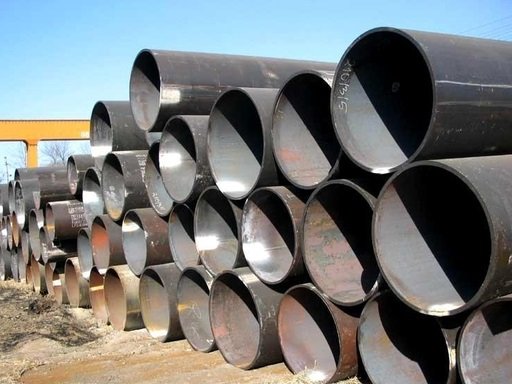
A quotation for LSAW steel pipe should tell you more than the diameter, wall thickness, and price per ton. The forming process, steel grade, delivery condition, weld inspection, and dimensional tolerances all affect whether the pipe will work on site.
These details become particularly important with large-diameter pipe. Poor end geometry can slow field welding. An unsuitable delivery condition can conflict with fabrication requirements. A pipe supplied to a piling standard cannot be accepted automatically for pressure service.
The best starting point is the application: what the pipe will carry or support, the conditions it will face, and the specification it must meet.
What Is LSAW Steel Pipe?
LSAW stands for Longitudinal Submerged Arc Welded. Steel plate is formed into a cylindrical shape, and its longitudinal edges are joined by submerged arc welding.
In this welding process, granular flux covers the arc and weld pool. Large-diameter LSAW production commonly includes welding from both the inside and outside, followed by dimensional control and inspection.
LSAW pipe is used for applications including transmission pipelines, water infrastructure, industrial piping, and structural work. Its suitability depends on the finished product specification—not simply the presence of a straight weld seam.
The term SAWL, used in line-pipe specifications, identifies submerged arc welded pipe with a longitudinal seam.
1. Understand the Manufacturing Process
UOE Forming
In the UOE process, plate edges are prepared and crimped before the plate is pressed into a U shape and then an O shape. After welding, mechanical expansion helps control the finished geometry.
EUROPIPE’s published UOE sequence includes inside and outside welding, mechanical expansion, hydrostatic testing, destructive testing, and final weld inspection.
JCOE Forming
JCOE uses progressive press forming to bend the plate through J, C, and O stages. The E refers to expansion.
This route offers flexibility across a range of pipe dimensions. It is an established industrial process; Jindal SAW, for example, identifies JCO-E as its LSAW forming method.
Which Process Should You Choose?
Neither abbreviation is a quality certificate.
Both routes can produce suitable pipe when the mill has the equipment, procedures, and inspection capability required for the order. Compare the manufacturer’s demonstrated capability at your actual diameter, thickness, grade, and length.
| Manufacturing detail | What the buyer should establish |
|---|---|
| Forming route | Whether it complies with the project specification |
| Plate source | Approved material specification and traceability |
| Welding | Qualified procedures, consumables, and production controls |
| Expansion | Whether required, how performed, and how documented |
| Seam arrangement | Number of longitudinal seams and whether circumferential joints are permitted |
| Inspection | Methods, coverage, acceptance criteria, and reporting |
A mill’s maximum diameter and maximum wall thickness may describe different products. Confirm that the required combination is within its proven production range.
2. Select Wall Thickness from the Design Requirements
Wall thickness is one of the largest cost drivers in LSAW pipe. It also affects forming, welding, handling, and installation.
However, selecting it by comparing nearby stock sizes is a poor shortcut.
Pressure-Carrying Pipe
Required thickness depends on the governing design code and factors such as:
- Design pressure and temperature.
- Outside diameter.
- Material allowable stress.
- Applicable weld or quality factors.
- Corrosion and erosion allowances.
- Manufacturing tolerances.
- External pressure and other mechanical loads.
A grade with higher yield strength may allow a thinner wall in some designs, but that change needs engineering approval. Buckling, fatigue, fracture control, or installation loads may still govern.
Structural and Piling Applications
For piles, columns, and other structural uses, thickness must address the relevant structural loads and stability checks.
A large-diameter pipe with a relatively thin wall may be sensitive to ovalization, local buckling, or handling damage. Pressure capacity alone does not establish structural suitability.
Nominal Thickness vs. Minimum Required Thickness
A nominal thickness is an ordering dimension. It does not necessarily mean every measured point must equal or exceed that number.
The applicable standard defines permitted tolerances. The ordered thickness must account for those tolerances and the design requirements.
For example, if the design requires a minimum remaining steel thickness, ordering that exact value as the nominal wall can be insufficient once permitted manufacturing variation and allowances are considered.
Specify whether the order is based on nominal wall thickness or a guaranteed minimum requirement, and confirm that the supplier accepts the wording.
3. Choose the Standard for the Service
LSAW describes a manufacturing process. It does not define the complete material specification.
The standard must match the intended use.
| Application | Standard commonly considered | Main purchasing point |
|---|---|---|
| Petroleum and natural gas transmission | API 5L or ISO 3183 | Specify grade, product specification level, delivery condition, and project requirements |
| Steel water pipelines | AWWA C200 | Define material, fabrication, joints, lining, coating, and inspection requirements |
| EFW pressure pipe for atmospheric and lower-temperature service | ASTM A671/A671M | Specify the complete grade and class |
| EFW pressure pipe for moderate-temperature service | ASTM A672/A672M | Specify the complete grade and class |
| Steel pipe piles | ASTM A252/A252M | Confirm structural requirements; do not assume pressure-service qualification |
API 5L covers two product specification levels, PSL 1 and PSL 2, for seamless and welded line pipe. ISO 3183 also addresses steel pipe for petroleum and natural gas pipeline transportation. AWWA C200 addresses steel water pipe 6 inches and larger.
ASTM A671 and A672 cover electric-fusion-welded pipe for their respective service categories. ASTM A252 covers steel pipe piles. These specifications serve different purposes and are not interchangeable.
API 5L: Grade Alone Is Incomplete
An inquiry stating only “API 5L X52 LSAW” leaves important details open.
The order should establish the required PSL, delivery condition, dimensions, toughness requirements, and any supplementary provisions. Sour service, offshore use, and strain-based applications need their applicable requirements identified explicitly.
Do not assume that PSL 2 alone establishes suitability for every demanding service.
ASTM A671 and A672: Include the Class
For these specifications, the grade identifies the plate material, while the class addresses manufacturing heat treatment and examination or pressure-testing provisions.
“A671 CC60” is therefore less complete than an order stating the required grade and class. The class should be checked against the project’s heat-treatment and inspection requirements before production.
Also, EFW is a broader welding category. Confirm the required longitudinal submerged arc welding route rather than assuming that every EFW offer is the same product.
4. Check Geometry Before Field Welding Becomes the Problem
A pipe can meet its strength requirements and still be difficult to install.
For large-diameter LSAW pipe, pay particular attention to:
- Outside diameter and circumference at the ends.
- Out-of-roundness.
- Straightness.
- End squareness.
- Bevel angle and root face.
- Weld reinforcement near the ends.
- Local shape variation beside the longitudinal seam.
End fit-up matters because adjacent pipes must align within the field welding procedure’s limits. Excessive mismatch can increase preparation time and repair work.
Where the project needs tighter end tolerances than the product standard provides, agree on them before ordering. Include the measurement method and inspection frequency.
5. Define Weld Inspection Clearly
“100% tested” is not a complete inspection requirement.
Ask what was tested, by which method, over what area, and against which acceptance criteria. Ultrasonic testing, radiography, and hydrostatic testing answer different questions.
A hydrostatic test does not replace weld examination. Likewise, weld examination does not establish every aspect of pressure integrity or dimensional compliance.
The inspection plan should identify the required production stages, any reinspection after repair, and the records supplied with each shipment. Established UOE production sequences include multiple examination and testing stages rather than one final check.
6. Treat Coating and Lining as Separate Specifications
A coating described only as “black paint” may be intended for temporary storage protection.
For buried, submerged, or otherwise exposed pipe, specify the required protective system. External coating and internal lining may have different purposes and acceptance criteria.
Confirm surface preparation, coating thickness, testing, repair procedures, and pipe-end cutbacks where relevant. Drinking-water applications also need the applicable contact-material approvals.
Coating thickness must not be counted as steel wall thickness.
7. Compare Prices on the Same Basis
Before choosing the lowest offer, check that each supplier has priced the same product.
A useful comparison includes:
- Actual outside diameter and wall thickness.
- Grade, standard edition, PSL or class.
- Delivery condition.
- Forming and welding route.
- Inspection and certification.
- Length tolerances and permitted joints.
- Coating, lining, and end preparation.
- Packing, freight, and delivery terms.
Confirm whether invoicing uses theoretical or actual weight. For theoretical weight, establish the agreed calculation basis and whether coating or other additions are included.
A lower price per ton can still produce a higher installed cost if the pipe requires extra end preparation, inspection, or corrective work.
What Details to Prepare for Your LSAW Pipe Inquiry
What Details to Prepare for Your LSAW Pipe Inquiry
To get an accurate quotation for LSAW steel pipe, buyers need to offer complete project‑related information. Please specify service application, applicable standard, steel grade, outer diameter, wall thickness, pipe length, total quantity, delivery condition, pipe end finishing, inspection requirements, anti‑corrosion protection, and required test documents.
You should also note any limitations for forming processes, longitudinal weld seams, circumferential joints or weld repair works. Attach your project‑specific specifications together with product standards, so our mill can fully review requirements before quoting.
Proper LSAW pipe selection depends on clear requirements: feasible manufacturing process, design‑compliant wall thickness, and standards matching your working conditions. Defined acceptance criteria ensure every pipe can be fully inspected before shipment to your site.