
When a piping project requires high pressure resistance, heavy wall thickness or non-standard dimensions, engineers and procurement teams often face the same question: should the material be supplied as conventional seamless pipe or as a forged and machined tubular product?
There is no universal answer.
For standard dimensions and relatively large quantities, seamless steel pipe is usually the more practical solution. Forged tubular products become more relevant when the project calls for unusually heavy walls, precise inside diameters, special dimensions or relatively small production quantities.
The important point is not to ask which product is “better,” but which manufacturing route better satisfies the actual engineering specification.
What Is a Seamless Steel Pipe?
A seamless steel pipe is manufactured without a longitudinal weld seam. Production normally begins with a solid round billet, which is heated, pierced and subsequently rolled or elongated until the required outside diameter and wall thickness are achieved.
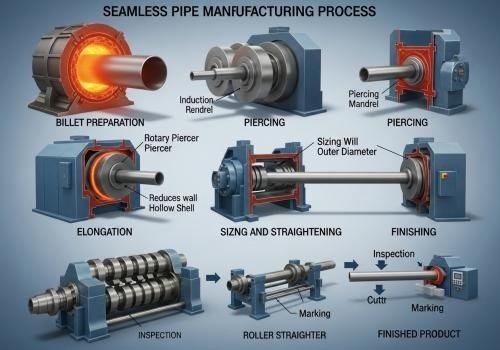
This process is highly suitable for industrial-scale production.
ASTM A106, for example, covers seamless carbon steel pipe intended for high-temperature service and specifies nominal, or average, wall thickness. The standard covers a broad range of pipe sizes and permits non-standard dimensions provided the other requirements of the specification are satisfied.
Typical seamless pipe applications include:
oil and gas process piping, refineries, petrochemical plants, power generation, boilers, high-temperature pipelines, mechanical applications and pressure systems.
The major commercial advantage of conventional seamless production is efficiency. Once a size falls within a mill’s production range, relatively large quantities can be manufactured economically.
What Is a Forged Pipe?
The term “forged pipe” can cause confusion because it is not one single universal ASTM product category.
In industrial purchasing, the expression may refer to a forged hollow, forged tubular component or a hollow product manufactured through forging followed by machining.
During forging, heated steel is mechanically deformed under compressive force. Depending on the manufacturing route, subsequent piercing, heat treatment, boring, turning and machining operations may be used to obtain the required OD, ID, wall thickness and surface finish.
This additional machining capability is particularly valuable where dimensional control is more important than production speed.
It is also important not to confuse a forged tubular product with ASTM A105 simply because A105 is widely associated with forged carbon steel. ASTM A105 primarily covers forged carbon steel piping components such as flanges, fittings, valves and similar pressure-system components; it does not simply serve as a “forged version” of ASTM A106 pipe.
Forged Pipe vs Seamless Pipe: Main Differences
| Factor | Conventional Seamless Pipe | Forged / Machined Tubular Product |
|---|---|---|
| Manufacturing | Piercing and rolling | Forging plus machining, depending on route |
| Production efficiency | High | Lower |
| Standard sizes | Excellent availability | Usually used when standard sizes are unsuitable |
| Heavy wall capability | Depends on mill range | Strong option for very heavy sections |
| Dimensional customization | Limited by mill capability | High |
| ID control | Depends on specification and manufacturing tolerance | Can be closely machined |
| Small quantities | Often less economical | Can be attractive for special small lots |
| Large production orders | Usually more economical | Usually less competitive |
| Surface machining | Normally limited | Can be extensively machined |
| Typical use | General process and pressure piping | Critical, heavy-wall or custom applications |
1. Wall Thickness Is One of the Most Important Differences
For many projects, nominal wall thickness alone is not enough.
Engineers must consider the actual minimum thickness allowed by the governing material standard, dimensional standard and purchase specification.
Conventional seamless pipes are generally produced according to established OD and wall-thickness ranges. Manufacturing tolerances mean that the actual wall thickness and consequently the actual ID may differ from theoretical dimensions.
That difference may be perfectly acceptable for ordinary piping.
For a critical heavy-wall component, however, the buyer may require much tighter control of the bore or a guaranteed machined ID.
This is where forged and machined tubular products can become useful.
Instead of accepting the ID that results from normal pipe-production tolerances, the bore can be machined toward the required dimensions.
2. Why Inside Diameter Can Matter During Installation
Inside diameter is not just a drawing dimension.
When two heavy-wall pipes or components must be welded together, excessive differences between their internal diameters can create fit-up problems.
Depending on the piping design, additional internal machining or transition preparation may be required before welding.
That means a cheaper material price does not necessarily mean a cheaper installed cost.
For high-pressure steam systems, offshore piping, subsea components and other critical applications, dimensional consistency can therefore influence welding preparation, inspection, installation time and final system performance.
Projectmaterials highlights this difference between OD-controlled conventional seamless pipe and specially controlled forged products as one of the major engineering reasons for selecting the latter in certain projects.
3. Large Diameter and Heavy Wall: When Forging Becomes Interesting
One of the most useful ways to evaluate the two manufacturing routes is to look at the combination of diameter and wall thickness.
Standard seamless production is extremely competitive within normal mill ranges.
As dimensions become larger and walls become heavier, however, the available number of mills may decrease dramatically.
At some point, producing a forged hollow and machining it to final dimensions may become technically or commercially more practical.
As an industry rule of thumb rather than a universal engineering standard, forged tubular products are often considered for diameters above approximately 18 inches and wall thicknesses around 40–50 mm or more. Actual feasibility depends entirely on grade, OD, ID, length, quantity, mechanical properties and mill capability.
This distinction is important.
A 20-inch pipe with a moderate wall thickness may still be commercially available as conventional seamless pipe, while another product of similar diameter but an exceptionally heavy wall may require a completely different manufacturing route.
Always evaluate OD and wall thickness together.
4. Does Forged Steel Always Have Better Properties?
Not automatically.
Forging can improve grain flow and refine the microstructure under appropriately controlled manufacturing and heat-treatment conditions. This can provide excellent mechanical performance for demanding components.
But manufacturing route alone does not determine whether a product is suitable for a service condition.
The engineer must still evaluate:
material grade, chemical composition, heat treatment, tensile properties, impact toughness, hardness, NDE requirements, design temperature, design pressure and corrosion environment.
The same principle applies to corrosion.
A forged product is not automatically more corrosion-resistant simply because it is forged. Corrosion performance depends primarily on material chemistry, environmental conditions, temperature, fluid composition and surface condition.
5. Which Option Is More Economical?
For common pipe dimensions and substantial quantities, conventional seamless pipe usually has the advantage.
Its manufacturing process is optimized for repeat production.
Forged tubular products involve additional forging and machining operations, which increase manufacturing time and machining cost.
However, procurement decisions should consider total project cost rather than price per tonne alone.
If a forged and machined product eliminates extensive site machining, solves an unavailable heavy-wall requirement or enables the buyer to purchase a very small quantity of a special size, it may become the more economical solution overall.
When Should You Choose Seamless Pipe?
Seamless pipe is generally the first option to evaluate when the project requires standard NPS or OD dimensions, standard or commonly available wall thicknesses, larger quantities, conventional ASTM/API grades and normal dimensional tolerances.
Typical grades include ASTM A106 Gr. B, API 5L line pipe grades and ASTM A335 alloy-steel pipe grades, depending on service conditions.
When Should You Consider a Forged Tubular Product?
A forged or forged-and-machined solution deserves consideration when the project requires unusually heavy walls, special OD/ID combinations, tightly controlled internal dimensions, short special production runs, demanding mechanical properties or dimensions beyond conventional seamless mill capability.
It is particularly relevant to certain offshore components, power-generation applications, heavy mechanical systems and special pressure components.
What Information Should Be Included in an RFQ?
A technically complete RFQ normally produces a faster and more reliable quotation than a request containing only a material grade and diameter.
For a seamless or forged tubular inquiry, provide the applicable ASTM, ASME, API, EN or project specification; material grade; NPS or OD; required ID if critical; wall thickness or schedule; length; quantity; heat-treatment condition; minimum mechanical properties; impact-test requirements; NDE requirements; hydrostatic testing requirements; dimensional tolerances; end preparation; surface condition; coating or corrosion protection; inspection requirements; certification requirements; and delivery destination.
If minimum wall thickness or inside diameter is critical, state this explicitly rather than relying only on nominal dimensions.
Final Recommendation
Do not select forged or seamless material from the manufacturing method alone.
Start with the design conditions and procurement specification.
For standard sizes and normal production quantities, seamless pipe is generally the most efficient solution. For unusually heavy walls, custom ID/OD combinations or dimensions outside normal mill capability, a forged and machined tubular product may offer significant technical advantages.
Aspera Steel supports project-based sourcing of carbon steel, alloy steel, stainless steel and special piping products for oil & gas, petrochemical, power-generation and industrial applications.
Send us your material grade, OD, wall thickness, length, quantity and applicable specification. Our team can review the requirement and identify a suitable manufacturing and supply route.